Mobile Development
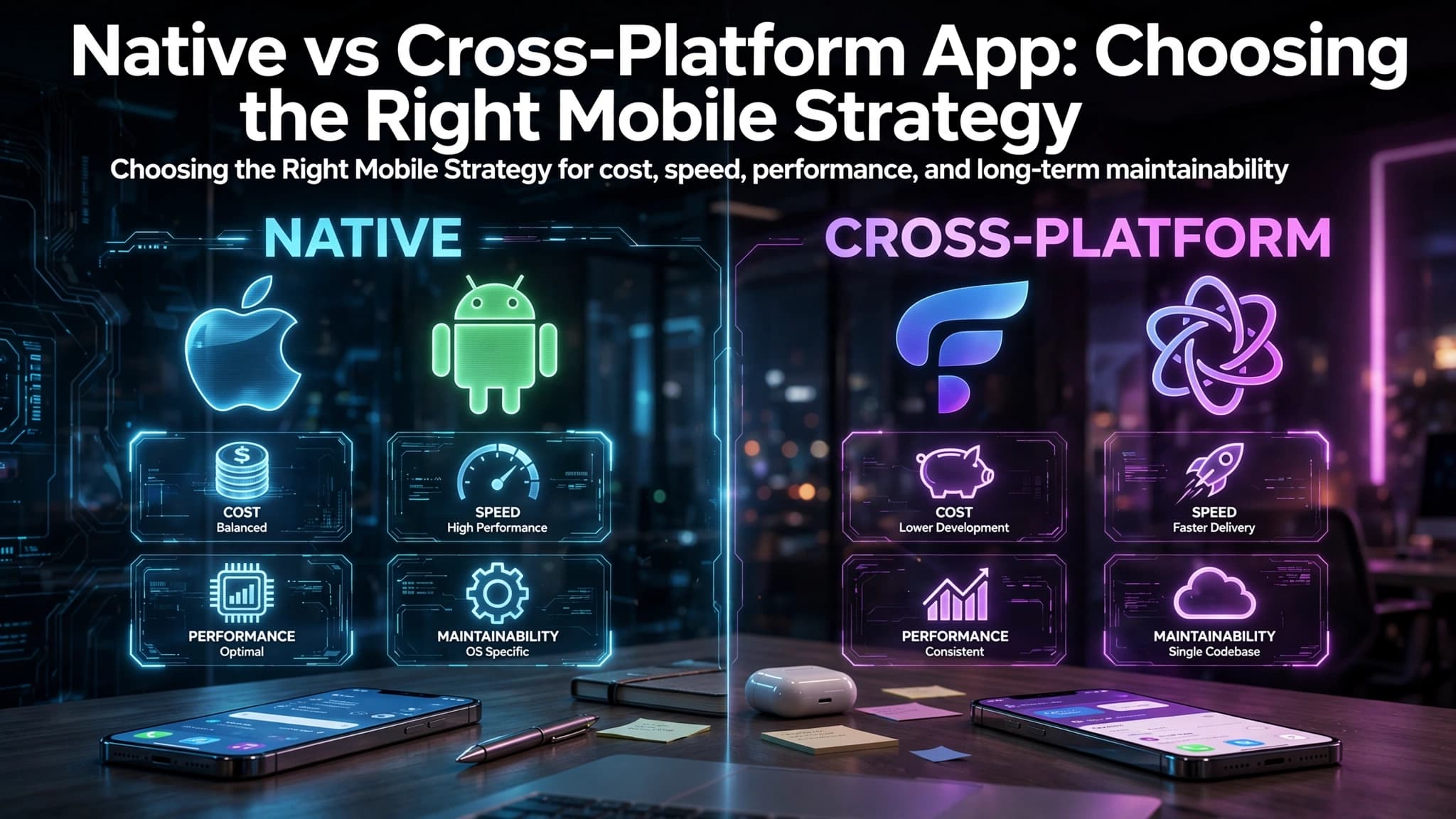
Native vs Cross-Platform App: Choosing the Right Mobile Strategy
Native vs Cross-Platform App: Choosing the Right Mobile Strategy for cost, speed, performance, and long-term maintainability.
S
Shayma Parween
Lead Developer
Jun 22, 2026
11 min read
Native vs Cross-Platform App: Choosing the Right Mobile Strategy
Native vs Cross-Platform App: Choosing the Right Mobile Strategy comes down to trade-offs, not ideology. Native development is usually the better fit when performance, platform-specific UX, or deep access to device features are critical. Cross-platform is usually the better fit when you need to launch faster, share code across iOS and Android, and keep maintenance simpler without sacrificing too much capability.
Key takeaways
- Native apps are best when you need top-tier performance, deep device integration, or a highly polished platform-specific experience.
- Cross-platform apps are best when speed to market, shared code, and tighter budgets matter more than platform-perfect UI behavior.
- The right mobile strategy depends on product complexity, offline needs, third-party integrations, and your team’s long-term capacity to maintain the app.
- A hybrid approach can be practical: start cross-platform for shared features, then use native modules where performance or device access matters.
- Architecture, testing, and release discipline often matter more than the framework choice itself.
For business leaders, the real question is not which approach is best in the abstract. It is which approach fits your product goals, delivery timeline, in-house skills, and total cost of ownership over the next 12 to 36 months.
What native and cross-platform actually mean in practice
Native apps are built specifically for one operating system using its primary tools and language: Swift or Objective-C for iOS, Kotlin or Java for Android. This gives the development team direct access to platform APIs, the latest OS capabilities, and the most consistent behavior with Apple or Google design patterns. In practical terms, native often shines when your app needs advanced camera work, BLE hardware communication, complex animations, or high-performance media processing.
Cross-platform apps use a shared codebase to target both iOS and Android. Common options include Flutter, React Native, and .NET MAUI. These frameworks have matured significantly, and for many business apps they are a strong default. You still need platform-specific work at times, but most screens, business logic, and API integration can be shared across both platforms.
A useful way to think about it is this: native optimizes for control, while cross-platform optimizes for efficiency. Neither is automatically better. The right choice depends on how much control your product genuinely needs versus how much efficiency your organization needs to sustain delivery.
When native is the safer choice
Native is usually the stronger choice for products where milliseconds matter or where the app must feel deeply aligned with each platform. If you are building a consumer experience with rich gestures, complex transitions, offline-first workflows, or heavy use of the phone’s hardware, native can reduce friction and simplify access to platform features. It is also the usual choice for products that need the newest OS capabilities as soon as they ship.
There are also cases where native reduces risk. Apps tied to regulated workflows, secure enterprise authentication, or specialized peripherals often benefit from direct platform support. If your roadmap includes advanced use of Apple HealthKit, Google Pay, NFC, Wallet passes, background processing, or custom security controls, native can save time that would otherwise be spent fighting framework limitations.
Typical scenarios where native often makes sense include:
- Premium consumer apps with highly polished interactions
- Camera-heavy, video-heavy, or AR-enabled experiences
- Apps requiring close integration with wearables or IoT hardware
- Highly regulated enterprise or field-service applications
- Products that must adopt platform features immediately after release
The trade-off is straightforward: you are typically building and maintaining two codebases, which means more specialized talent, more QA effort, and more release coordination. That does not make native expensive in every case, but it does make it more operationally demanding.
When cross-platform is the smarter business decision
Cross-platform is often the better business decision when the product is still proving itself, the core features are mostly standard across platforms, or the team needs to iterate quickly. A single shared codebase can reduce duplicated effort for UI, state management, networking, analytics, and business rules. For many companies, that means fewer moving parts and faster feature parity between iOS and Android.
Modern frameworks are strong enough for a wide range of business applications. Flutter can be especially effective when you want a consistent UI across devices. React Native is attractive if your engineering team already knows JavaScript or TypeScript and you want to leverage web development skills. .NET MAUI can fit organizations already standardized on Microsoft tools and backend ecosystems.
Cross-platform is commonly a good fit for:
- MVPs and pilot launches
- Internal business apps and dashboards
- SaaS companion apps
- Consumer apps with standard CRUD workflows
- Companies with a small product team that needs to ship on both platforms
The main limitation is that shared code does not eliminate platform differences. You still need to account for OS updates, native modules, device fragmentation, app store rules, and edge-case UI behavior. In our experience at eSparks IT Solutions, the best cross-platform projects are the ones that deliberately plan for those exceptions instead of pretending they do not exist.
A practical decision framework for business leaders
The most reliable way to choose is to evaluate the app against five questions in order. First, what is the product trying to do that generic mobile apps do not? If the answer includes advanced hardware use, high-end animation, or real-time responsiveness, native moves up the list. If the app is mainly forms, lists, workflows, booking, content, or standard API-driven screens, cross-platform is often enough.
Second, how differentiated is the mobile experience? If mobile is the core product and user experience is a key differentiator, platform-specific tuning can matter. If mobile is simply one channel in a broader service model, efficiency may matter more than absolute platform perfection. Third, what does your team already know? A strong React, TypeScript, or .NET team can be productive faster in cross-platform than in a fully native setup. A team with deep iOS and Android specialization may be better served by native.
A simple decision sequence looks like this:
- Define the must-have device features and performance constraints
- Map the app’s complexity: simple, moderate, or high
- Estimate how often the product will change in the next year
- Compare team skills against the required stack
- Decide whether speed to market or long-term platform optimization is the priority
- Validate the choice with a technical discovery phase before committing
This is where architecture matters as much as framework selection. A clean API layer, proper offline handling, modular UI design, and disciplined release planning can make a cross-platform app feel far more reliable. Conversely, a poorly architected native app can still become slow, fragile, and expensive to maintain.
Costs, timelines, and team shape: realistic estimates
For most companies, the biggest driver is not just build cost; it is the total time and effort to get to a stable, maintainable product. A straightforward native app for one platform may often take roughly 3 to 5 months for a small team, while full native delivery for both platforms can extend that significantly depending on scope. A comparable cross-platform app may often land in the 2 to 4 month range for an MVP or first release, because shared code reduces duplicated implementation.
These are only typical estimates, not guarantees. A simple app with a few screens and standard API integration can move quickly in either model. A product with offline sync, role-based permissions, in-app messaging, payments, or complex state management can take much longer regardless of framework choice.
Staffing shape also matters. Native usually requires either two specialized mobile developers or a team comfortable with platform-specific work. Cross-platform can sometimes be built with a smaller team, which helps early-stage businesses and internal product teams. But savings can disappear if the team lacks framework expertise and spends too much time solving integration issues or reworking the UI for platform conventions.
If you are budgeting, look beyond development labor. Include QA on real devices, app store submission cycles, security review, analytics setup, crash reporting, and post-launch maintenance. Those costs are real in both approaches, and they often reveal whether the initial framework choice will scale cleanly.
Common pitfalls that derail mobile strategy
One of the most common mistakes is choosing a framework before defining the product requirements. Teams often start with “we want one codebase” or “we want native performance,” but the right answer depends on the specific app. That shortcut leads to unnecessary rework later, especially when a product suddenly needs offline sync, real-time notifications, or deeper device integration.
Another frequent mistake is underestimating long-term maintenance. Cross-platform apps are not automatically low-maintenance, and native apps are not automatically higher quality. Both approaches need API versioning, dependency management, automated testing, crash monitoring, and a release process that includes real-device validation. If your app supports multiple regions such as the USA, UK, Canada, Australia, UAE, Saudi Arabia, Qatar, or the Netherlands, you also need to plan for locale behavior, time zones, payment providers, and compliance requirements.
Watch for these pitfalls:
- Choosing a stack based on a hiring trend rather than product needs
- Ignoring platform-specific UX differences in navigation, gestures, and accessibility
- Overlooking app store review constraints and release dependencies
- Failing to plan for offline mode, sync conflicts, and retry logic
- Building too much custom native code inside a cross-platform project without governance
The best way to avoid these problems is to define non-negotiable requirements up front, prototype risky areas early, and keep the architecture modular. If a feature clearly belongs in native code, isolate it cleanly so it does not contaminate the rest of the app.
A balanced approach: use both where it makes sense
For many organizations, the best answer is not pure native or pure cross-platform. A hybrid strategy can be the most pragmatic. You can build the main app in Flutter or React Native, then add native modules for features that need deeper hardware access, advanced security, or platform-specific polish. This approach is especially useful when the product must evolve quickly but still meet demanding technical requirements.
We often recommend this model for businesses that want to avoid overcommitting early. It lets you launch with shared code, learn from actual user behavior, and then invest selectively in native improvements where they create measurable value. That may include push notification handling, biometric authentication flows, secure key storage, payment modules, or complex media processing.
The strategic advantage is flexibility. You are not locked into an all-or-nothing architecture, and you can keep technical debt contained if the app grows. The key is discipline: document which parts are shared, which are native, why the split exists, and how future developers should extend it. Good mobile strategy is less about purity and more about building a product that can survive real-world change.
For teams working with a broader digital roadmap, mobile should also fit the rest of the stack: cloud infrastructure, DevOps release automation, API security, analytics, and data governance. A mobile app is rarely isolated, and the most successful programs treat it as one part of a connected system rather than a standalone deliverable.
Frequently Asked Questions
Is native always better than cross-platform?
No. Native is better when performance, device integration, or platform-specific UX are critical, but cross-platform is often the better choice for speed, shared code, and lower operational overhead. The best option depends on the product’s requirements, not on a general rule.
Which is faster to build: native or cross-platform?
Cross-platform is usually faster for a first release because one codebase can serve both iOS and Android. Native often takes longer because each platform is built and maintained separately, although the exact timeline depends on complexity and team experience.
Can a cross-platform app feel as good as a native app?
Yes, for many business apps it can feel very close to native when the design system, performance, and navigation are handled well. The gap becomes more noticeable in advanced animations, heavy media workflows, or features that depend on deep OS-level behavior.
When should a company switch from cross-platform to native?
A switch makes sense when the app’s requirements outgrow the framework, such as needing advanced hardware access, stricter performance control, or tighter platform-specific UX. It can also make sense if the product’s growth justifies separate optimization for each platform.
Work with eSparks IT Solutions
Planning a project around this? We help businesses across the USA, UK, Canada, Australia and the GCC ship it. Explore our Mobile Development services and portfolio, estimate your project cost, or book a free call.
Related mobile app services
S
Shayma Parween
Lead Developer
Passionate technology writer and industry expert with years of experience in software development, cloud computing, and digital transformation. Dedicated to sharing insights and helping developers stay ahead of the curve.
Related Topics
Continue Reading
More insights in Mobile Development
Mobile Development
Mobile App Maintenance: Costs, Scope, and Best Practices
A practical guide to mobile app maintenance, including scope, costs, timelines, risks, and how to choose the right support model.
Sep 24, 2026
Read More
Mobile Development
React Native vs Flutter: How Business Leaders Should Choose
React Native vs Flutter explained for CTOs and founders: compare cost, speed, performance, hiring, and long-term fit.
Sep 23, 2026
Read More
Mobile Development
Enterprise Mobile Access Architecture: A Practical Guide
Learn how enterprise mobile access architecture secures apps, identities, devices, and APIs without slowing users or overcomplicating IT.
Sep 19, 2026
Read MoreReady to Transform Your Business?
Let's discuss how our expertise can help you achieve your goals