
Mobile Development
Understanding Mobile App Development Cost in 2026: A Complete Guide
Understanding Mobile App Development Cost in 2026: A Complete Guide for planning budgets, features, tech stack, and delivery tradeoffs.
S
Shayma Parween
Lead Developer
Jun 23, 2026
10 min read
Understanding Mobile App Development Cost in 2026: A Complete Guide
Key takeaways
- Mobile app cost in 2026 is driven more by scope, integrations, and quality requirements than by the app label itself.
- A simple MVP can often be delivered in a few months, while a feature-rich, secure, multi-platform product usually requires a larger budget and longer timeline.
- Native iOS and Android builds usually cost more than a single cross-platform codebase, but they can reduce platform-specific tradeoffs in performance and UX.
- The most common budget overruns come from unclear requirements, late design changes, integration surprises, and incomplete testing.
- Maintenance, cloud infrastructure, app store updates, and security work should be budgeted from the start, not treated as optional extras.
Understanding Mobile App Development Cost in 2026: A Complete Guide starts with a simple truth: there is no single price for a mobile app. Cost depends on what the app must do, how many platforms it must support, what level of security and reliability it needs, and how much integration work sits behind the screens. For most business leaders, the right question is not “How much does an app cost?” but “What is the cost of building the right version for my business stage, risk profile, and users?”
In 2026, mobile budgets are shaped by product complexity, cloud architecture, AI features, compliance expectations, and the choice between native and cross-platform development. A basic internal tool may be built for a modest investment, while a customer-facing product with payments, offline sync, role-based access, and real-time data can require a much larger program. The best estimates are always tied to scope, technical stack, and the level of polish you expect at launch.
What actually drives the cost of a mobile app
The biggest cost driver is feature depth. A login screen and a simple content feed are far cheaper than a product with in-app payments, push notifications, chat, GPS tracking, media uploads, third-party integrations, and admin dashboards. Every added workflow introduces design effort, development time, testing scenarios, and more edge cases that need to be handled correctly.
Platform strategy also matters. Building natively for iOS with Swift and Android with Kotlin typically gives the best platform-specific experience, but it usually means two codebases and more engineering effort. Cross-platform approaches such as Flutter or React Native can reduce duplication and are often attractive for business apps, MVPs, and teams that want faster delivery. That said, the savings depend on the app’s requirements; if the product leans heavily on device-specific behavior, advanced animations, or hardware integration, native development can still be the better long-term choice.
Beyond the visible app, the backend can be a major cost center. APIs, authentication, user management, analytics pipelines, payment processing, notifications, audit logs, and admin portals all need to be designed, built, secured, and maintained. In practice, many projects spend as much effort on the supporting system as on the mobile interface itself.
Understanding Mobile App Development Cost in 2026: A Complete Guide to typical budget bands
For planning purposes, it helps to think in broad categories rather than fixed prices. A simple app with a limited set of screens, basic authentication, and minimal backend logic often falls into the lower budget band and may take around 8 to 14 weeks to release an MVP, depending on team size and approval cycles. A mid-complexity app with custom UI, integrations, and a more robust backend commonly needs several months and a larger investment.
At the higher end, enterprise-grade apps usually involve multiple roles, stronger security controls, more rigorous QA, admin tooling, and integration with internal systems such as CRM, ERP, identity providers, data warehouses, or proprietary APIs. These projects frequently move in phases: discovery, design, MVP, pilot, hardening, and scale-up. That phased approach reduces risk, but it also means the total budget should account for both initial release and subsequent enhancement work.
A useful way to frame typical effort is by complexity:
- Basic app: simple content, forms, login, limited integrations, minimal backend.
- Moderate app: custom workflows, payments, notifications, analytics, moderate backend, one or two integrations.
- Complex app: multi-role access, real-time features, offline capability, advanced security, multiple integrations, custom admin tools, and compliance demands.
These are estimates, not guarantees. Two apps that look similar on paper can diverge significantly if one needs stronger uptime, auditability, or complex data handling.
Technology choices that influence cost and long-term value
The stack you choose changes both build cost and lifetime cost. For front-end mobile work, Swift and Kotlin remain strong choices when native performance and deep OS integration matter. Flutter is often efficient for product teams that want a consistent UI across iOS and Android from one codebase. React Native can be a practical fit when you want to align mobile development with an existing JavaScript or TypeScript team.
On the backend, common choices include Node.js with TypeScript, .NET, Java Spring Boot, or Python-based services, depending on the team’s strengths and the system’s needs. Cloud-native infrastructure on AWS, Azure, or Google Cloud often simplifies scaling, observability, and managed services. Serverless functions, containers, and managed databases can reduce operational overhead, but they should be selected based on architecture fit rather than trend.
AI and data features can also change the budget significantly. If your app needs recommendations, chat assistants, document processing, or predictive workflows, you may need model integration, vector search, prompt design, evaluation workflows, and guardrails for privacy and accuracy. Security requirements also raise cost: SSO via SAML or OAuth, MFA, encryption at rest and in transit, secure key management, mobile app hardening, and regular vulnerability testing all add engineering effort, but they are often essential for business systems.
Build vs buy vs custom: how leaders should decide
One of the fastest ways to overspend is to custom-build what already exists. Before commissioning a mobile app, leaders should ask whether the requirement can be covered by SaaS, low-code tooling, configuration, or API integration. If the business need is mostly process automation, internal approvals, or workflow tracking, a lighter-weight platform may be enough.
Custom development makes sense when the app is part of the product itself, when the user experience is a differentiator, or when the workflow is too specific for off-the-shelf software. It also makes sense when you need control over data residency, integration logic, security posture, or roadmap timing. In those cases, the question is not whether custom software is expensive; it is whether the business impact justifies the investment.
A practical decision framework looks like this:
- Define the business outcome first. Be clear about whether the app is meant to generate revenue, reduce operational cost, improve retention, or enable field work.
- Separate must-have from nice-to-have. Early scope discipline is the biggest defense against budget creep.
- Map required integrations. ERP, CRM, payments, maps, identity, analytics, and notification services each carry design and testing effort.
- Decide how much risk the business can tolerate. If the app handles regulated data or mission-critical operations, budget more for architecture, QA, and security.
- Choose a delivery model. MVP, pilot, or full release will change the size of the first budget and the timing of later phases.
This is where an experienced partner such as eSparks can help teams avoid paying for architectural mistakes they only discover after release.
Common hidden costs and how to avoid them
Many budgets fail because they only include the visible development work. Design exploration, product discovery, technical architecture, QA automation, app store preparation, release management, analytics setup, and post-launch support all take time. If those are omitted from the estimate, the project looks cheaper than it really is.
Integration work is another frequent surprise. Connecting to legacy systems is rarely as simple as calling an API. You may need data mapping, authentication bridging, retry logic, queueing, transformation rules, and exception handling. Third-party services also bring vendor dependencies; if a payment, messaging, or mapping API changes, your app may need updates that were not obvious at the start.
Common pitfalls include:
- Starting development before requirements are stable.
- Designing for every future feature instead of the first release.
- Underestimating QA for different screen sizes, OS versions, and network conditions.
- Ignoring accessibility, localization, and app store review requirements.
- Forgetting maintenance, updates, and security patches after launch.
The safest way to avoid these traps is to invest in discovery and technical scoping before full build. A well-run discovery phase often uncovers complexity early, when it is cheaper to adjust.
A realistic process for estimating scope, timeline, and budget
A credible estimate starts with a product workshop or discovery phase. The team should document user roles, core journeys, data flows, integrations, compliance constraints, and non-functional requirements such as performance, uptime, and accessibility. From there, the work can be broken into epics, features, and implementation tasks, which is the only reliable basis for budget planning.
For business decision-makers, the estimate should include more than build hours. Ask for timeline assumptions, team composition, release phases, QA coverage, deployment method, and post-launch support expectations. Clarify whether the estimate covers design, API development, CI/CD setup, testing devices, cloud hosting, and app store submissions. If an estimate does not state what is excluded, it is incomplete.
A strong planning model usually includes:
- Discovery and validation
- UX/UI design and prototyping
- Mobile app development
- Backend and integration work
- QA, security review, and performance testing
- Deployment, release support, and monitoring
- Maintenance and iterative enhancement
Typical timelines vary widely, but a simple MVP may fit into a few months, while a more advanced business app often requires a multi-phase roadmap. In our experience at eSparks, the best estimates are the ones that show tradeoffs clearly instead of promising an unrealistically fixed scope.
How to budget for launch and beyond
Launch is not the finish line. Mobile apps need ongoing support for OS updates, device compatibility, dependency upgrades, certificate renewals, cloud usage, logging, bug fixes, and security patches. App stores also change policies, review requirements, and submission rules over time, which means release management is an ongoing discipline.
It is wise to reserve a maintenance budget from day one. The right amount depends on usage, complexity, compliance, and product criticality, but most organizations should plan for continuous upkeep rather than a one-time project. If the app is customer-facing, revenue-bearing, or operationally critical, ongoing monitoring and incident response should be part of the operating model.
A good budget also includes room for iteration. Real users always surface new needs after launch, and the best mobile products improve through measured releases. That is where a product mindset matters: build the minimum viable version carefully, measure what happens, and expand only after the business evidence is clear.
FAQ
How much does a mobile app cost in 2026?
A mobile app can range from a modest MVP budget to a significantly larger enterprise investment, depending on features, platforms, integrations, and security requirements. A simple app is usually far less expensive than a complex, multi-role product with backend services, compliance controls, and custom admin tools.
Is Flutter cheaper than native app development?
Flutter is often more cost-efficient when you want one codebase for iOS and Android, especially for business apps and MVPs. Native development can cost more upfront because it typically requires separate iOS and Android builds, but it may be the better choice for advanced device-specific performance or platform integration.
What is the biggest reason app budgets go over plan?
The most common cause is scope change after development begins. Hidden complexity in integrations, security, testing, and approval cycles also pushes budgets higher when they are not identified during discovery.
Should maintenance be included in the app budget?
Yes. Mobile apps require updates for operating system changes, security patches, dependency upgrades, app store compliance, and bug fixes. A realistic budget should include both initial delivery and ongoing support.
Work with eSparks IT Solutions
Planning a project around this? We help businesses across the USA, UK, Canada, Australia and the GCC ship it. Explore our Mobile Development services and portfolio, estimate your project cost, or book a free call.
Related mobile app services
S
Shayma Parween
Lead Developer
Passionate technology writer and industry expert with years of experience in software development, cloud computing, and digital transformation. Dedicated to sharing insights and helping developers stay ahead of the curve.
Related Topics
Continue Reading
More insights in Mobile Development
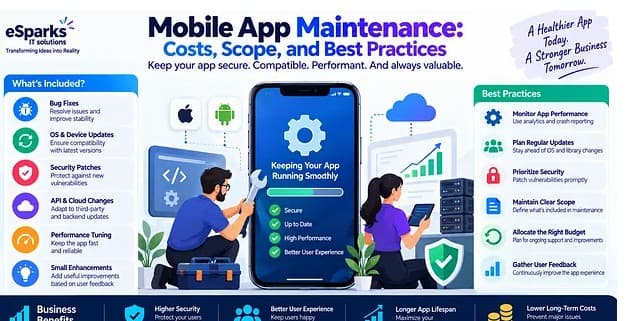
Mobile Development
Mobile App Maintenance: Costs, Scope, and Best Practices
A practical guide to mobile app maintenance, including scope, costs, timelines, risks, and how to choose the right support model.
Sep 24, 2026
Read More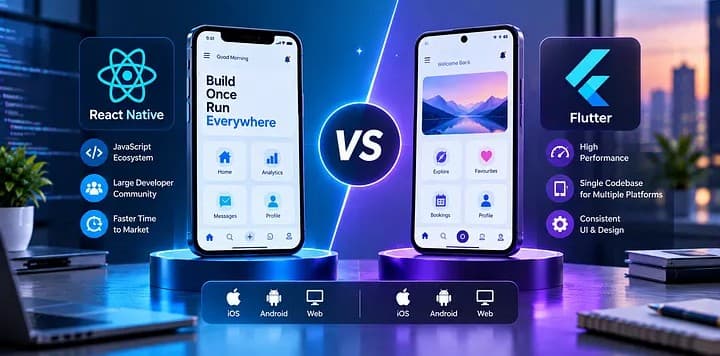
Mobile Development
React Native vs Flutter: How Business Leaders Should Choose
React Native vs Flutter explained for CTOs and founders: compare cost, speed, performance, hiring, and long-term fit.
Sep 23, 2026
Read More
Mobile Development
Enterprise Mobile Access Architecture: A Practical Guide
Learn how enterprise mobile access architecture secures apps, identities, devices, and APIs without slowing users or overcomplicating IT.
Sep 19, 2026
Read MoreReady to Transform Your Business?
Let's discuss how our expertise can help you achieve your goals