Mobile Development
Enterprise Mobile App Security: A Practical Guide
Enterprise mobile app security guide covering architecture, APIs, offline risk, BYOD, testing, and controls that reduce real-world exposure.
Shayma Parween
Lead Developer
- Published
- Sep 8, 2026
- Reading time
- 10 min read
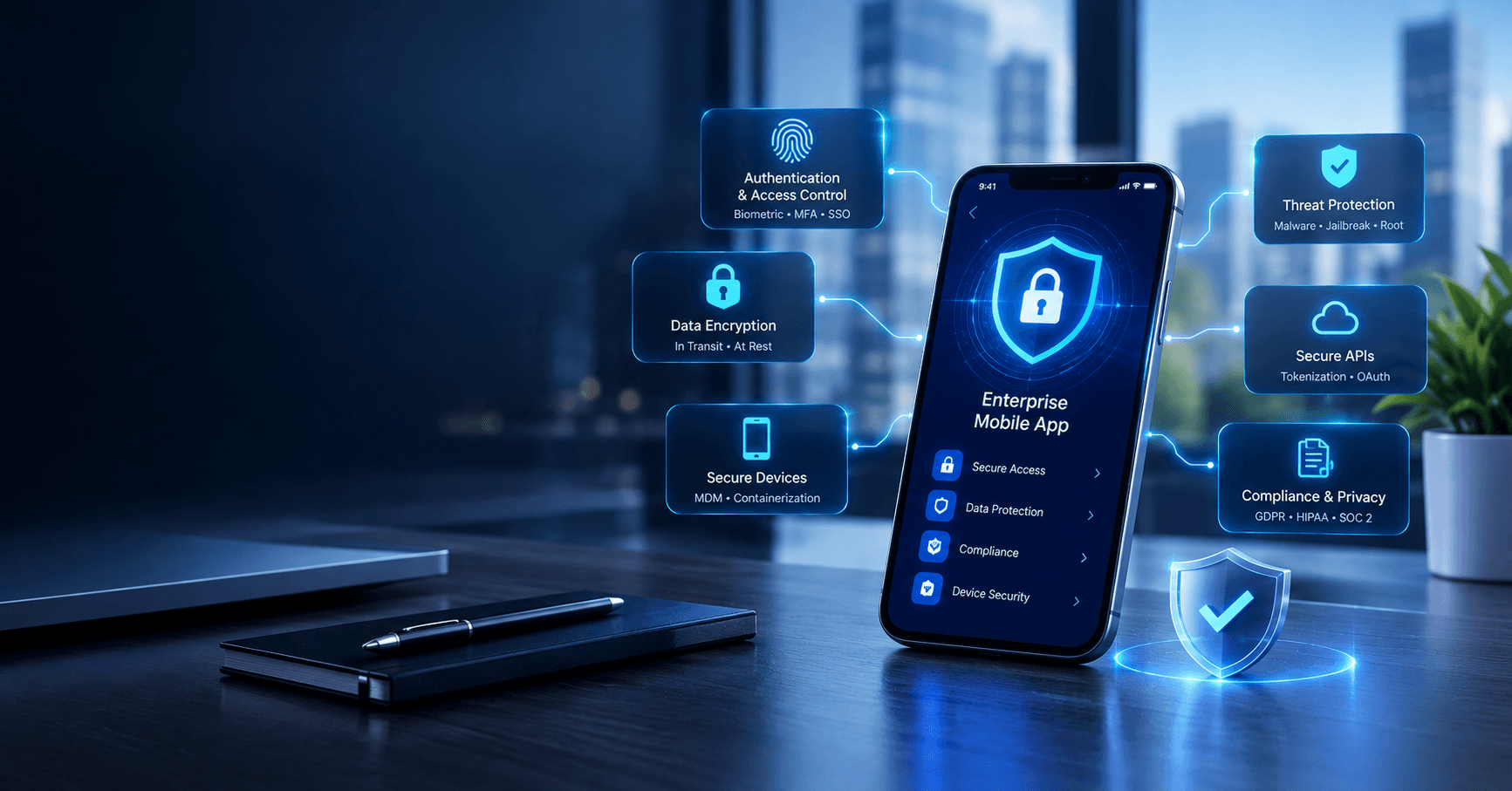
Enterprise mobile app security means protecting business data, user identities, APIs, and devices across the entire app lifecycle, not just adding a login screen or encrypting a database. For decision-makers, the practical goal is simple: reduce the chance that a compromised phone, stolen token, weak API, or rushed release turns into data exposure, downtime, or compliance trouble.
Key takeaways
- Enterprise mobile app security is a full lifecycle discipline that combines secure coding, identity controls, API protection, device safeguards, monitoring, and incident response.
- The safest enterprise apps assume the device, network, and even valid user sessions can be compromised, so they validate every request and minimize trust by design.
- For most business apps, the highest-risk weaknesses are insecure APIs, weak authentication, poor secrets handling, and missing controls around offline data storage on devices.
- A realistic security roadmap starts with data classification and threat modeling, then maps controls to business risk, compliance needs, and operating constraints before development begins.
- Good security decisions are usually architectural decisions: what data is stored, where trust is placed, how sessions are handled, and what happens when devices are lost, rooted, jailbroken, or offline.
- A capable software partner should explain specific security practices, standards, and trade-offs in plain language rather than relying on generic claims about being secure.
Why enterprise mobile apps are a different security problem
Consumer apps and enterprise apps may use similar mobile frameworks, but the risk profile is very different. Enterprise mobile apps usually connect to internal systems, customer records, payment workflows, field operations, HR data, or regulated information. That means a single weakness in authentication, session handling, or API authorization can expose far more than one screen in a mobile app; it can open a path into core business systems.
The attack surface is also broader than many teams expect. A typical business app includes the mobile client, backend APIs, identity provider, cloud storage, push notifications, analytics SDKs, admin dashboards, CI/CD pipelines, and third-party integrations. Security breaks often happen in the seams between these components: a mobile app stores tokens insecurely, an API trusts the client too much, or a release pipeline exposes secrets. The most resilient programs treat the mobile app as one endpoint in a larger enterprise system, not as an isolated product.
For business leaders, that changes how you evaluate a build or modernization project. The right question is not “Is the app secure?” but “What are the highest-risk failure modes, and which controls reduce them to an acceptable level?” That framing leads to clearer engineering choices, more realistic budgets, and fewer surprises after launch.
Enterprise mobile app security starts with architecture, not patching
The strongest security decisions are made before development accelerates. Architecture determines where sensitive data lives, how identity is verified, which services talk to each other, and what happens when a device is offline or compromised. If those decisions are weak, later fixes are usually expensive and incomplete.
A practical starting point is data classification. Identify what the app handles: public content, internal business data, personal information, financial records, health-related data, intellectual property, or operational commands. Then map data flows across the mobile client, APIs, cloud services, and third parties. This reveals where encryption is needed, where data should never be cached locally, and where strict audit logging matters.
A good enterprise architecture usually includes several of these patterns:
- Short-lived access tokens with refresh controls rather than long-lived sessions
- Server-side authorization checks for every sensitive action; never trust the client to enforce permissions
- Minimal local storage, with sensitive values kept in platform-provided secure storage when storage is necessary
- Encrypted transport using modern TLS, plus certificate pinning only where justified by risk and operational maturity
- Segmented backend services and least-privilege service accounts
- Device integrity or app attestation checks for higher-risk use cases
- Centralized secrets management instead of hardcoded credentials in apps or pipelines
Threat modeling should happen early, ideally before UI polish and backlog growth make change harder. A lightweight method such as STRIDE works well because it asks concrete questions: can users spoof identities, tamper with requests, repudiate actions, access hidden data, exhaust service capacity, or elevate privileges? Even a half-day workshop with product, engineering, security, and operations stakeholders often surfaces the biggest risks faster than a long requirements document.
One common architectural mistake is treating “mobile” as just another front end while keeping the same broad internal APIs used by web or admin tools. Enterprise mobile apps often need narrower endpoints, stronger token validation, stricter rate limits, and more defensive response handling. Reusing backend capability is fine; reusing trust assumptions is where problems begin.
The controls that matter most in real-world deployments
Security programs become effective when they prioritize the controls most likely to prevent expensive mistakes. For enterprise mobile apps, a small set of controls usually carries most of the practical value.
First, identity and access management must be designed for enterprise realities. That often means standards-based authentication and authorization with support for single sign-on, conditional access, and multi-factor authentication for sensitive actions. Role-based or attribute-based access control should be enforced on the server, not just reflected in the interface. Single sign-on can improve security when done properly because it centralizes policy and reduces password sprawl.
Second, API security deserves as much attention as the mobile app itself. Common issues include broken object-level authorization, overly broad endpoints, poor input validation, weak rate limiting, and verbose error responses that leak information. Mature teams secure APIs with consistent authentication middleware, schema validation, authorization checks, and centralized logging. They also test against common API risk categories, because many damaging incidents stem from APIs that technically work but trust requests they should reject.
Third, protect data at rest and in transit without assuming encryption alone solves the problem. HTTPS is table stakes, but you also need sensible storage rules. If the app supports offline use for field teams, define exactly what can be cached, how long it persists, and how it is wiped on logout, device compromise, or remote revoke. Avoid embedding API keys, client secrets, and environment-specific credentials in the app package. Attackers routinely extract them from binaries and configuration files.
Additional controls that often matter in enterprise settings include:
- Mobile device management or enterprise mobility policies for corporate-owned devices
- Root and jailbreak detection for high-risk workflows, with graceful handling rather than brittle blocking alone
- App shielding or runtime protections when threat exposure justifies the extra complexity
- Audit trails for sensitive actions such as approvals, exports, role changes, and financial submissions
- Secure push notification design so sensitive content does not appear in lock-screen previews by default
- Dependency and software composition analysis for third-party libraries and SDKs
The practical order matters. If a team has limited time, fixing authorization gaps, token handling, local storage rules, and secrets exposure usually pays off before investing in more advanced protections. Runtime defenses can help, but they rarely compensate for weak backend authorization or poor session design.
Secure offline access, BYOD, and lost-device risk
Many enterprise mobile apps have to work in warehouses, hospitals, field service environments, retail floors, or travel scenarios where connectivity is limited. That business requirement creates a difficult security trade-off: the more usable the app is offline, the more data and trust you may be placing on a device you do not fully control.
A practical approach is to define offline access by data class, not by convenience alone:
- Public or low-sensitivity reference data may be cached for longer periods.
- Internal operational data may be cached in a reduced form with expiration rules.
- Sensitive personal, financial, or regulated data may need view-only access, redaction, or no offline storage at all.
- High-risk actions such as approvals, payments, privilege changes, or record exports often should require a fresh online authorization check.
Teams also need explicit revocation behavior. If a user leaves the company, a phone is stolen, or a session is flagged as risky, how quickly should access disappear? On managed devices with reliable connectivity, remote wipe or app-level revoke may happen quickly. In bring-your-own-device environments, you may need a layered model: short token lifetime, encrypted local data, forced reauthentication after inactivity, and a policy that blocks sensitive functions until the device checks in again.
BYOD introduces extra design constraints because privacy and control are balanced differently than on corporate-owned devices. Overly aggressive device inspection can create legal or employee-relations problems, while weak controls can leave business data exposed. In practice, many organizations separate personal and business risk by using app-level protections rather than assuming full device management. That can include secure storage, copy/paste restrictions for certain screens, screenshot limits where appropriate, and selective wipe of business data without touching personal content.
Estimate ranges help planning. For a typical enterprise app, basic offline hardening such as secure local storage, cache rules, logout wipe, and token refresh design may add roughly days to a few weeks of engineering effort depending on app complexity. Broader BYOD and device-policy work, especially where legal, HR, and compliance teams must align, often takes longer than coding itself.
Common implementation pitfalls that weaken otherwise solid designs
A surprising number of enterprise mobile security issues come from ordinary delivery pressure rather than exotic attacks. The architecture may be sound on paper, but small shortcuts in implementation create real exposure.
Common pitfalls include:
- Storing access tokens in insecure preferences or logs
- Leaving debug endpoints, verbose error messages, or development certificates in production builds
- Trusting role or entitlement data sent by the mobile client instead of recalculating permissions server-side
- Using long session lifetimes because reauthentication feels inconvenient
- Reusing broad internal APIs that expose more fields or actions than the mobile app needs
- Allowing sensitive information in notifications, screenshots, clipboard contents, or crash reports
- Failing to rotate signing keys, API credentials, or compromised secrets quickly
- Adding third-party SDKs without reviewing their permissions, data collection, or update history
Some of the most expensive pitfalls are operational. For example, certificate pinning may sound attractive, but if it is implemented without a mature certificate rotation process, it can create outages during renewals or emergency changes. Likewise, root or jailbreak detection can reduce abuse in some scenarios, but brittle implementations often lock out legitimate users while motivated attackers bypass the checks anyway. These controls should be matched to the threat model, not adopted by default.
Another weak spot is secrets handling in build and release systems. Many teams focus on the mobile codebase while overlooking signing keys, environment files, provisioning artifacts, and CI/CD credentials. A compromised pipeline can undermine otherwise strong app security. At minimum, protect build secrets in a dedicated secrets manager, limit who can trigger production releases, require code review for security-sensitive changes, and keep an auditable release trail.
Testing, monitoring, and incident response across the lifecycle
Enterprise mobile app security is not a one-time assessment before launch. Mobile operating systems change, dependencies change, APIs evolve, and business logic grows. The security program needs checks before release and visibility after release.
A practical lifecycle usually combines several layers:
- Secure code review for authentication flows, storage, cryptography use, and sensitive business logic
- Automated static analysis and dependency scanning in CI/CD
- Dynamic testing of app behavior, API authorization, session handling, and rate limiting
- Penetration testing before major releases or when sensitive scope changes
- Logging and monitoring for anomalous access patterns, repeated failures, impossible travel, mass exports, and privilege misuse
The most valuable testing often targets business logic rather than generic vulnerability lists. Can one authenticated user retrieve another user’s records by changing an identifier? Can an offline workflow be replayed after permissions change? Can a stale token still perform high-risk actions? Those are the kinds of issues that matter in production.
Monitoring must also be designed carefully. Mobile telemetry can help detect abuse, but security teams should be selective about what they collect and retain. Device identifiers, location data, and user activity details can create privacy and compliance issues if logged too broadly. Capture enough to investigate incidents and support audit requirements, but avoid excessive collection that increases legal exposure.
Incident response planning is frequently underdeveloped for mobile apps. At a minimum, teams should define how to revoke tokens, disable risky features, rotate secrets, force minimum app versions, notify affected stakeholders, and preserve forensic evidence from APIs and backend systems. If the app is business-critical, run tabletop exercises. Even a 60-minute drill can reveal gaps in ownership, tooling, and communication.
In terms of cadence, lightweight automated checks should run on every merge or build. Broader manual reviews often make sense before major releases, new integrations, or scope changes that touch regulated data. Security debt grows quietly when release speed increases but review depth does not.
How to prioritize investments and estimate effort realistically
Not every enterprise app needs the same level of security control. A field-inspection app with low-sensitivity data has different needs than a mobile app that exposes account changes, payments, health information, or administrative functions. The key is to align investment with likely impact.
A simple prioritization model is:
- Identify the most sensitive data and highest-impact actions.
- Map realistic threats such as stolen devices, token theft, API abuse, malicious insiders, and release pipeline compromise.
- Rate each risk by business impact and implementation difficulty.
- Fix the high-impact, lower-effort issues first.
For many organizations, the first wave of work includes:
- Server-side authorization review
- Stronger token and session lifecycle controls
- Local storage minimization and secure key handling
- Dependency review and secrets cleanup
- Logging for sensitive actions and abuse detection
That initial hardening often fits into a focused sprint or multi-sprint effort, depending on architecture quality and release constraints. More advanced capabilities such as app attestation, device posture integration, custom runtime defenses, or extensive offline policy controls usually require broader coordination and testing. Expect those to take longer because they affect operations, support, and user experience as much as code.
Decision-makers should also weigh the cost of false confidence. A checklist full of controls can look impressive while leaving core weaknesses untouched. In enterprise mobile app security, the controls with the highest practical return are usually the least glamorous: narrow APIs, strong authorization, disciplined storage rules, short-lived tokens, protected build pipelines, and tested incident response.
When these foundations are in place, the app is not just harder to attack. It is also easier to operate, audit, and adapt as business requirements change.
Frequently Asked Questions
What is enterprise mobile app security?
Enterprise mobile app security is the practice of protecting business mobile applications across the full lifecycle, including app code, user authentication, APIs, backend systems, device storage, release pipelines, monitoring, and incident response.
What are the biggest risks in enterprise mobile apps?
The most common high-impact risks are weak API authorization, poor token and session handling, insecure local storage, exposed secrets in the app or CI/CD pipeline, and excessive trust in the mobile client for permissions or validation.
How do you secure an enterprise mobile app that must work offline?
Start by classifying data and deciding what can be cached locally, for how long, and under what conditions it must be wiped. Use platform secure storage, short-lived tokens, forced reauthentication for sensitive actions, and clear revocation rules for lost or unmanaged devices.
Is MDM required for enterprise mobile app security?
Not always. Managed devices can simplify enforcement, but many organizations also support BYOD. In those cases, app-level controls such as secure storage, selective wipe, conditional access, and strong server-side authorization can reduce risk without full device control.
Work with eSparks IT Solutions
Planning a project around this? We work with businesses in the United States, Canada and the UAE, as well as the UK and Australia. Explore our Mobile Development services and portfolio, estimate your project cost, or book a free call.
Written by
Shayma Parween
Lead Developer
Lead Developer at eSparks IT Solutions. Writes from the team's own delivery work across software, cloud, DevOps and security.
Related topics
Continue reading
More in Mobile Development

Mobile Development
Mobile App Development Company Dubai: Selection Guide
Choosing a mobile app development company dubai requires more than comparing quotes. Use this guide to assess architecture, security, cost, and delivery fit.
Oct 23, 2026Read
Mobile Development
Mobile App Maintenance: Costs, Scope, and Best Practices
A practical guide to mobile app maintenance, including scope, costs, timelines, risks, and how to choose the right support model.
Sep 24, 2026Read

Mobile Development
React Native vs Flutter: How Business Leaders Should Choose
React Native vs Flutter explained for CTOs and founders: compare cost, speed, performance, hiring, and long-term fit.
Sep 23, 2026Read
Work with us
Have a system to build, fix or scale?
Tell us what you are working on and where it hurts. We will tell you how we would approach it.