Mobile Development
Bespoke Programming and App Development Guide
Learn when bespoke programming and app development is the right choice, how to assess partners, typical costs, timelines and delivery risks.
Shayma Parween
Lead Developer
- Published
- Sep 12, 2026
- Reading time
- 10 min read

Bespoke programming and app development means building software around your exact business processes, users, integrations and compliance needs rather than forcing your team to adapt to a generic tool. It is usually the right choice when off-the-shelf products create operational friction, limit differentiation, or cannot meet security, performance or data requirements without costly workarounds.
Key takeaways
- Bespoke programming and app development is most valuable when your workflows, integrations, security needs or competitive model do not fit off-the-shelf software.
- A strong software partner should explain architecture, delivery process, testing, security controls, hosting and handover in concrete technical terms, not just promise speed.
- Typical custom software timelines range from several weeks for a focused MVP to many months for a multi-system platform, depending on complexity, compliance and integrations.
- The biggest causes of failure in custom software projects are unclear requirements, weak stakeholder ownership, under-scoped integration work and missing post-launch support plans.
- A good decision framework starts with business outcomes and operational constraints, then narrows technology choices based on users, data, risk, scalability and total cost of ownership.
When bespoke software is the better business decision
Many companies first look at SaaS products, low-code tools, or plugin-heavy platforms because they appear faster and cheaper. Sometimes they are. But once you need specific workflows, role-based permissions, unusual pricing models, partner portals, field operations support, machine data ingestion, or deep integrations with ERP, CRM, payment, logistics or legacy systems, standard tools can become expensive compromises.
A typical example is a distributor whose teams work across sales, warehousing and after-sales service. A generic CRM may track leads well, but it often struggles to model contract pricing, inventory availability, returns, engineer scheduling and customer-specific approval flows in one coherent system. Another example is a healthcare or financial services firm that must control data residency, audit trails, encryption, retention policies and access rules far beyond what a simple packaged app allows.
Bespoke development is not only about adding features. It is often about reducing operational drag. Decision-makers usually feel the need for custom software when teams are maintaining spreadsheets next to core systems, copying data between tools, manually checking exceptions, or delaying decisions because reports are unreliable. Those are symptoms of process mismatch, and they usually cost more over time than the licence fee savings suggest.
Bespoke programming and app development: what you should define first
Before discussing frameworks or vendors, define the problem in business terms. The strongest projects start with a clear statement of who the users are, what task they need to complete, what systems already hold the data, and what risk exists if the process fails. If that groundwork is vague, technical delivery becomes guesswork.
A practical starting point is to capture these six items:
- Core users: internal staff, customers, partners, suppliers, field teams, or all of them
- Critical workflows: onboarding, quoting, ordering, approvals, fulfilment, reporting, support
- Required integrations: Microsoft Dynamics, Salesforce, SAP, HubSpot, Stripe, Xero, Netsuite, custom APIs, SFTP feeds
- Security and compliance: ISO 27001 alignment, GDPR, SOC-style controls, audit logging, encryption standards, retention rules
- Non-functional needs: performance, uptime expectations, offline use, multilingual support, accessibility, browser/device support
- Success criteria: shorter turnaround time, fewer manual steps, better data accuracy, faster release cadence, stronger governance
From there, define what must be in the first release versus what can wait. In our experience at eSparks IT Solutions, most overruns happen because everything is marked essential. An MVP should still be useful and production-grade, but it should prioritise the minimum workflow that creates measurable business value. For a customer portal, that might mean secure login, account view, document access and support requests first, with analytics dashboards or advanced automation in later phases.
Choosing the right architecture, stack and delivery model
There is no single best tech stack for every project. The right architecture depends on transaction volume, complexity, team capability, compliance obligations and expected lifespan. A partner should be able to explain trade-offs clearly instead of pushing a favourite stack into every engagement.
For web applications, common choices include React, Next.js, Angular or Vue on the front end, with .NET, Node.js, Java, Python or PHP/Laravel on the back end. For mobile apps, native Swift and Kotlin are often best for performance-heavy or hardware-dependent use cases, while Flutter or React Native can work well for cross-platform business applications when you want one shared codebase. For data-heavy systems, PostgreSQL, SQL Server and MySQL remain dependable relational options, while Redis, Elasticsearch or MongoDB may support caching, search or document-oriented workloads where appropriate.
Cloud and infrastructure decisions matter just as much as the application code. Many business platforms now run on AWS, Microsoft Azure or Google Cloud using containers, Kubernetes, serverless functions, managed databases, object storage and CDN services. A good architecture should also account for CI/CD pipelines, infrastructure as code with Terraform or Bicep, secret management, backup strategy, observability and disaster recovery. If a supplier talks about features but not deployment, monitoring, rollback or incident response, that is a warning sign.
For a medium-complexity line-of-business platform, a sensible pattern might be:
- Front end in React or Next.js
- API layer in .NET or Node.js
- PostgreSQL or SQL Server as primary database
- Azure App Service, AKS or AWS ECS for hosting
- CI/CD through GitHub Actions, GitLab CI or Azure DevOps
- Authentication via Azure AD, Auth0, Okta or Keycloak
- Observability with Datadog, Grafana, Prometheus, Application Insights or CloudWatch
The right delivery model is equally important. Agile works well when supported by disciplined backlog management, sprint reviews, acceptance criteria and release planning. It should not mean open-ended scope. For business leaders, the key is transparency: what is being built now, what is deferred, what is blocked, and what decision is needed from your side.
How to assess a software partner without getting lost in sales language
A credible software partner should be able to move comfortably between strategy and engineering detail. Founders and CTOs do not need pages of jargon, but they do need evidence that the team can manage complexity. The best conversations usually focus on risk, trade-offs and operational reality rather than polished demos.
When evaluating a partner, ask questions that reveal how they think:
- How do you turn discovery findings into a prioritised roadmap and a technical design?
- How do you handle changing requirements without losing budget control?
- What is your approach to testing: unit, integration, end-to-end, performance and security?
- How will you integrate with our existing systems and who owns interface definitions?
- What is your standard approach to authentication, authorisation, encryption and audit logging?
- How do you document the system for future internal or third-party teams?
- What happens after launch: support, SLAs, bug triage, patching and enhancement planning?
You should also ask for practical artefacts, not just references. Useful evidence includes sample architecture diagrams, anonymised user stories, acceptance criteria, release processes, runbooks, support workflows and code quality practices. Good teams usually work with source control discipline, pull requests, coding standards, peer review, static analysis and issue tracking. If documentation is an afterthought or ownership is vague, long-term maintainability suffers.
Commercial structure matters too. Fixed-price can work for well-defined, short-scope builds, but it often becomes rigid if discovery was shallow. Time and materials can be more honest for complex programmes, provided the vendor offers clear velocity reporting, budget burn visibility and governance. Some organisations prefer a discovery phase first, then a phased delivery contract once requirements and technical unknowns are better understood. That model often reduces unpleasant surprises.
Typical costs, timelines and what really drives them
Business leaders usually ask for a price early, which is understandable. The honest answer is that bespoke software costs vary less by technology choice and more by scope, integration complexity, security requirements, data migration effort and the level of product thinking required.
As a broad guide, a focused MVP for a business web app with a small number of user roles and limited integrations may take roughly 8 to 16 weeks. A more substantial platform with customer-facing workflows, mobile support, several third-party integrations, reporting, admin controls and hardened security can take 4 to 9 months. Enterprise-grade multi-system programmes can extend beyond that, especially where procurement, compliance reviews and staged rollouts are involved.
Cost follows similar patterns. Typical budgets often fall into these rough bands, though local rates and team composition vary:
- Smaller MVP or workflow automation app: often in the tens of thousands of pounds
- Mid-size operational platform or portal: often from the high tens to low hundreds of thousands
- Larger multi-product or regulated platforms: often well beyond that once integrations, support and governance are included
The most common cost drivers are:
- Number and complexity of integrations
- Data migration and data cleansing effort
- Role-based permissions and approval workflows
- Mobile offline capability or device integration
- Compliance, penetration testing and audit requirements
- Reporting, dashboards and analytics logic
- Multi-region hosting, performance and resilience needs
One useful discipline is to separate build cost from ownership cost. Hosting, observability, licence fees, support coverage, patching, security reviews and enhancement capacity should be planned from day one. Cheap builds sometimes become expensive systems if the codebase is brittle, undocumented or hard to deploy.
Delivery pitfalls that derail custom software projects
Most failed projects do not fail because the language was wrong or the cloud provider was poor. They fail because core decisions were deferred, ownership was weak, or risk was ignored until late in delivery. The patterns are remarkably consistent.
The first common pitfall is unclear stakeholder authority. If the product owner cannot make scope decisions, the team ends up waiting on committees. That creates stop-start delivery, contradictory feedback and rework. The second is underestimating integration work. API documentation rarely tells the whole story; rate limits, edge cases, authentication quirks and incomplete data mappings often emerge only during implementation.
Another major issue is treating non-functional requirements as optional extras. Performance, security, logging, accessibility and backup strategy should not be left until the end. Retrofitting them is slower and more expensive than designing for them upfront. For UK and international businesses, accessibility expectations, data handling policies and breach response plans are not side notes; they are part of operational readiness.
To reduce delivery risk, insist on a few basics:
- Discovery that includes process mapping, technical constraints and integration validation
- Written acceptance criteria for each significant feature
- Environments for development, testing and production with release controls
- Regular demos against agreed scope, not just status updates
- Test plans that cover happy paths, edge cases and failure scenarios
- A launch checklist covering data migration, rollback, monitoring and support handover
Where AI features are involved, apply extra scrutiny. Many firms now want assistants, search, summarisation, forecasting or document processing in their software. Those can be valuable, but they require clear data boundaries, model evaluation criteria, prompt management, fallback logic, human review points and cost controls. AI should support a business process, not be added as a novelty layer.
A step-by-step framework to decide whether to build now
If you are weighing custom software against existing tools, use a structured decision framework rather than a generic build-versus-buy debate. The goal is not to prove that bespoke is always better. It is to choose the option with the best operational fit and long-term economics.
Step 1: define the business problem in one paragraph. What is broken, who is affected and what is the cost of inaction? Step 2: map the current workflow end to end, including manual workarounds, approvals, duplicate data entry and reporting gaps. Step 3: identify the systems of record and integration points. Step 4: classify requirements into must-have, should-have and later-phase items.
Step 5 is to evaluate alternatives honestly. Can a SaaS platform solve 80 percent of the need without dangerous compromise? Can a low-code layer handle a departmental workflow while core systems remain unchanged? Or is the process sufficiently central, differentiating or regulated that custom development is justified? Step 6: assess risk and operating model. Who will own the product internally? Who approves scope? What support model is needed after launch?
Step 7 is to request a discovery-led proposal from shortlisted partners. That proposal should include:
- Problem summary and assumptions
- Recommended architecture and rationale
- Delivery phases and indicative timeline
- Team composition and responsibilities
- Dependencies and key risks
- Testing, security and deployment approach
- Commercial model and what is out of scope
Finally, Step 8: decide based on total value, not lowest initial price. A partner who asks sharper questions, exposes hidden complexity and plans for maintainability is often reducing your risk, even if the proposal is not the cheapest. The right outcome is software that fits your business, can evolve safely and does not become another operational bottleneck six months after go-live.
Frequently Asked Questions
What is bespoke programming and app development?
Bespoke programming and app development is the creation of software tailored to a company’s exact workflows, users, integrations and compliance needs. Unlike off-the-shelf products, it is designed around how the business actually operates rather than forcing teams to adapt to generic processes.
When should a business choose bespoke software over SaaS?
A business should consider bespoke software when packaged tools cannot handle critical workflows, required integrations, data controls or competitive differentiators without heavy compromise. It is especially useful where manual workarounds, fragmented reporting or strict security requirements make standard software inefficient or risky.
How long does bespoke app development usually take?
A focused MVP can often be delivered in several weeks to a few months, while broader platforms with integrations, reporting, mobile support and compliance controls commonly take several months. The timeline depends mainly on scope clarity, integration complexity, approval cycles and the level of testing required.
How can I tell if a development partner is technically credible?
A technically credible partner should explain architecture choices, testing strategy, security controls, deployment process, documentation and support in concrete terms. They should also ask detailed questions about workflows, data, integrations, risk and ownership rather than talking only about features and timelines.
Work with eSparks IT Solutions
Planning a project around this? We work with businesses in the United States, Canada and the UAE, as well as the UK and Australia. Explore our Mobile Development services and portfolio, estimate your project cost, or book a free call.
Written by
Shayma Parween
Lead Developer
Lead Developer at eSparks IT Solutions. Writes from the team's own delivery work across software, cloud, DevOps and security.
Related topics
Continue reading
More in Mobile Development

Mobile Development
Mobile App Development Company Dubai: Selection Guide
Choosing a mobile app development company dubai requires more than comparing quotes. Use this guide to assess architecture, security, cost, and delivery fit.
Oct 23, 2026Read
Mobile Development
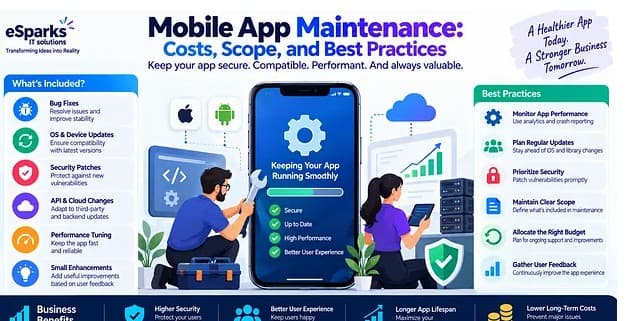
Mobile App Maintenance: Costs, Scope, and Best Practices
A practical guide to mobile app maintenance, including scope, costs, timelines, risks, and how to choose the right support model.
Sep 24, 2026Read
Mobile Development
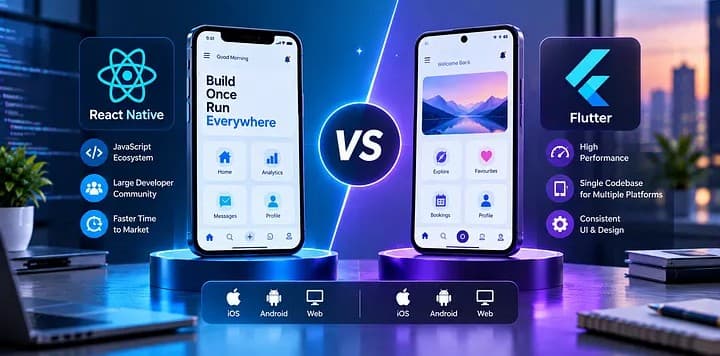
React Native vs Flutter: How Business Leaders Should Choose
React Native vs Flutter explained for CTOs and founders: compare cost, speed, performance, hiring, and long-term fit.
Sep 23, 2026Read
Work with us
Have a system to build, fix or scale?
Tell us what you are working on and where it hurts. We will tell you how we would approach it.