
AI & Machine Learning
AI Automation Practical Applications Business Impact Explained
Learn ai automation practical applications business impact, where it works, what it costs, and how leaders can choose the right use cases.

Tauseef Alam
Chief Technology Officer
Aug 11, 2026
10 min read
AI automation practical applications business impact comes down to one simple reality: AI creates measurable value when it automates a specific business process with clear inputs, clear decisions, and clear owners. In practice, the strongest use cases are not flashy demos but operational workflows such as support triage, document processing, forecasting support, software delivery, and security monitoring where AI improves speed, consistency, and team capacity without removing human oversight.
Key takeaways
- The most valuable AI automation initiatives usually start with repetitive, rules-informed work that has enough volume, clean data, and a clear owner.
- AI should be paired with workflow design, integrations, access controls, and human review rather than treated as a standalone model deployment.
- For most businesses, the fastest path to impact is automating one bounded process end to end before expanding to adjacent functions.
- A realistic AI automation evaluation includes system fit, data quality, exception handling, governance, and the cost of ongoing monitoring after launch.
- Success in AI automation is measured by cycle time, error reduction, throughput, compliance consistency, and team capacity, not by novelty alone.
Where AI automation creates value first
Business leaders often ask where AI belongs first: front office, back office, engineering, or operations. In our experience, the answer is usually wherever work is both repetitive and decision-heavy enough to benefit from pattern recognition. Good candidates include invoice handling, lead qualification, internal knowledge search, support categorization, procurement reviews, compliance document checks, test case generation, and incident summarization.
The common thread is not industry hype; it is workflow structure. A useful AI automation target usually has most of these traits:
- High task volume or recurring workload
- Inputs that are digital or can be digitized
- A process owner who can define success
- Historical examples to learn from or benchmark against
- Limited downside if the first version needs human approval
- Existing systems that can be integrated through APIs, webhooks, queues, or RPA
For decision-makers, this matters because AI rarely delivers value as a standalone chatbot floating outside the core business. It delivers value when embedded into a process. A support team may use large language models to draft responses, but the business impact appears only when the model is connected to CRM data, ticketing rules, knowledge articles, permissions, and escalation paths. The same is true in finance, HR, logistics, and software delivery.
AI automation practical applications business impact in real operations
The phrase ai automation practical applications business impact sounds broad, but on the ground it maps to a manageable set of business patterns. Most successful projects fit one or more of these categories: classify, extract, summarize, predict, recommend, generate, or monitor. Once you understand those patterns, evaluating use cases becomes much easier.
Here are concrete examples by function:
- Customer operations: classify incoming tickets, route by intent and priority, draft replies from approved knowledge, summarize multi-thread conversations, detect churn signals, and surface next-best actions in a CRM.
- Finance and admin: extract invoice fields with OCR plus document AI, validate against purchase orders, flag anomalies, summarize expense notes, and automate approval routing.
- Engineering and IT: generate test cases, summarize pull requests, label incidents, detect infrastructure anomalies, enrich alerts, and automate runbook steps through orchestration.
- Sales and marketing: score leads using behavioral signals, summarize discovery calls, extract action items, personalize outreach within guardrails, and analyze campaign feedback themes.
- HR and internal ops: answer policy questions from approved knowledge bases, parse CVs into structured data, schedule interviews, and summarize employee helpdesk requests.
- Security and compliance: correlate alerts, classify risk, summarize investigations, review access requests, and flag policy exceptions for analyst review.
The key is choosing the right technical approach for each pattern. Document processing may need OCR, layout-aware extraction, validation rules, and human review. Knowledge assistants often need retrieval-augmented generation using embeddings, vector search, and source citation. Predictive use cases may be better served by gradient boosting, time-series forecasting, or simpler statistical models than by a generative AI stack. Good architecture follows the process, not the trend.
The technical building blocks leaders should understand
You do not need to be hands-on with model training to evaluate an AI automation program, but you do need a working view of the stack. Most production systems combine several layers: data ingestion, preprocessing, model inference, workflow orchestration, integration with existing systems, observability, and governance. Weakness in any layer can erase business value even if the model itself performs well.
A practical stack often includes tools such as Python or TypeScript services, APIs, event queues like RabbitMQ or Kafka, workflow engines, cloud services on AWS, Azure, or Google Cloud, and CI/CD pipelines for safe rollout. For AI capabilities, teams may use hosted LLM APIs, open-source models, vector databases, OCR engines, and classic ML libraries. Security controls matter just as much: SSO, RBAC, encryption at rest and in transit, audit logs, secrets management, network segmentation, and data retention policies.
For enterprise buyers, these are the architectural questions worth asking:
- Does the solution integrate with our ERP, CRM, ITSM, document store, or code repositories through stable APIs?
- Can it run in our preferred cloud, region, or hybrid environment?
- What happens when the model is uncertain, wrong, or times out?
- Is there a human-in-the-loop checkpoint for high-risk decisions?
- Are prompts, outputs, and source data logged in a compliant way?
- Can the workflow be tested, versioned, and rolled back like any other software change?
When we built GitHub Timesheet, one lesson was especially clear: the product value did not come from code generation or AI novelty, but from fitting software around the way teams actually track engineering activity and approvals. That same principle applies to AI automation. Workflow design and integration discipline usually matter more than the sophistication of the model alone.
A step-by-step framework to choose the right use case
A lot of AI spending goes wrong at the selection stage. Teams start with a technology they want to use and search for a problem to attach it to. A better approach is to score processes against business fit, technical feasibility, risk, and adoption readiness.
A practical decision framework looks like this:
- Map candidate workflows. List processes with repetitive work, delays, error-prone handoffs, or overloaded teams. Focus on areas where cycle time and consistency matter.
- Define the unit of work. Be precise: one invoice, one support ticket, one access request, one code review summary, one compliance document. Vague automation goals usually stall.
- Check data readiness. Identify source systems, field quality, file formats, historical examples, and access constraints. If the data is fragmented or unreliable, account for cleanup first.
- Separate rules from judgment. Decide which steps are deterministic and which need model-based classification, extraction, or generation. This prevents overusing AI where standard automation is enough.
- Assess risk and exception rates. The best early use cases have tolerable failure modes and clear paths for human review. High-stakes approvals, legal decisions, or medical interpretation require stricter controls.
- Estimate value in operational terms. Use cycle time, backlog reduction, analyst capacity, consistency, and rework avoidance rather than inflated headline claims.
- Prototype narrowly. Start with one process, one department, one source system, and one measurable outcome. Prove end-to-end execution before scaling.
This framework helps leaders avoid a common trap: selecting a use case because the demo looks impressive. A polished demo says little about messy reality such as poor source documents, identity permissions, duplicate records, and unexpected exceptions. Production value appears only when the workflow survives those realities.
Cost, timeline, and team expectations
Executives understandably want a realistic answer to two questions: what will this cost, and how long will it take? The honest answer is that AI automation costs vary less by model choice and more by scope, integration depth, governance needs, and how messy the existing process is. A narrow internal assistant or summarization workflow can often be piloted in a few weeks. A cross-functional automation involving document pipelines, approvals, ERP integration, and audit requirements may take a few months to design, validate, and harden.
Typical cost drivers include:
- Discovery and process mapping
- Data preparation and access setup
- API and system integrations
- UX for approvals and exception handling
- Security and compliance controls
- Monitoring, retraining, prompt tuning, and support after launch
For many organizations, a sensible path is a staged investment model. Stage one is discovery and prototype validation. Stage two is a pilot in one business unit with defined guardrails. Stage three is production hardening with observability, incident response, role-based access, and cost monitoring. This staged approach reduces risk because it exposes integration issues and process exceptions early, before the organization commits to a broad rollout.
Team expectations also need calibration. AI automation rarely means replacing an entire function. More often it changes role composition: less manual triage, more exception handling; fewer repetitive checks, more policy review; less copy-paste work, more decision support. That shift is where business impact becomes durable, but only if training, ownership, and support models are defined upfront.
Common pitfalls and how to avoid them
The most expensive AI mistakes are usually not model mistakes. They are operational mistakes. Leaders underestimate process ambiguity, overestimate data quality, or deploy AI into workflows with no clear owner. The result is a system that works in demos but causes friction in day-to-day operations.
Here are the pitfalls we see most often:
- Automating a broken process. If approvals are unclear or source data is inconsistent, AI can accelerate confusion rather than remove it.
- Choosing generative AI where rules would work better. Deterministic logic is often safer and cheaper for fixed validation, routing, or threshold checks.
- Ignoring exception handling. Every workflow needs a path for low-confidence outputs, duplicates, ambiguous documents, and policy conflicts.
- Skipping governance. Without audit trails, retention policies, redaction rules, and access controls, even a useful automation may not be deployable.
- Measuring the wrong thing. Token usage or model accuracy alone does not reveal business impact. Process-level outcomes matter more.
- Underinvesting in change management. If users do not trust the outputs or understand when to override them, adoption stays low.
Avoidance is straightforward but disciplined. Start with process mapping. Put confidence thresholds and review queues in place. Track source-grounded outputs where possible. Use evaluation datasets based on real examples, not idealized samples. Instrument the workflow with logs, alerts, and fallback behavior. Most importantly, assign a business owner who is accountable after launch, not just during procurement.
How to measure impact and scale responsibly
Once a pilot is live, the next challenge is deciding whether to expand it. This is where many teams either scale too fast or stall forever. The right approach is to evaluate both business outcomes and operational reliability. A useful AI workflow should not only produce acceptable outputs; it should fit support processes, security reviews, release management, and user habits.
Measure impact through a balanced scorecard:
- Operational efficiency: cycle time, queue depth, throughput, handoff reduction
- Quality: rework rate, exception rate, policy adherence, output consistency
- User adoption: acceptance rate, override rate, time saved per task, satisfaction from internal users
- Technical reliability: latency, failure rate, integration stability, alert volume, rollback readiness
- Governance: audit completeness, access review outcomes, retention compliance, source traceability
Scaling should also follow a pattern. Expand from one stable workflow to adjacent use cases that share data sources, controls, and process owners. For example, if you have already automated support ticket classification and summarization, the next logical step may be knowledge retrieval and response drafting within the same service environment. That is usually lower risk than jumping immediately into a completely different domain such as finance approvals or security investigations.
This is where a capable software and IT partner adds value: not by promising magic, but by helping the organization build repeatable delivery habits. At eSparks, we have found that the teams seeing the best long-term results treat AI automation as an engineering and operations discipline. They combine product thinking, integration design, cloud architecture, DevOps, data governance, and security from the start, so the business impact is practical, durable, and easier to extend.
Frequently Asked Questions
What is the difference between AI automation and traditional automation?
Traditional automation follows fixed rules and works best when inputs and decisions are predictable. AI automation adds capabilities such as classification, extraction, summarization, prediction, and natural language interaction, which helps when the work involves unstructured data or judgment-like pattern recognition.
Which business processes are usually the best first candidates for AI automation?
The best first candidates are high-volume, repetitive workflows with digital inputs, measurable outcomes, and manageable risk. Common examples include support triage, document processing, knowledge search, meeting or ticket summarization, anomaly flagging, and software delivery assistance.
How long does it typically take to implement an AI automation solution?
A narrow pilot can often be designed and validated in a few weeks, especially if the data is accessible and the workflow is contained. Broader implementations with multiple integrations, governance requirements, and exception handling usually take longer because production reliability matters more than a quick demo.
How should leaders measure business impact from AI automation?
Leaders should measure process-level outcomes such as cycle time, backlog reduction, consistency, rework, exception rates, and team capacity. Model quality matters, but the business impact is determined by how well the automation improves an end-to-end workflow in real operating conditions.
Work with eSparks IT Solutions
Planning a project around this? We help businesses across the USA, UK, Canada, Australia and the GCC ship it. See a related project: GitHub Timesheet. Explore our AI & Machine Learning services and portfolio, estimate your project cost, or book a free call.
Related AI services & solutions

Tauseef Alam
Chief Technology Officer
Passionate technology writer and industry expert with years of experience in software development, cloud computing, and digital transformation. Dedicated to sharing insights and helping developers stay ahead of the curve.
Related Topics
Continue Reading
More insights in AI & Machine Learning
AI & Machine Learning
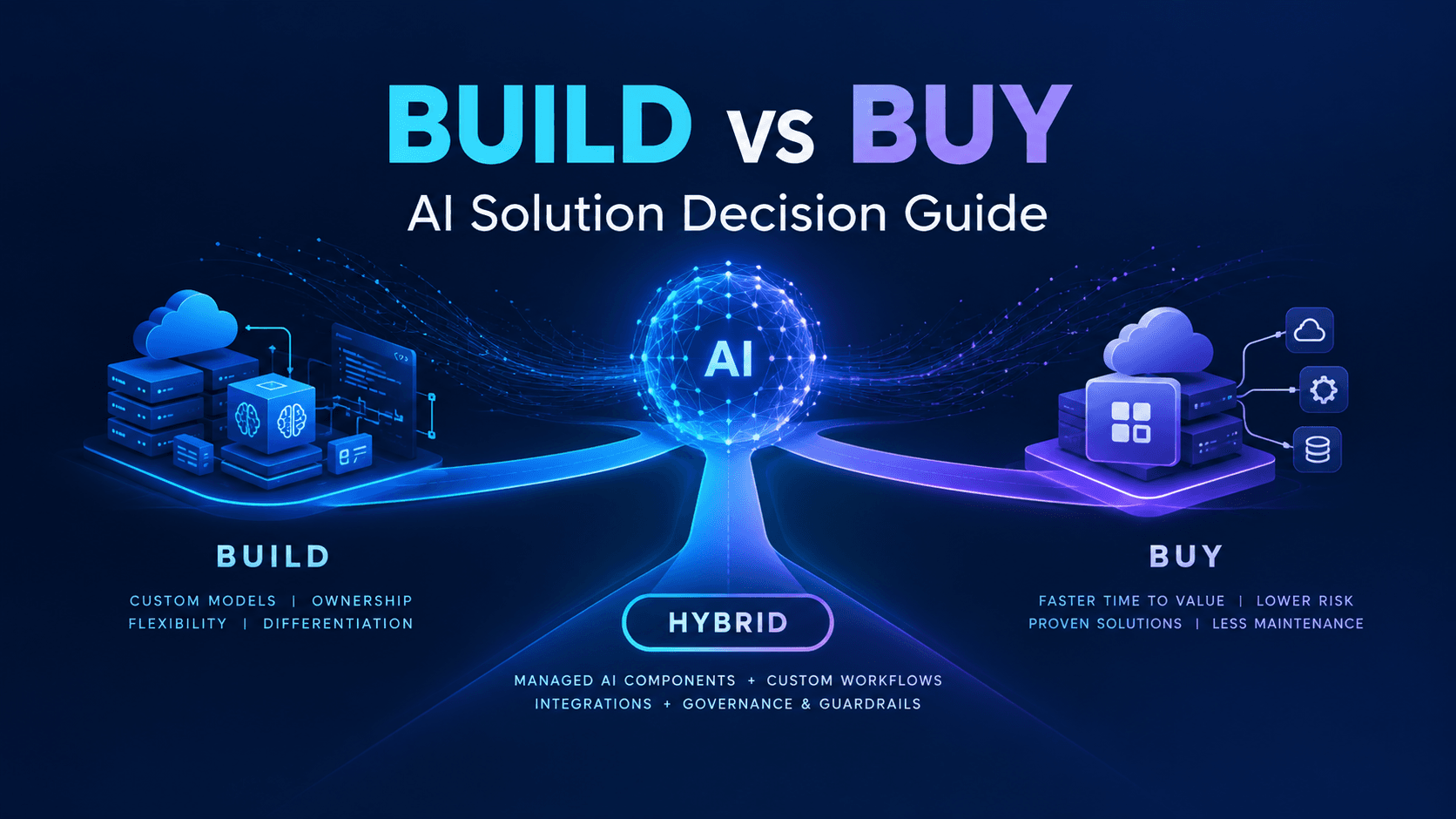
Build vs Buy AI Solution: A Practical Decision Guide
How to decide build vs buy ai solution for your business: costs, timelines, risks, architecture, and a practical framework for leaders.
Sep 10, 2026
Read More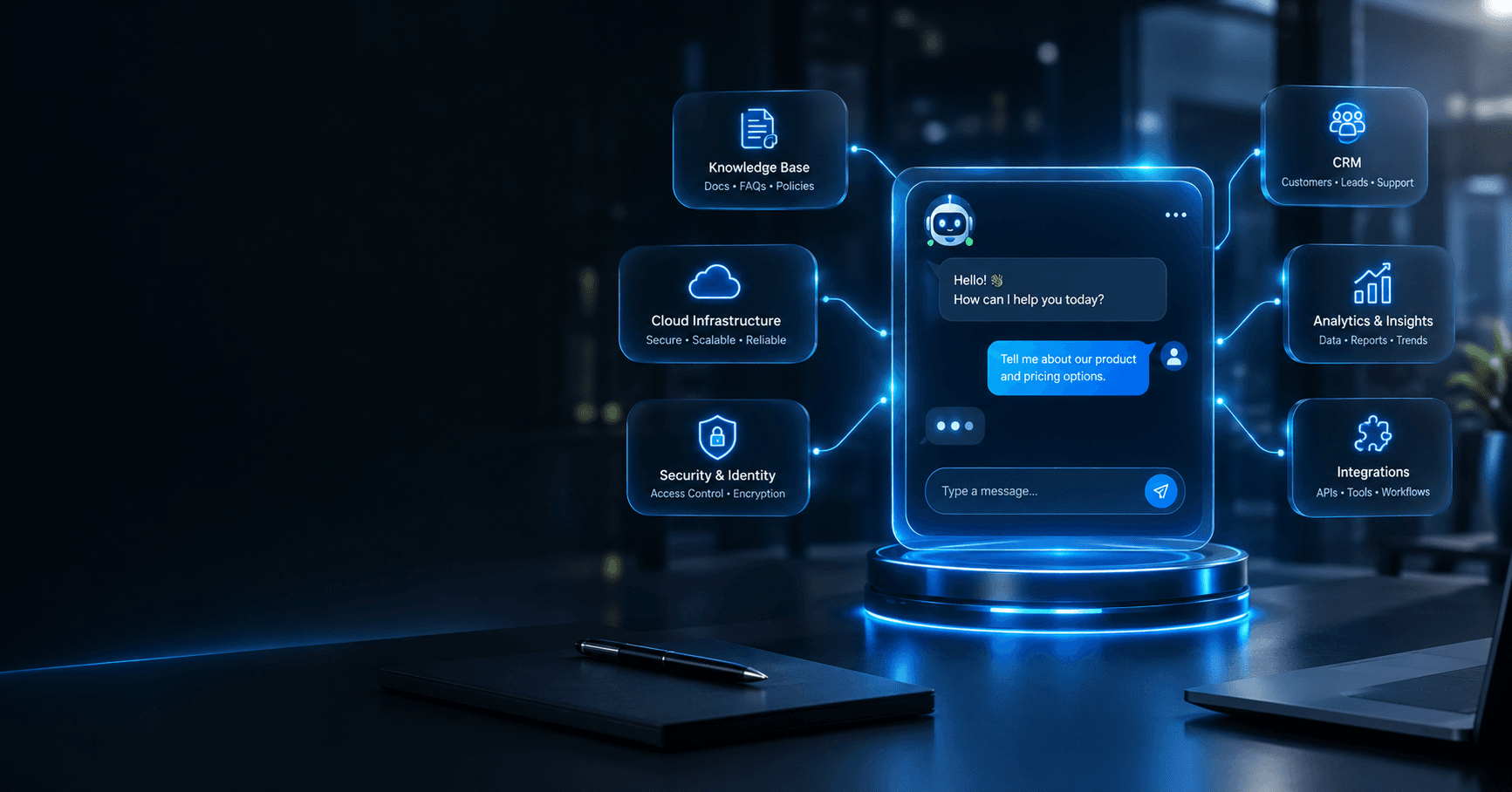
AI & Machine Learning
Custom AI Chatbot Development: A Practical Guide
A buyer’s guide to custom ai chatbot development: use cases, architecture, costs, timelines, risks, and vendor selection.
Sep 9, 2026
Read More
AI & Machine Learning
Practical AI Automation Use Cases Internal Operations
Explore practical ai automation use cases internal operations teams can deploy first, with architecture, costs, governance, and rollout advice.
Aug 30, 2026
Read MoreReady to Transform Your Business?
Let's discuss how our expertise can help you achieve your goals