Back to Portfolio
Developer Tools
● Live in productionGitHub Timesheet
Team time tracking that lives in GitHub issues
Visit Live SiteNo database · no login
Styled Excel export
Installable PWA
Overview
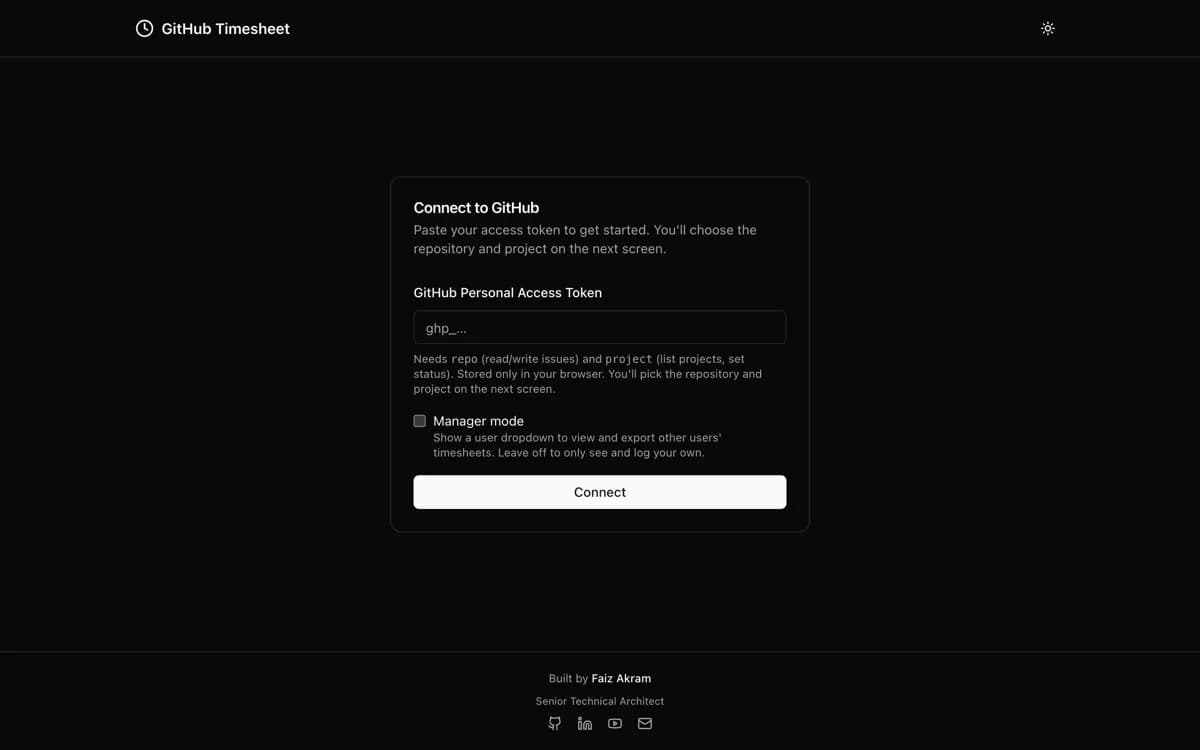
GitHub Timesheet is a developer tool that brings team time tracking directly into GitHub issues. Built with Next.js 15, React 18, TypeScript, the GitHub GraphQL API, Radix UI, Tailwind, and as an installable PWA, it is designed as a zero-database solution where GitHub issues serve as the source of truth. The product supports a monthly calendar, Jira-style durations, multi-user views, and a team dashboard for utilization, capacity, forecast, and date ranges. It also suggests time entries from GitHub commits and PRs, includes approval and reopen-request workflow support, tracks holidays and leave/PTO, and provides styled Excel export. The result is a fast, no-database, no-login workflow for teams already living in GitHub.
Key Capabilities
What we designed, built and shipped
Zero-database — GitHub issues are the source of truth
Monthly calendar, Jira-style durations & multi-user views
Team dashboard: utilization, capacity, forecast & date ranges
Suggests time entries from your GitHub commits & PRs
Approval + reopen-request workflow; holidays & leave/PTO
Technology Stack
Cutting-edge technologies powering the solution
Next.js 15
React 18
TypeScript
GitHub GraphQL API
Radix UI
Tailwind
PWA
Ready to Start Your Project?
Let's discuss how we can help you achieve similar results for your business
More Success Stories
Explore our other developer tools projects
DevOps & Infrastructure
ThinClient OS + Fleet Manager
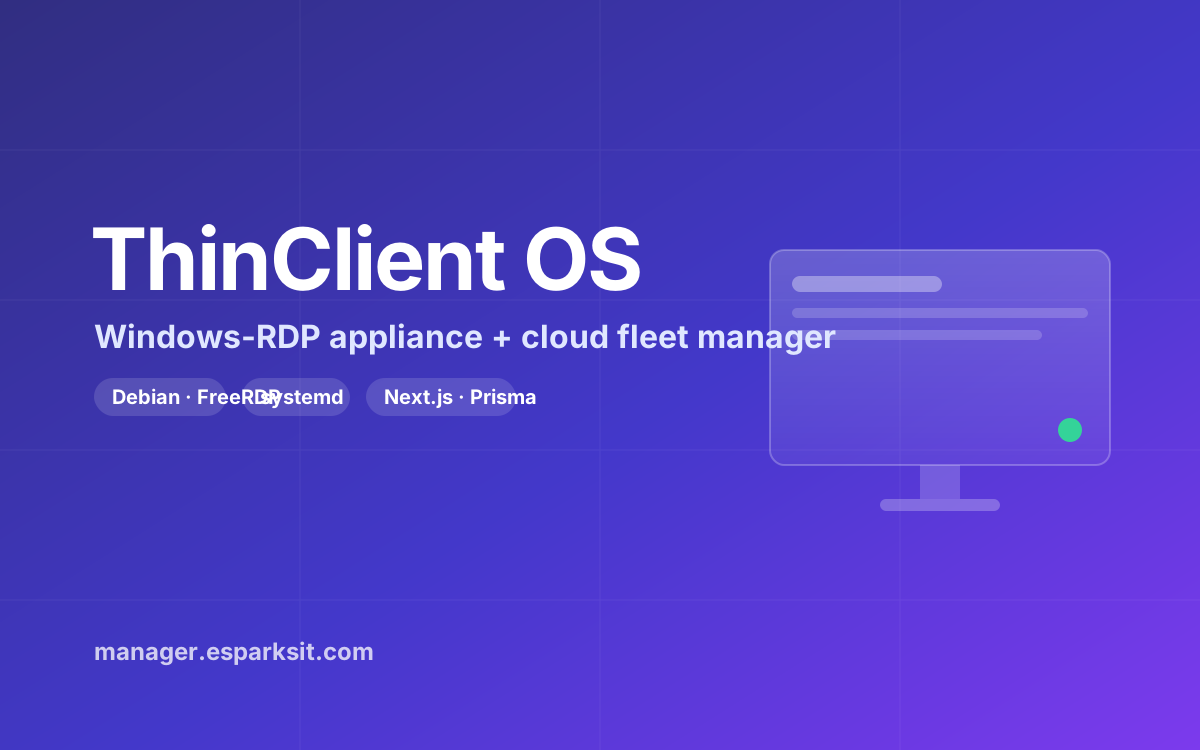
A production-grade Linux appliance that boots straight into a full-screen Windows RDP session — no desktop, no shell, no login prompt — backed by a self-healing watchdog and an infinite reconnect loop. On machines with Secure Boot and a TPM 2.0 chip the whole disk is encrypted (LUKS2, AES-256) with the key sealed in the machine's own TPM, and the encrypted install has been attack-tested against disk theft and boot tampering. Lost or stolen machines are wiped remotely, crypto-erasing the disk on encrypted installs. Optional per-account policy adds lock-screen password rules with a three-strike lockout, Windows-server certificate pinning, USB-storage and clipboard blocking, and memory hardening. New machines can be required to wait for administrator approval (on by default for new accounts), operating-system security patches can roll out through canary machines, and signed kernel updates roll back on their own if they fail to start. It ships as a reproducible ISO with a graphical installer and pairs with a Next.js fleet manager that provisions, monitors, secures and remotely controls the machines and the AWS, Azure and VPS Windows servers they connect to.
Read Full Case Study
Data Platform
Database Migration Platform
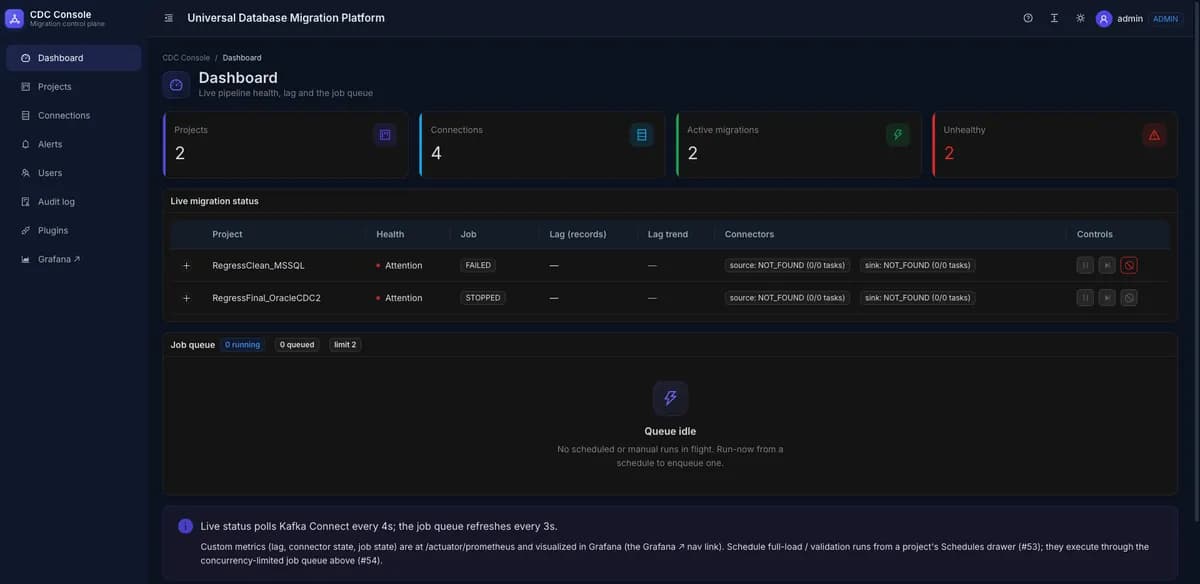
eSparks IT Solutions built a browser-operated data platform for planning, running, monitoring, and validating real-time migrations between heterogeneous databases. Five relational engines (SQL Server, PostgreSQL, MySQL, Oracle, Db2) migrate in either direction; MongoDB is supported as a CDC source. Its Java 21 and Spring Boot 3 control plane orchestrates jobs, while a React interface supports operation through the browser. For real-time CDC, the data plane uses Debezium, Kafka, and a JDBC sink, with PostgreSQL in the stack and deployment via Docker Compose or Kubernetes (Strimzi). The platform includes end-to-end integrity validation with drift detection, custom Java SMTs, AES-GCM secret encryption, Prometheus/Grafana, and JWT/RBAC security. SQL Server, PostgreSQL, MySQL and MongoDB migrations are live-verified end-to-end — including a production programme that moved roughly 960 million rows across 405 tables from SQL Server to PostgreSQL with zero rows missing at validation; Oracle and Db2 connectors are implemented and tested at the unit/config level, pending live verification.
Read Full Case Study
AI Platform
CallIntell — AI Call Synopsis & Quality
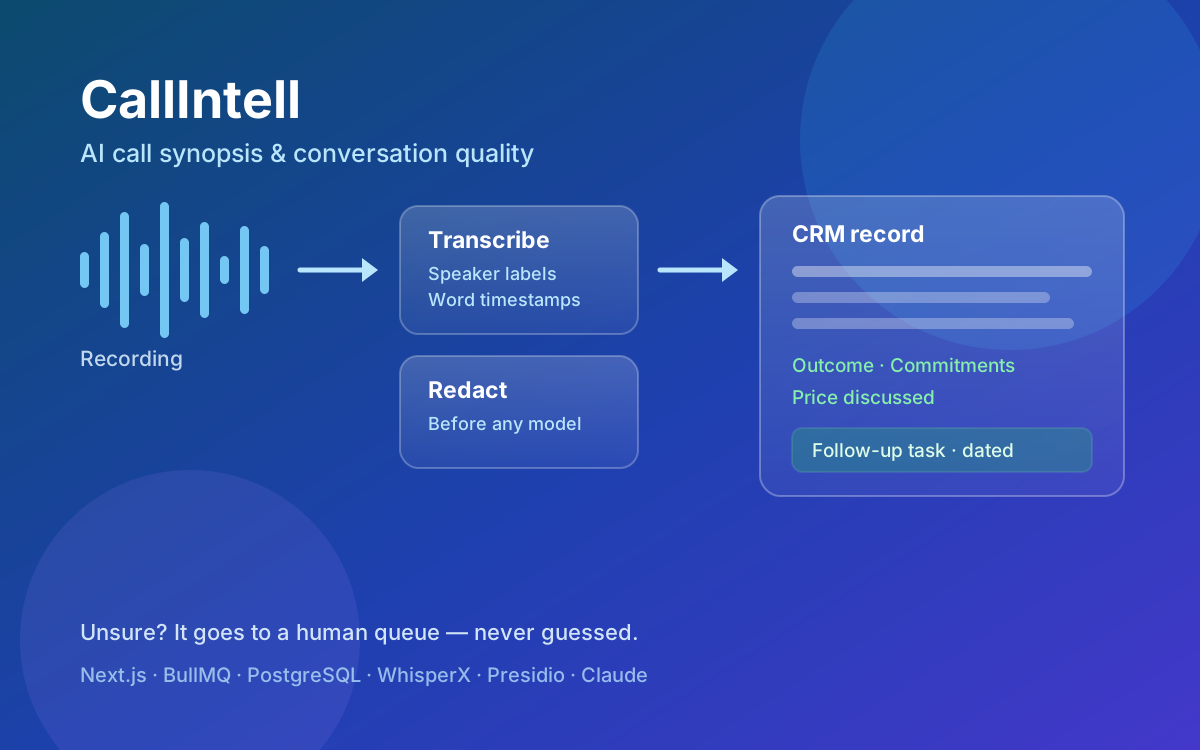
CallIntell turns recorded phone calls into reviewed, structured CRM records without anyone listening to the call. A six-stage queue-backed pipeline fetches the recording, transcribes it with speaker labels and word-level timestamps on serverless GPU, strips personal identifiers before any text reaches a language model, matches the call to its CRM record, and generates a schema-validated synopsis — outcome, commitments, objections, price discussed — with every point linked to the second of audio it came from. Spoken follow-up phrases such as “call me in ten days” are resolved into dated CRM tasks in the customer's own time zone, with the verbatim wording kept alongside. Anything the system is not confident about routes to a human review queue rather than being guessed, and CRM writes are idempotent so a retry cannot duplicate a note or a task. Built on Next.js, BullMQ on Redis, PostgreSQL with Drizzle, WhisperX with diarization, Microsoft Presidio redaction and Claude, with passkey and TOTP sign-in, an append-only audit log, per-company isolation and usage metering. Deployed and running the first customer workflow; not yet opened as a public product.
Read Full Case Study