AI & Machine Learning
Build vs Buy AI Solution: A Practical Decision Guide
How to decide build vs buy ai solution for your business: costs, timelines, risks, architecture, and a practical framework for leaders.

Tauseef Alam
Chief Technology Officer
- Published
- Sep 10, 2026
- Reading time
- 10 min read
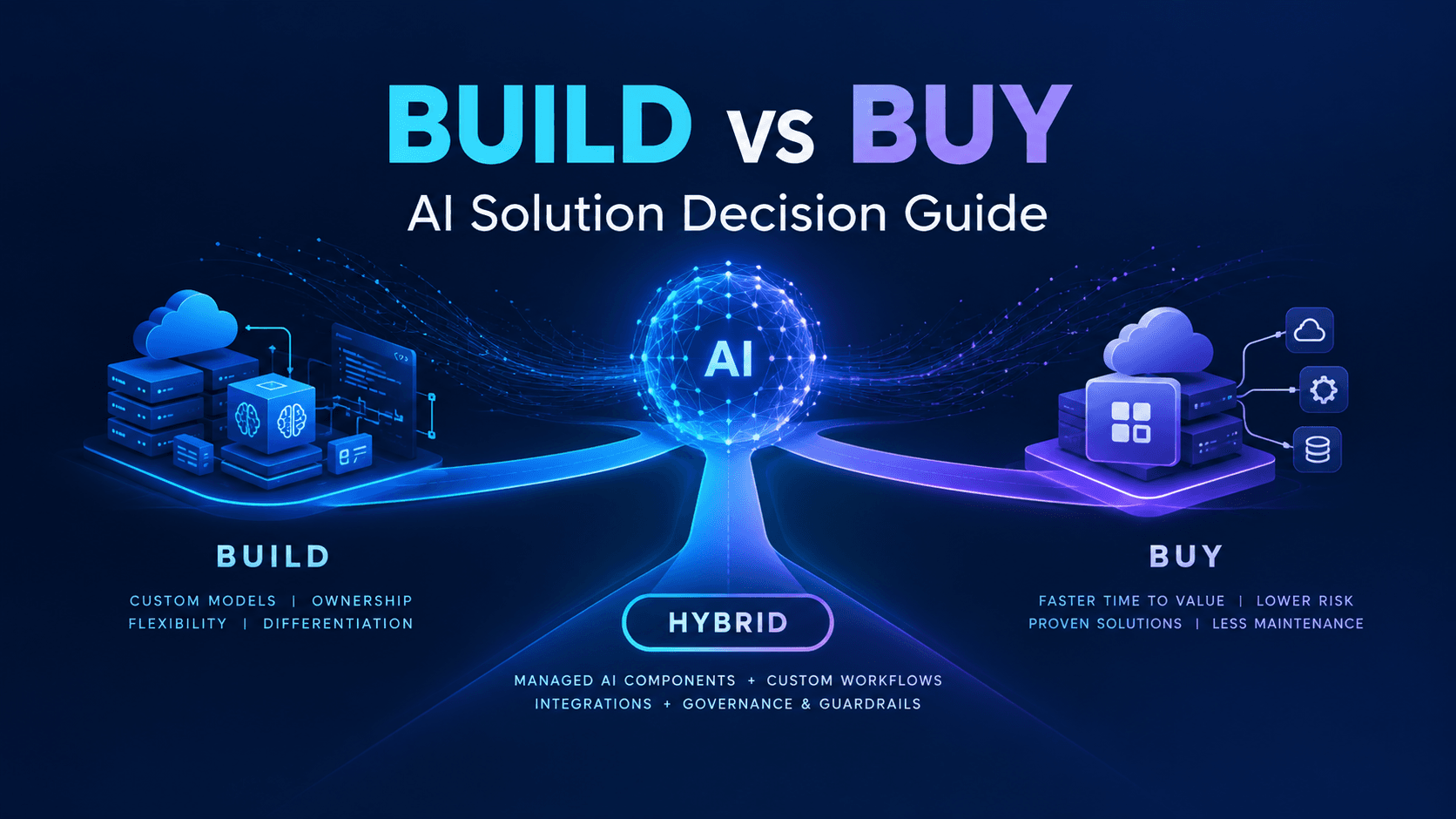
If you are deciding whether to build vs buy ai solution, the short answer is this: buy when the capability is common and speed matters; build when the workflow, data, or compliance needs are strategic and hard to fit into a generic product. In practice, many companies get the best outcome with a hybrid model: purchase proven AI components, then build the integration, governance, and user experience that make them work in the real business.
Key takeaways
- The right build vs buy AI solution decision depends less on hype and more on whether your advantage comes from unique data, workflow complexity, and compliance requirements.
- Buying is usually faster for common capabilities such as chatbots, document search, transcription, and standard forecasting, especially when time-to-value matters.
- Building is usually justified when the model behavior, integrations, governance, or data pipeline must match business processes that off-the-shelf tools cannot support well.
- A hybrid approach often delivers the best balance: buy foundational components or models, then build orchestration, guardrails, integrations, and domain-specific workflows around them.
- AI project costs are driven as much by data quality, security, observability, and change management as by model selection or coding effort.
Start with business value, not model choice
Leaders often begin with tools, vendors, or model names, but the better starting point is the business problem. Ask what decision, process, or customer interaction needs improvement, and what “good” looks like in operational terms: faster response times, lower manual effort, better risk review, fewer support escalations, stronger knowledge access, or more consistent outputs. If the use case is not tied to a measurable workflow, the build-versus-buy debate becomes abstract and usually wasteful.
In our experience, the most successful AI decisions are framed around one of four patterns: automation, augmentation, prediction, or insight. Automation means removing repetitive work such as document classification or ticket routing. Augmentation means helping people work faster, such as a support copilot or developer assistant. Prediction covers things like churn scoring, anomaly detection, or demand forecasting. Insight includes semantic search, summarization, and natural-language analytics across internal data.
For each pattern, define the minimum viable outcome before discussing architecture. Useful scoping questions include:
- What user action should change if the AI works well?
- What data sources are required: CRM, ERP, emails, PDFs, logs, data warehouse, knowledge base?
- What level of accuracy or reliability is acceptable for this workflow?
- Is a human required in the loop before action is taken?
- What happens if the model is wrong, delayed, or unavailable?
Those answers quickly reveal whether a prebuilt product is sufficient or whether you need custom engineering around your specific operating model.
Build vs buy AI solution: when buying is the smarter move
Buying is usually the better option when the capability is mature, broadly available, and not a source of competitive differentiation. Common examples include AI meeting notes, generic chatbots, document OCR, call transcription, translation, standard recommendation features, helpdesk summarization, and knowledge search over a fairly clean content repository. For these cases, you are mainly evaluating product fit, integration quality, security posture, and pricing rather than inventing new AI methods.
The biggest advantage of buying is speed. A SaaS or managed platform can often be piloted in weeks rather than months, especially if the vendor already supports your identity provider, collaboration stack, and data connectors. This matters for business teams that need to prove value quickly or where the opportunity cost of waiting is high. Buying can also reduce operational burden: vendor-managed scaling, model updates, uptime, basic monitoring, and routine security controls may come included.
Buying tends to work well when most of the following are true:
- The use case is common across industries.
- Your inputs and outputs are fairly standardized.
- Limited customization is acceptable.
- You need fast deployment and lower upfront investment.
- Data can stay within approved vendor boundaries.
- Vendor lock-in risk is acceptable or manageable.
That said, buying is not the same as “set and forget.” You still need due diligence. Review API limits, data retention settings, prompt and content filtering behavior, audit logs, role-based access control, single sign-on, regional hosting options, and support for standards such as SOC 2, ISO 27001, GDPR-aligned controls, HIPAA-oriented safeguards where relevant, and encryption in transit and at rest. Many disappointing AI rollouts happen not because the model is weak, but because procurement ignored integration depth, governance, or downstream workflow fit.
When building is the better strategic choice
Building makes sense when the real value lies in a unique process, proprietary data, or a workflow that off-the-shelf products cannot model well. This is common in industries with specialized terminology, complex approvals, strict governance, multi-system orchestration, or high consequences for errors. Think claims triage, underwriting support, clinical documentation workflows, contract risk review, industrial anomaly detection, or enterprise copilots that must reason over internal systems with fine-grained permissions.
Custom development is also the right path when AI must be deeply embedded in a broader platform rather than used as a standalone tool. For example, a field service app may need a vision model to detect equipment issues, a rules engine to enforce service protocols, a mobile workflow for technicians, and an audit trail for supervisors. That is not just “an AI feature”; it is a product capability spanning models, apps, APIs, identity, observability, and operations.
Building is usually justified when several of these apply:
- Your competitive edge comes from proprietary data or domain logic.
- You need custom retrieval, prompt orchestration, or agent flows.
- Vendor products cannot meet your access controls or deployment constraints.
- Outputs must be tightly governed, explained, or reviewed.
- You need to integrate AI with internal systems, approvals, or event-driven workflows.
- Long-term unit economics favor owning more of the stack.
Technically, building may involve retrieval-augmented generation using a vector store such as Pinecone, Weaviate, OpenSearch, Azure AI Search, or pgvector on PostgreSQL; orchestration frameworks such as LangChain or LlamaIndex; APIs through Python FastAPI, Node.js, or .NET; and deployment on AWS, Azure, or Google Cloud with CI/CD and infrastructure-as-code using Terraform. For predictive use cases, the stack may include feature pipelines, batch and streaming data, MLflow, dbt, Airflow, Kafka, and model monitoring for drift. The important point is not the tool list; it is that custom AI becomes a software engineering and operations commitment, not just a model experiment.
The hidden cost drivers executives often miss
The headline price of an AI subscription or a model API rarely reflects the true cost. Whether you build or buy, the largest effort often sits outside the model itself: preparing data, connecting systems, defining guardrails, testing edge cases, and redesigning workflows so people actually use the output. A cheap product can become expensive if it needs heavy manual cleanup. A custom build can become inefficient if you underestimate governance and support.
Typical bought solutions may involve lower upfront costs but recurring license, usage, and integration fees. Depending on the tool and seat count, pilot costs may start small, then expand materially once more teams, data connectors, and premium features are enabled. Custom builds usually require a higher initial investment across discovery, architecture, engineering, MLOps, security review, and user acceptance testing. A focused internal copilot or AI workflow can take roughly 8 to 16 weeks for an initial production version; broader multi-system platforms often take several months. These are broad industry-typical estimates, not guarantees.
Common cost drivers to model early include:
- Data preparation: labeling, deduplication, access cleanup, taxonomy design, chunking strategy for RAG, and content freshness.
- Integration work: CRM, ERP, document management, ticketing, identity, messaging, and analytics systems.
- Usage economics: token consumption, embeddings, inference frequency, storage, vector search, and image or speech processing.
- Security and compliance: DLP controls, redaction, audit logging, retention policies, private networking, and legal review.
- Reliability engineering: fallbacks, prompt/version management, evaluation pipelines, human review queues, and observability.
- Change management: training, process updates, adoption support, and metrics to prove business impact.
One practical way to compare options is to model total cost of ownership over 12 to 24 months, not just launch cost. Include vendor fees, cloud spend, engineering maintenance, support incidents, and the cost of process failure if outputs are wrong or ignored.
A practical decision framework for leaders
A workable decision framework should be simple enough for business stakeholders yet concrete enough for engineering and security teams. We recommend scoring each use case across strategic value, time-to-value, data sensitivity, workflow complexity, and operating risk. This turns a subjective debate into a portfolio decision.
Use this step-by-step approach:
- Define the use case in one sentence. Example: “Help account managers draft accurate renewal summaries from CRM notes, tickets, and emails.”
- Identify the source of advantage. Is success driven by proprietary data, unique process knowledge, or merely access to a capable model?
- Map the workflow. Note systems involved, approval steps, exception handling, and whether humans review outputs.
- Classify risk. Separate low-risk internal assistance from medium- or high-risk decisions affecting revenue, compliance, safety, or customer rights.
- Test market fit. Review 3 to 5 vendors for coverage, APIs, security controls, extensibility, and pricing. Do not judge only on demos.
- Estimate build effort. Include discovery, design, connectors, guardrails, evaluation, deployment, and support.
- Decide architecture. Choose buy, build, or hybrid based on the previous six steps.
A simple interpretation helps. If the use case is low risk, common, and needed quickly, buy first. If the use case is high value but depends on proprietary data and complicated business logic, build or use a hybrid design. If the use case sits in the middle, start with a pilot on a purchased foundation model or AI service, then add custom layers only where the business case proves out.
This is also where an experienced software and IT partner can add real value. At eSparks, we often see companies save time by validating architecture and governance before committing to either a vendor contract or a custom roadmap. The right decision is less about AI ideology and more about disciplined product thinking.
Architecture choices that reduce regret later
Many organizations frame build versus buy as a binary choice, but the most resilient architecture is often modular. You might buy the model endpoint, speech service, OCR engine, or vector database as managed services, while building the workflow layer, business rules, connectors, observability, and role-specific interfaces. This avoids reinventing commodity capabilities while preserving control where it matters.
For generative AI, a strong enterprise pattern is retrieval-augmented generation with guardrails. Documents are ingested, cleaned, chunked, embedded, and indexed. At runtime, the app retrieves only the most relevant passages, applies access controls, sends grounded context to the model, and logs outputs for review. Add prompt templates, tool-use restrictions, citation requirements, confidence signals, and escalation paths to keep the system dependable. For high-sensitivity environments, private networking, regional deployment, secrets management, and provider options that do not train on your data are often non-negotiable.
A few architectural principles pay off repeatedly:
- Keep models swappable where possible; abstract providers behind a service layer.
- Separate domain data from prompts and application logic.
- Log prompts, retrieval results, user feedback, and output quality signals for evaluation.
- Build role-based access into retrieval, not just the app UI.
- Use feature flags and staged rollouts to control exposure.
- Create fallback behavior for low confidence, provider outages, or policy violations.
These choices reduce lock-in, improve governance, and make it easier to adapt as models and vendors change.
Common pitfalls and how to avoid them
The first major pitfall is choosing on novelty instead of fit. Teams get impressed by demos, then discover the tool cannot handle real documents, edge cases, multilingual content, or permission boundaries. The remedy is scenario-based testing with your own sample data, not canned vendor examples. Include messy inputs, contradictory records, and tasks that matter operationally.
The second pitfall is underestimating data readiness. Poor metadata, stale knowledge bases, duplicate records, and unclear ownership can break both bought and built AI. Before rollout, identify authoritative sources, define update schedules, remove obsolete content, and set rules for access and retention. For predictive systems, check label quality, class imbalance, and how outcomes are recorded over time.
The third pitfall is weak evaluation. AI quality cannot be judged by intuition alone. Create test sets for common tasks, edge cases, and prohibited behaviors. For generative systems, evaluate groundedness, completeness, toxicity filtering, hallucination rate, and whether the answer follows business policy. For ML prediction, monitor drift, precision-recall tradeoffs, and retraining triggers. Finally, do not neglect adoption. Even a technically strong solution fails if it interrupts workflow, lacks trust signals, or adds review effort without clear benefit.
The companies that make sound AI decisions are not necessarily those with the biggest budgets. They are the ones that define the problem clearly, understand where their advantage really lies, and choose a build, buy, or hybrid path that matches operational reality rather than AI fashion.
Frequently Asked Questions
How do I know if my company should build or buy an AI solution?
Buy when the use case is common, speed matters, and a standard product can meet your workflow and security needs. Build when the value depends on proprietary data, complex business rules, deeper integrations, or governance requirements that generic tools cannot support well.
Is a hybrid approach better than a pure build or pure buy strategy?
Often yes. A hybrid approach lets you use managed models or AI services for commodity capabilities while building the parts that create business value, such as workflow orchestration, access control, approvals, and integration with internal systems.
What are the biggest hidden costs in AI projects?
The largest hidden costs are usually data preparation, systems integration, governance, evaluation, and change management rather than model access alone. Subscription or API pricing is only one part of total cost of ownership.
How long does it typically take to launch an AI solution?
A bought AI tool can sometimes be piloted in a few weeks if the use case is straightforward and integrations are limited. A custom AI application usually takes longer because it requires architecture, data pipelines, testing, security review, and operational monitoring before production use.
Work with eSparks IT Solutions
Planning a project around this? We work with businesses in the United States, Canada and the UAE, as well as the UK and Australia. Explore our AI & Machine Learning services and portfolio, estimate your project cost, or book a free call.
Written by

Tauseef Alam
Chief Technology Officer
Chief Technology Officer at eSparks IT Solutions. Writes from the team's own delivery work across software, cloud, DevOps and security.
Related topics
Continue reading
More in AI & Machine Learning

AI & Machine Learning
AI Document Automation: A Practical Guide for Business
Learn how ai document automation works, where it fits, common pitfalls, costs, timelines, and how to evaluate the right delivery approach.
Oct 1, 2026Read

AI & Machine Learning
AI Adoption for Small Business: A Practical Guide
AI adoption for small business works best when you target one clear use case, secure your data, and roll out in measured phases with ROI checks.
Sep 28, 2026Read
AI & Machine Learning
Custom AI Chatbot Development: A Practical Guide
A buyer’s guide to custom ai chatbot development: use cases, architecture, costs, timelines, risks, and vendor selection.
Sep 9, 2026Read
Work with us
Have a system to build, fix or scale?
Tell us what you are working on and where it hurts. We will tell you how we would approach it.