Web Development
Understanding Custom Web App Cost: What You Need to Know
Understanding Custom Web App Cost: what drives pricing, realistic timelines, and how business leaders can scope a secure web app wisely.
S
Shayma Parween
Lead Developer
Jun 20, 2026
11 min read
Understanding Custom Web App Cost: What You Need to Know
Understanding Custom Web App Cost: What You Need to Know starts with one simple truth: there is no universal price for a custom web application. The cost depends on what the product must do, how many systems it must connect to, how secure and scalable it needs to be, and how much uncertainty exists in the requirements. In practice, business leaders should think in terms of scope, risk, and operating model rather than looking for a single fixed number.
Key takeaways
- Custom web app cost is driven less by page count and more by scope, integrations, security, architecture, and delivery risk.
- A small internal tool can often be built in weeks, while a complex multi-role platform with integrations and compliance typically takes months.
- The cheapest proposal is often the most expensive one if it omits discovery, testing, observability, or post-launch support.
- A clear scope, prioritized features, and the right technology choices reduce both upfront cost and long-term maintenance cost.
- Buyers should compare estimates by deliverables, assumptions, and excluded items, not just by the final number.
A straightforward internal portal may be built with a modest budget and a short timeline, while a customer-facing platform with role-based access, payments, analytics, and compliance requirements can require a much larger investment. The right estimate is the one that makes the assumptions visible and ties the price to the actual business problem, not just the screen count.
What Actually Drives the Price
The biggest cost driver is functional complexity. A login screen, a dashboard, and a few forms are relatively simple. Once you add multi-step workflows, approvals, document management, search, notifications, audit trails, or real-time updates, the amount of design, development, and testing rises quickly. Features that appear small on a roadmap often carry hidden work in edge cases and permissions.
Integrations are another major factor. Connecting to CRMs such as Salesforce or HubSpot, ERPs, payment gateways, identity providers, shipping platforms, accounting tools, or legacy databases typically requires API work, data mapping, retries, monitoring, and exception handling. If the data model is messy or the external system has poor documentation, integration can become one of the most time-consuming parts of the build.
Security, compliance, and reliability also affect cost. For many businesses in the USA, UK, Canada, Australia, UAE, Saudi Arabia, Qatar, and the Netherlands, requirements may include SSO with Okta or Azure AD, MFA, encryption at rest and in transit, role-based access control, GDPR-aware data handling, logging, and auditability. If the app handles sensitive data, expects growth, or must meet internal governance standards, the architecture and testing effort should reflect that from day one.
Scope Is the Real Budget Lever
A good budget conversation starts with what the app must do on day one, what can wait, and what is unnecessary. We often recommend separating the product into must-have, should-have, and later-phase features. That gives decision-makers a realistic baseline and prevents the budget from being consumed by nice-to-have functionality before the core workflow is proven.
For example, a field-service platform might need job dispatching, technician scheduling, mobile-friendly forms, and photo upload in the first release. Inventory forecasting, advanced analytics, and AI-assisted recommendations may be valuable, but they are rarely necessary to launch the initial version. When scope is staged this way, the first release is faster, cheaper, and easier to validate with users.
Requirements quality matters as much as the number of features. Vague requests such as “make it scalable” or “build admin analytics” can hide major implementation choices. Clear requirements should specify roles, workflows, data fields, business rules, exceptions, reports, and acceptance criteria. In our experience at eSparks IT Solutions, the best estimates come after a structured discovery process that turns business goals into testable requirements.
Typical Cost Ranges and Timeline Patterns
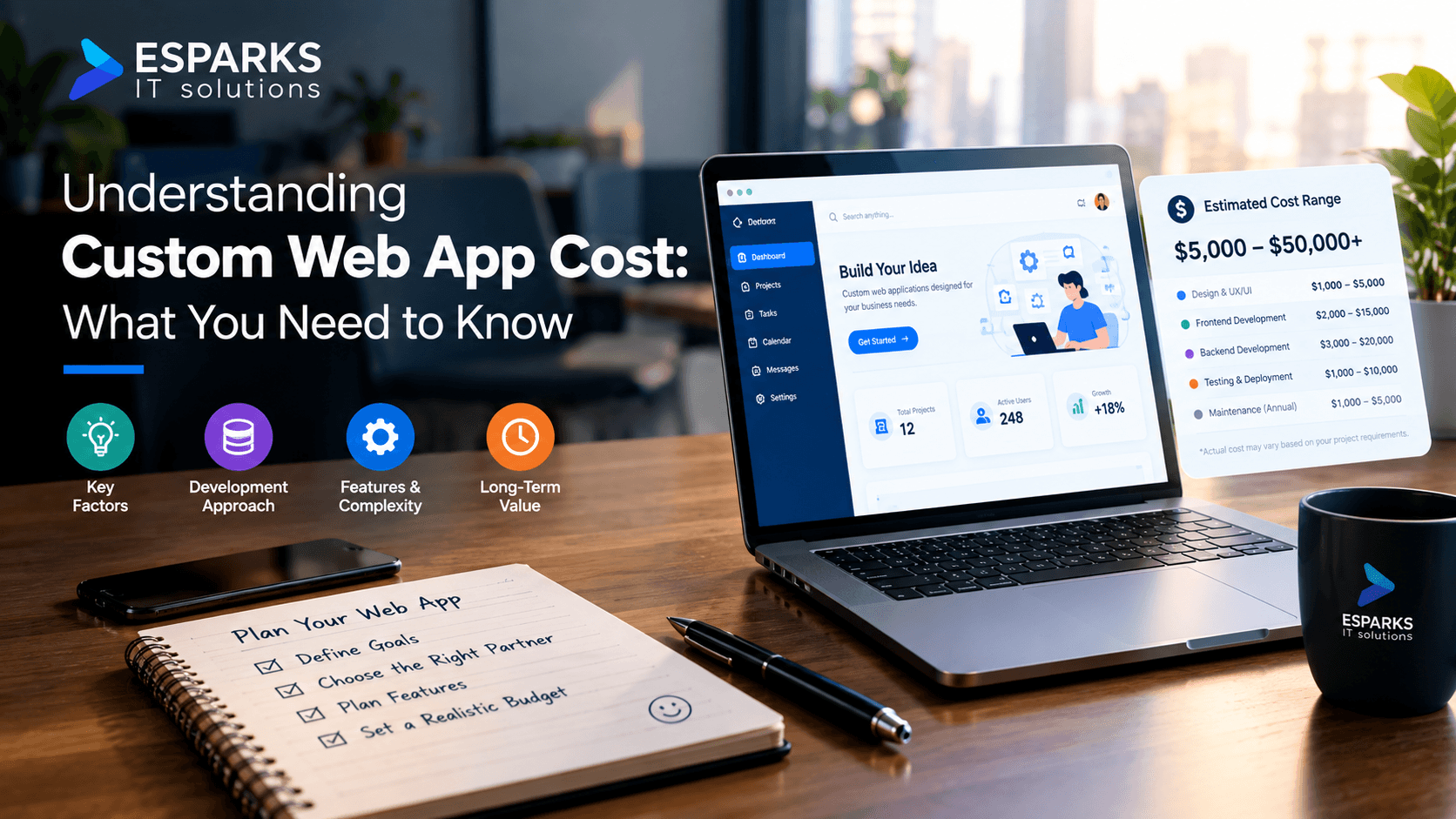
While every project is unique, there are practical ranges that help leaders plan. A simple custom web app with a limited feature set, basic auth, standard UI, and light integration can often fit into a lower budget band and take roughly 6 to 10 weeks. A mid-complexity product with multiple user roles, dashboards, workflow automation, and a few integrations commonly takes 3 to 6 months. A more complex platform with real-time features, custom APIs, compliance needs, and extensive QA can take 6 to 12 months or longer.
Costs tend to rise with the number of specialized roles involved. A lean MVP may be built by a small team consisting of a product lead, UI/UX designer, one or two engineers, and QA support. Larger applications often require backend engineers, frontend engineers, DevOps support, security review, business analysis, and sometimes data engineering or AI expertise. The more distinct disciplines involved, the more coordination and validation the project requires.
It is also useful to think about cost beyond the initial build. Hosting, cloud infrastructure, monitoring, bug fixes, feature enhancements, security patching, and support are part of the true lifecycle cost. A proposal that looks inexpensive upfront but omits operations, observability, and maintenance may cost more over the first year than a more complete estimate that anticipates the full product lifecycle.
Choosing the Right Tech Stack Without Overspending
Technology choices should fit the product, not chase trends. For many modern web apps, React or Next.js on the frontend and Node.js, .NET, Python Django, or Java Spring Boot on the backend are common choices because they are widely supported and fit many business use cases. The right stack depends on team skills, integration needs, performance requirements, and expected product lifespan.
Database selection also affects cost and maintainability. PostgreSQL is often a strong default for transactional systems because it is reliable, flexible, and well understood. MongoDB can work well for document-centric use cases, but it is not automatically cheaper or better. For caching, Redis is often used when performance matters. For search, Elasticsearch or OpenSearch may be appropriate when standard database search is not enough. The point is not to use the newest tool, but the simplest stack that meets the actual requirements.
Cloud and DevOps decisions influence long-term cost more than many buyers expect. A well-structured deployment on AWS, Azure, or Google Cloud, with CI/CD pipelines, containerization through Docker, orchestration where needed, and Infrastructure as Code using Terraform or similar tools, can reduce deployment risk and make the app easier to support. Overengineering, however, can inflate the budget. If a product is early-stage and low-traffic, a lean cloud setup may be the smarter choice than a highly complex architecture.
How to Evaluate Quotes and Avoid Budget Surprises
When comparing proposals, do not compare only the total number. Ask what is included, what is excluded, and which assumptions were used. A strong estimate should show discovery, design, development, QA, deployment, and post-launch support separately. It should also specify whether third-party licenses, cloud costs, content migration, training, and change requests are included.
A useful decision framework is to review each quote against five questions. First, does the scope clearly map to your business goal? Second, are the deliverables and acceptance criteria concrete? Third, are integrations and edge cases spelled out? Fourth, is testing covered across unit, integration, and user acceptance levels? Fifth, does the partner explain what could change the estimate and why? If those answers are vague, the number is not trustworthy.
Watch for common pitfalls. Fixed-price quotes can look safe, but if the scope is underdefined, the vendor may reduce risk by excluding critical work or charging heavily for changes. Time-and-materials models can be flexible, but only if the buyer has active product oversight. A good partner will propose a delivery model that matches the clarity of the requirements, not the model that simply looks easiest to sell.
A Practical Decision Framework for Leaders
Start by defining the business outcome. Is the app meant to reduce manual work, improve customer self-service, launch a new digital product, or consolidate fragmented systems? Once that goal is clear, identify the primary users, the core workflow, the data that must be stored, and the systems that must connect. That gives you a product boundary before you ask for pricing.
Next, prioritize the release plan. A useful structure is phase one for the smallest usable version, phase two for operational improvements, and phase three for optimization and intelligence. For example, a partner portal may launch first with onboarding, document upload, case tracking, and notifications. Later phases may add reporting, self-service analytics, and AI-supported triage. This approach lowers upfront cost while preserving the path to scale.
Finally, require the estimate to include delivery and maintenance assumptions. Good proposals explain how design will be reviewed, how releases will be tested, how security will be handled, and how support will work after launch. This matters whether you build internally or with a software partner such as eSparks IT Solutions, because the right estimate is really a plan for reducing delivery risk.
Common Mistakes That Increase Cost Later
One of the most expensive mistakes is starting development before the workflow is fully understood. Teams sometimes jump into UI design or coding with only a rough idea of the process, then discover missing roles, approvals, or exception handling halfway through. That leads to rework, delayed launch, and budget creep. Discovery is not overhead; it is often the cheapest phase of the project.
Another common issue is underinvesting in non-functional requirements. Performance, availability, audit logging, backup strategy, accessibility, and security controls are easy to postpone until they become painful. If the app is customer-facing or handles business-critical data, these are not optional extras. Standards such as WCAG for accessibility and OWASP guidance for web security are useful reference points when evaluating scope.
The third mistake is assuming that launch equals completion. A web app needs monitoring, incident response, bug fixes, and ongoing improvement. Teams that ignore post-launch support usually pay for it later in slower response times, technical debt, and dissatisfied users. Planning for maintenance early is one of the simplest ways to keep long-term cost under control.
FAQ
What is the biggest factor in custom web app cost?
The biggest factor is scope complexity, especially the number of workflows, user roles, integrations, and security requirements. A simple app with standard forms is much cheaper than a platform that must connect to several systems and enforce strict access rules.
How long does a custom web app usually take to build?
A simple app may take 6 to 10 weeks, a mid-sized product often takes 3 to 6 months, and a complex platform can take 6 to 12 months or more. The timeline depends on requirements clarity, team size, integrations, and testing depth.
Is a fixed-price quote always better?
No. Fixed price works best when requirements are well defined and unlikely to change. If the scope is still evolving, a time-and-materials or phased approach can reduce the risk of hidden exclusions and expensive change orders.
How can I reduce cost without hurting quality?
Reduce cost by narrowing the initial scope, reusing proven patterns, choosing a practical tech stack, and investing in discovery before development starts. The cheapest way to save money is usually to remove low-value features, not to skip testing or architecture.
Frequently Asked Questions
What is the biggest factor in custom web app cost?
The biggest factor is scope complexity, especially the number of workflows, user roles, integrations, and security requirements. A simple app with standard forms is much cheaper than a platform that must connect to several systems and enforce strict access rules.
How long does a custom web app usually take to build?
A simple app may take 6 to 10 weeks, a mid-sized product often takes 3 to 6 months, and a complex platform can take 6 to 12 months or more. The timeline depends on requirements clarity, team size, integrations, and testing depth.
Is a fixed-price quote always better?
No. Fixed price works best when requirements are well defined and unlikely to change. If the scope is still evolving, a time-and-materials or phased approach can reduce the risk of hidden exclusions and expensive change orders.
How can I reduce cost without hurting quality?
Reduce cost by narrowing the initial scope, reusing proven patterns, choosing a practical tech stack, and investing in discovery before development starts. The cheapest way to save money is usually to remove low-value features, not to skip testing or architecture.
Work with eSparks IT Solutions
Planning a project around this? We help businesses across the USA, UK, Canada, Australia and the GCC ship it. Explore our Mobile Development services and portfolio, estimate your project cost, or book a free call.
Related web development services
S
Shayma Parween
Lead Developer
Passionate technology writer and industry expert with years of experience in software development, cloud computing, and digital transformation. Dedicated to sharing insights and helping developers stay ahead of the curve.
Related Topics
Continue Reading
More insights in Web Development
Web Development
Progressive Web Apps for Business: A Practical Guide
Learn when progressive web apps for business make sense, what they cost, key trade-offs, and how to choose the right architecture and partner.
Sep 22, 2026
Read More
Web Development
Web Application Scalability: A Practical Guide
Learn what web application scalability means, how to design for growth, and which architecture, cloud, data, and DevOps choices matter most.
Sep 21, 2026
Read More
Web Development
Headless CMS Benefits for Modern Digital Platforms
Explore headless CMS benefits for web, mobile and omnichannel delivery, plus costs, pitfalls and a practical decision framework for leaders.
Sep 20, 2026
Read MoreReady to Transform Your Business?
Let's discuss how our expertise can help you achieve your goals