Web Development
React vs Angular for Enterprise Apps: How to Choose
A practical guide to react vs angular for enterprise apps, covering architecture, cost, scale, security, and team fit for business leaders.
Shayma Parween
Lead Developer
- Published
- Sep 7, 2026
- Reading time
- 10 min read
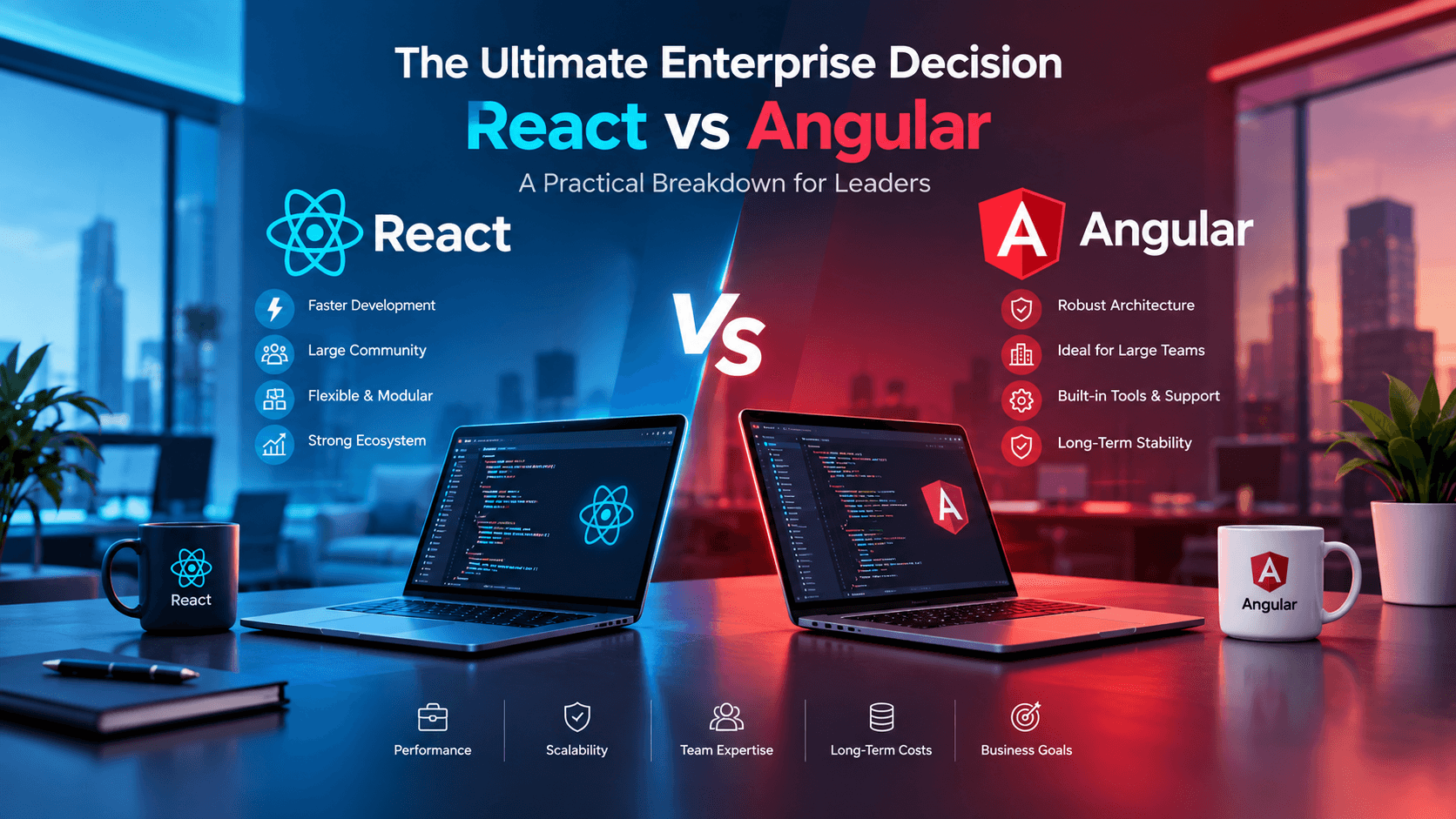
When evaluating react vs angular for enterprise apps, the short answer is this: React is usually the better fit when you want flexibility, rapid UI innovation, and a broad ecosystem, while Angular is often the better fit when you want a highly structured framework with built-in conventions for large teams. Neither is universally superior; the right choice depends on governance, internal skills, product complexity, and how you plan to maintain the application over several years.
Key takeaways
- For most enterprise teams, React offers more flexibility and a larger ecosystem, while Angular offers a more opinionated, all-in-one framework with stronger built-in structure.
- The best choice in react vs angular for enterprise apps depends less on popularity and more on your team skills, governance needs, integration complexity, and long-term maintenance model.
- Angular is often a strong fit for large organizations that want standardized patterns, TypeScript-first development, and consistent architecture across multiple teams.
- React is often a strong fit when you need faster UI iteration, micro-frontend flexibility, or tighter control over selecting libraries for routing, state, and data fetching.
- Framework selection should be made with a delivery plan in mind, including testing strategy, security controls, CI/CD, performance budgets, and upgrade ownership.
Why this decision matters beyond the frontend
Business leaders sometimes treat frontend framework choice as a developer preference. In enterprise environments, it is not. The framework influences hiring, delivery speed, code consistency, testing standards, security practices, upgrade effort, and the ease of integrating with existing systems such as ERP, CRM, IAM, analytics, and legacy APIs.
It also affects how confidently multiple teams can work in parallel. A customer portal, internal operations dashboard, partner extranet, and mobile-friendly admin panel may all share design systems, authentication flows, and data contracts. If the framework encourages consistency, teams onboard faster and governance becomes simpler. If it encourages flexibility, innovation can move faster, but standards need to be actively enforced.
For founders, CTOs, and IT managers, the real question is not Which technology is trendier? It is Which option reduces delivery risk while supporting our roadmap? That means looking at architecture, staffing, maintainability, performance, compliance, and total cost over the life of the product.
React vs Angular for enterprise apps: the practical difference
At a high level, React is a UI library centered on component-based interfaces. In enterprise use, it is typically paired with additional tools such as Next.js or Vite for app setup, React Router for routing, TanStack Query or RTK Query for server-state management, Redux Toolkit or Zustand for client state, and testing tools like Jest, Vitest, Cypress, or Playwright.
Angular is a full framework. It includes strong conventions, dependency injection, routing, forms, HTTP tooling, RxJS-based reactive patterns, TypeScript by default, and a formal CLI. That makes Angular attractive when an organization wants one approved way to build things across teams and business units.
In practice, the difference often shows up in these areas:
- Flexibility: React lets teams compose their own stack. Angular gives more out of the box.
- Learning curve: React is easier to start with, but enterprise-grade React architecture still requires careful decisions. Angular takes longer upfront, especially for teams unfamiliar with RxJS and Angular patterns.
- Standardization: Angular makes consistency easier. React can also be standardized, but usually through internal architecture rules and templates.
- Ecosystem choice: React offers more freedom and a larger third-party ecosystem. Angular reduces decision fatigue.
- Upgrade governance: Angular versions and conventions are centralized. React upgrades are often simpler at the core level, but surrounding libraries may need coordinated updates.
A simple way to frame it: React gives you a toolkit to design your own enterprise approach; Angular gives you a blueprint with fewer architectural choices left open.
Architecture, scalability, and team operations
Enterprise applications rarely stay small. They gain modules, roles, regions, integrations, workflows, and audit requirements over time. That is why framework choice should be assessed at the architecture level, not just through sample screens or developer demos.
Angular tends to shine where many developers must work inside a shared structure. Features like modules, services, guards, dependency injection, typed forms, and established project conventions support predictable scaling. For large internal systems, regulated environments, or multi-vendor delivery models, this can reduce architectural drift. Teams can define clear boundaries for domains such as billing, identity, approvals, procurement, or reporting.
React scales well too, but usually through disciplined engineering practices rather than framework prescription. In successful enterprise React programs, we typically see a defined component architecture, strict TypeScript usage, shared UI libraries, linting and formatting rules, API abstraction layers, design tokens, and template repositories. Without those controls, React projects can become inconsistent across teams.
For distributed enterprises, micro-frontends may also matter. Both React and Angular can support them, often using module federation, single-spa, or platform-specific orchestration. React is commonly chosen when business units need autonomy and fast release cycles. Angular can work well when central governance is stronger and shared standards are non-negotiable.
A few architecture questions worth asking early:
- Will several teams build features in parallel over multiple years?
- Do you need a shared design system used across products?
- Will external vendors contribute code?
- Is the app mainly an internal workflow system, a customer-facing platform, or both?
- Are you planning SSR, edge rendering, or mostly client-side interactivity?
When we built Esparks Edu — School Management ERP, one lesson that stood out was that framework choice matters less than the discipline around modular boundaries, role-based access patterns, and maintainable data flows. Enterprise success usually comes from architecture decisions around the framework, not from the logo on the framework homepage.
Performance, security, and compliance considerations
Performance in enterprise apps is about more than Lighthouse scores. Decision-makers should care about perceived speed under realistic conditions: authenticated sessions, large data tables, search filters, charts, forms, role-based menus, and API-heavy dashboards. Both React and Angular can deliver strong performance if implemented correctly, but they reward different practices.
In React, performance often depends on good component design, avoiding unnecessary re-renders, using memoization carefully, code splitting, route-level lazy loading, virtualization for large lists, and optimized data fetching. In Angular, performance often benefits from Ahead-of-Time compilation, lazy-loaded modules, disciplined change detection strategy, and careful RxJS handling. In both cases, poor state management or excessive client-side logic will hurt performance more than the framework choice itself.
Security and compliance are equally critical. Enterprise applications commonly need SSO with OAuth 2.0, OpenID Connect, SAML, MFA integration, session management, secure token handling, audit trails, CSP headers, dependency scanning, and secrets management. Angular includes built-in protections such as contextual escaping that help reduce common risks like XSS when used correctly. React is secure as well, but because it is less opinionated, teams must be explicit about patterns for sanitization, auth flows, routing guards, and secure API communication.
A mature enterprise delivery setup should include:
- TypeScript for stronger contracts and safer refactoring
- Automated SAST and dependency scanning in CI/CD
- DAST or authenticated security testing for critical workflows
- OWASP-aligned secure coding standards
- Role-based access control and least-privilege API design
- Logging and audit events for sensitive actions
- Performance budgets for bundles, routes, and APIs
If your application operates in sectors with stronger governance expectations, Angular's opinionated structure can make compliance reviews easier. If your team already has mature platform engineering and frontend standards, React can meet the same bar without difficulty.
Cost, hiring, and delivery timeline: realistic expectations
Leaders often ask which option is cheaper. The honest answer: the framework itself is rarely the main cost driver. Scope, integration complexity, workflow depth, testing needs, data migration, and change management usually matter more. Still, React and Angular can influence cost in practical ways.
React can reduce initial time to a polished interface, especially for teams experienced with modern React patterns and design systems. It is often easier to hire React developers in many markets. But flexibility can create hidden costs if the team spends too long choosing libraries or if different squads adopt inconsistent patterns that later require refactoring.
Angular may involve more upfront setup and a steeper onboarding curve, but it can pay back through consistency in large programs. For organizations with multiple long-lived applications, Angular's standard structure can lower governance overhead. Hiring can be more specialized in some regions, though strong TypeScript and enterprise JavaScript engineers can usually adapt.
Typical estimates, framed broadly:
- A focused internal dashboard or operations portal often takes a few months with either stack when APIs are ready and scope is controlled.
- A multi-module enterprise platform with SSO, approvals, reporting, file handling, and admin controls often runs across two or more phases over several quarters.
- Discovery, UX design, architecture setup, QA automation, DevOps, and security hardening typically consume a meaningful portion of budget regardless of framework.
Cost planning should include items buyers often overlook:
- Design system creation or adaptation
- Automated testing coverage for critical workflows
- Upgrade and dependency maintenance ownership
- Monitoring, observability, and production support
- Documentation and onboarding for internal teams
- Browser support requirements for legacy enterprise environments
A cheaper first release that becomes difficult to maintain is rarely cheaper over three to five years. Total cost of ownership matters more than sprint-one velocity.
A step-by-step decision framework for business leaders
The safest way to choose is to use a decision framework tied to business constraints, not personal preference. We recommend a six-step evaluation process.
First, define the application type. Is this a customer-facing digital product where UX experimentation and speed of iteration matter most? Or is it a process-heavy enterprise system with many forms, permissions, workflows, and integrations? React often excels in the first case; Angular is often strong in the second, though there are exceptions.
Second, assess team reality. Review current skills, hiring plans, vendor mix, and who will own the code in year two and year four. A brilliant framework choice on paper can fail if your team cannot sustain it.
Third, map integration and governance needs. Consider identity providers such as Azure AD, Okta, or Auth0; APIs built in .NET, Node.js, Java, or Python; analytics; CMS; and data platforms. If your organization values strong standards and repeatability, Angular may reduce variability. If you need flexibility across products, React may be easier to align with a broader digital ecosystem.
Fourth, test architecture with a thin proof of concept. Do not build a toy counter app. Build a real slice with authentication, role-based navigation, one complex form, one data table, API error handling, and automated tests. Evaluate bundle size, code organization, developer experience, and how easily a second engineer can extend it.
Fifth, score the options against weighted criteria such as:
- Team expertise and hiring availability
- Speed to initial release
- Long-term maintainability
- Fit for governance and compliance
- Integration complexity
- UI flexibility and design system alignment
- Testing and observability readiness
- Upgrade and platform support burden
Sixth, document the standards that come with the decision. If you choose React, define the approved stack and patterns. If you choose Angular, define module boundaries, state strategy, coding conventions, and upgrade cadence. Most framework problems in enterprises are really standards problems.
Common pitfalls and how to avoid them
One common mistake is choosing React because it is popular, then underinvesting in architecture. The result is a fragmented codebase with multiple state patterns, duplicated API logic, and inconsistent testing. Avoid this by locking in a clear stack early: for example, React with TypeScript, Next.js or Vite, React Router, TanStack Query, a validated form library, Playwright for E2E tests, and a shared component library.
Another mistake is choosing Angular for structure, then fighting the framework with ad hoc patterns that bypass its strengths. If you pick Angular, lean into its conventions. Use strict TypeScript, organized services, guards, reactive forms where appropriate, CLI-driven structure, and disciplined RxJS usage rather than mixing in inconsistent approaches.
A third pitfall is ignoring backend and platform dependencies. Frontend choice cannot compensate for unstable APIs, weak DevOps, or unclear authorization logic. Enterprise projects succeed when frontend, backend, cloud, QA, and security are planned together. That includes API versioning, contract testing, CI/CD pipelines, feature flags, observability, and rollback strategy.
Finally, do not underestimate upgrades. Frameworks evolve, dependencies shift, browsers change, and security advisories appear. Assign ownership for maintenance from the start. Whether you choose React or Angular, establish a release policy, dependency review schedule, regression suite, and non-production environments that allow safe updates.
For most decision-makers, the conclusion is straightforward. Choose React when flexibility, UX speed, and ecosystem breadth are strategic advantages and you have the discipline to standardize your stack. Choose Angular when organizational scale, formal structure, and consistency across teams are more valuable than freedom of tooling choice.
Frequently Asked Questions
Which is better for large business systems: React or Angular?
Both can support large business systems well, but they solve enterprise needs differently. React is usually better when you want flexibility and fast UI iteration, while Angular is often better when you want built-in structure, stronger conventions, and easier standardization across multiple teams.
Is Angular more secure than React for enterprise apps?
Angular is not automatically more secure overall, but it does provide more built-in patterns and protections that can reduce mistakes when teams follow its conventions. React can be just as secure in enterprise use if the team applies strong standards for authentication, sanitization, dependency management, and secure API integration.
Does React cost less to build and maintain than Angular?
Not necessarily. React can speed up initial UI delivery, but inconsistent library choices and weak standards can increase long-term maintenance cost. Angular may require more upfront onboarding, yet its opinionated structure can reduce governance and maintenance effort in larger organizations.
How should a company choose between React and Angular?
A company should evaluate business goals, team skills, integration complexity, governance needs, and long-term ownership before choosing. The safest approach is to run a proof of concept using a real enterprise workflow, then score both options against maintainability, performance, security, and delivery risk.
Work with eSparks IT Solutions
Planning a project around this? We work with businesses in the United States, Canada and the UAE, as well as the UK and Australia. See a related project: Esparks Edu — School Management ERP. Explore our Web Development services and portfolio, estimate your project cost, or book a free call.
Written by
Shayma Parween
Lead Developer
Lead Developer at eSparks IT Solutions. Writes from the team's own delivery work across software, cloud, DevOps and security.
Related topics
Continue reading
More in Web Development

Web Development
Progressive Web Apps for Business: A Practical Guide
Learn when progressive web apps for business make sense, what they cost, key trade-offs, and how to choose the right architecture and partner.
Sep 22, 2026Read
Web Development
Web Application Scalability: A Practical Guide
Learn what web application scalability means, how to design for growth, and which architecture, cloud, data, and DevOps choices matter most.
Sep 21, 2026Read
Web Development
Headless CMS Benefits for Modern Digital Platforms
Explore headless CMS benefits for web, mobile and omnichannel delivery, plus costs, pitfalls and a practical decision framework for leaders.
Sep 20, 2026Read
Work with us
Have a system to build, fix or scale?
Tell us what you are working on and where it hurts. We will tell you how we would approach it.