
Programming
Multi Location Inventory Management Software Guide
A practical guide to multi location inventory management software: features, architecture, costs, rollout steps, and common mistakes to avoid.

Anika Rukhsar
Founder
Oct 9, 2026
11 min read
If your business operates across multiple warehouses, stores, dark stores, distributors, or online channels, multi location inventory management software is the system that keeps stock visibility, transfers, replenishment, and order fulfillment aligned in one place. The right platform does more than show quantities: it tracks what is available, reserved, in transit, damaged, or committed across every location so teams can make reliable purchasing, sales, and dispatch decisions.
Key takeaways
- Multi location inventory management software should provide a single, near real-time view of stock across warehouses, stores, and online channels, with clear rules for transfers, reservations, and replenishment.
- The best systems fail if item masters, units of measure, tax rules, and process ownership are not standardized before rollout.
- For most growing businesses, integration quality matters more than feature count because inventory accuracy depends on clean data flow between ERP, POS, ecommerce, accounting, and logistics systems.
- A phased rollout by location or process is usually safer than a big-bang implementation because it exposes data and workflow issues before they spread across the business.
- Typical project cost and timeline vary widely based on customization, integrations, and migration complexity; decision-makers should budget for process design, testing, training, and post-go-live support, not just software licenses.
Why businesses outgrow spreadsheets and basic stock tools
Many companies start with spreadsheets, accounting software stock modules, or a simple POS inventory feature. That can work for a single location with a small SKU count, stable demand, and limited channel complexity. Problems begin when the same item is stocked in several places, sold through multiple channels, or moved frequently between branches. At that point, the business is not managing “inventory” in the generic sense; it is managing stock states, location priorities, reorder logic, operational timing, and exceptions.
Common signs you have outgrown a basic setup include frequent stock mismatches between physical and system counts, urgent inter-branch transfers based on guesswork, missed sales because one branch cannot see another branch's stock, and finance teams struggling to reconcile valuation. In India, these issues get sharper when GST invoicing, e-commerce orders, B2B billing, batch control, and branch-wise reporting all need to coexist. A spreadsheet can record stock, but it cannot reliably enforce workflows, permissions, audit trails, and integration logic at scale.
Decision-makers should also watch for hidden costs that do not appear in software comparisons: manual reconciliation time, excess safety stock, delayed dispatches, dependence on a few staff members who “know the sheet,” and weak traceability during audits. These are operational risks, not just administrative annoyances. Once you have more than one active stocking point, the quality of your inventory architecture starts affecting customer experience, working capital, and leadership confidence in business data.
What good multi location inventory management software must do
A capable multi location inventory management software platform should create one trusted stock ledger with location-aware behavior. That means each SKU is tracked not only by total quantity, but by where it is, what state it is in, and what transactions changed it. For most businesses, the goal is not merely “real-time” in the marketing sense; it is dependable near real-time synchronization with explicit handling of delays, retries, and conflicts.
The core capabilities worth prioritizing are:
- Centralized item master with SKU, barcode, HSN/SAC if relevant, units of measure, tax mapping, category, variants, and status control
- Location-wise stock visibility across warehouses, stores, vans, consignment stock, and virtual locations such as returns or quarantine
- Stock state tracking: on hand, available, reserved, allocated, picked, packed, in transit, damaged, expired, and blocked
- Purchase, sales, transfer, return, and adjustment workflows with approval rules and audit logs
- Inter-location transfers with source-destination tracking, transit status, receipt confirmation, and discrepancy handling
- Reorder planning using min-max levels, reorder points, lead times, supplier constraints, and demand patterns
- Batch, lot, serial number, and expiry management where applicable
- Cycle counts and physical stock audits without shutting down operations
- Role-based access control, maker-checker workflows, and traceability of every inventory-affecting action
- Integration with POS, ecommerce, accounting/ERP, shipping aggregators, WMS, CRM, and payment systems
Two features are often overlooked but matter a lot in production environments. First, support for units of measure and conversion rules: buying in cartons, storing in cases, and selling in pieces can destroy accuracy if conversions are loose. Second, clear reservation logic: if an order is placed online, is stock reserved immediately, on payment success, or only at picklist creation? Small policy choices like these determine whether your reported availability can actually be trusted.
Architecture and integrations: where most projects succeed or fail
Inventory projects usually fail at the edges, not the center. The software may look good in demos, but stock accuracy collapses if surrounding systems post late, duplicate transactions, or use mismatched item codes. In our experience, decision-makers should evaluate architecture before UI polish.
A durable setup commonly uses a cloud-first architecture with modular services and an API-first integration model. Depending on business size and complexity, that may include a central inventory service, order management workflows, message queues for asynchronous updates, and event-driven syncing between systems. Technologies vary by stack, but patterns matter more than brands: REST or GraphQL APIs for application communication, webhooks for event notifications, PostgreSQL or MySQL for transactional consistency, Redis for caching, and message brokers such as RabbitMQ, Kafka, or AWS SQS for reliable background processing. For mobile-first store operations, Android apps with offline-capable sync can be essential where warehouse connectivity is inconsistent.
Key integration points to map in advance include:
- ERP or accounting: item masters, purchases, valuation, tax, credit notes, and journal impacts
- POS: in-store sales, returns, receipts, and local store-level availability
- Ecommerce marketplaces and D2C stores: order import, cancellations, returns, and inventory updates
- WMS and barcode systems: receiving, put-away, picking, packing, and dispatch scans
- Courier and logistics tools: shipment creation, tracking events, reverse logistics, proof of delivery
- BI/reporting tools: stock aging, fill rate, dead stock, branch consumption, margin, and forecast views
Security and governance should not be afterthoughts. Ask whether the system supports encrypted transport via TLS, encryption at rest, environment separation, SSO or SAML where needed, MFA for admin accounts, IP restrictions for sensitive actions, and detailed audit trails. If your partner discusses only screens and not operational resilience, backups, recovery objectives, monitoring, and log retention, that is a warning sign.
How to choose the right solution and partner
The best buying decision usually comes from process clarity, not a long feature checklist. Start by identifying your operating model: retail-led, distributor-led, warehouse-led, omnichannel, project-based, or manufacturing-adjacent. The same software may behave very differently depending on whether your business prioritizes rapid store replenishment, B2B dispatch planning, serialized high-value goods, or GST-compliant invoicing across branches.
A practical decision framework is:
- Define inventory-critical processes. List receiving, put-away, sales allocation, transfer, return, stock count, write-off, and reorder processes as they actually work today.
- Identify failure points. Note where errors happen: duplicate SKUs, delayed syncs, manual transfers, unrecorded damages, wrong unit conversions, or branch-level blind spots.
- Standardize master data. Clean item names, SKU conventions, location codes, tax mappings, units of measure, barcode standards, and vendor/customer references.
- Classify requirements. Separate must-have, should-have, and nice-to-have features. Many teams overpay for modules they will not use in year one.
- Decide build, buy, or hybrid. Off-the-shelf is faster for standard workflows; custom or hybrid is often better when pricing, tax, fulfillment, or approval rules are unique.
- Validate integration fit. Ask for interface maps, retry logic, error handling, and reconciliation reports, not just “we can integrate.”
- Run scenario-based demos. Use your own examples: one item, three locations, one online order, one transfer, one return, one stock mismatch.
- Plan change management. Assign process owners, branch champions, training windows, and cutover rules before development starts.
When we built Sparks Business — Inventory, Sales & GST Invoicing Platform, one recurring lesson was that inventory confidence depends less on flashy dashboards and more on disciplined transaction design, tax-aware workflows, and a clean branch model. That is true whether you are implementing a custom platform or configuring a product.
A good partner should be able to discuss domain specifics in business language: FEFO versus FIFO, landed cost implications, negative stock controls, branch-wise tax treatment, backorder policy, and what happens when a transfer is shipped but not received. Those conversations reveal real implementation maturity far more than generic promises around digital transformation.
Implementation roadmap, timelines, and typical cost ranges
Most inventory programs move more smoothly when rolled out in phases. A sensible sequence is master data and stock opening, then purchasing and receiving, then inter-location transfers, then sales channel integrations, then replenishment automation and analytics. A “big bang” across all branches and channels can work, but only if data quality, process discipline, and internal ownership are already strong.
A practical roadmap often looks like this:
- Discovery and process mapping: 2-4 weeks for workshops, current-state review, and requirement prioritization
- Solution design: 2-4 weeks for data model, workflow rules, integration architecture, permissions, and reports
- Build/configuration: 6-16 weeks depending on complexity, number of locations, mobile needs, and integrations
- Data migration and validation: 1-3 weeks for item masters, opening stock, vendor/customer mapping, and reconciliation
- Testing: 2-4 weeks including UAT, edge cases, concurrency, barcode flows, and exception handling
- Pilot rollout: 1-2 weeks for one site or one business unit
- Phased rollout and support: 2-6 weeks or more depending on geography and operational criticality
For cost, there is no honest universal number because software licenses, integration count, custom workflows, and migration quality can change the scope dramatically. As a broad market reality, a relatively standard SMB implementation using a product plus limited customization may sit in the low lakhs to mid lakhs INR. A custom or hybrid system with multiple integrations, mobile scanning workflows, advanced approvals, and branch-specific logic can move into higher lakhs or more. These are typical planning ranges, not guarantees. The more useful budgeting approach is to split costs into software, implementation, integration, migration, training, infrastructure, and support, then identify what is one-time versus recurring.
Do not underestimate post-go-live support. The first few weeks after launch usually expose master-data issues, unusual returns, branch exceptions, and user behavior gaps that no workshop fully predicts. Budgeting for stabilization is not a contingency; it is part of responsible implementation.
Common pitfalls and how to avoid them
The biggest inventory projects rarely fail because the software cannot record stock. They fail because business rules are vague, data is inconsistent, or people continue using parallel spreadsheets after go-live. The good news is that these problems are preventable with the right design discipline.
Watch for these common pitfalls:
- Poor item master hygiene: duplicate SKUs, inconsistent naming, and missing units of measure create endless reconciliation issues. Fix this before migration.
- Undefined transfer ownership: if no one owns dispatch confirmation and receipt confirmation, “in transit” stock becomes a black hole.
- Negative stock allowed by default: this may keep billing moving temporarily, but it destroys inventory trust unless used under tightly controlled exceptions.
- Weak reservation logic: without clear rules, the same stock can appear available to store sales, online orders, and B2B orders at once.
- Over-customization too early: replicating every old manual exception in software makes the system expensive and hard to maintain.
- Incomplete audit design: if adjustments, price changes, and manual overrides are not logged with user and timestamp, disputes become hard to resolve.
- Insufficient physical process fit: barcode workflows, label standards, shelf/bin design, and receiving discipline matter as much as software screens.
- No reconciliation reporting: every integrated system needs exception reports for missing, delayed, or failed transactions.
To avoid these issues, create policy documents for stock states, transfer cutoff times, approval thresholds, return handling, and count variance treatment. Use role-based permissions aggressively. Run pilot stock counts after migration. Train by role, not in one generic session. Most importantly, decide which system is the source of truth for each data domain. For example, item masters may originate in ERP, inventory balances in the inventory platform, and customer-facing availability in the order management layer. Ambiguity here creates expensive downstream confusion.
KPIs, governance, and long-term scalability
Once the system is live, leaders need governance that turns inventory data into action. That starts with a small set of operational KPIs reviewed consistently. Good examples include stock accuracy by location, transfer turnaround time, fill rate, stock aging, dead stock value, cycle count adherence, order allocation exceptions, and inventory adjustment reasons. The exact KPI list should reflect your business model rather than copy a generic template.
Scalability also depends on the ability to add new locations, channels, tax rules, and product lines without rewriting core logic. Ask whether the architecture supports location hierarchies, configurable workflow rules, webhooks or APIs for future systems, and reporting that can segment by branch, region, channel, or legal entity. If you plan to expand internationally or integrate with marketplaces, also consider multi-currency, timezone handling, tax abstraction, and language readiness.
From a governance standpoint, review three layers regularly:
- Data governance: SKU creation rules, archival policies, barcode standards, and branch/location coding
- Operational governance: transfer SLAs, count schedules, approval matrices, and incident handling
- Technical governance: release process, logs and monitoring, backup and recovery drills, API versioning, and security reviews
For founders, CTOs, and IT managers, the strategic takeaway is simple: inventory software is not just a back-office purchase. It becomes a control layer for demand fulfillment, cash flow discipline, and branch-level operational trust. If you select the platform carefully, standardize process rules early, and treat integration and governance as first-class requirements, you give the business a system that can support growth instead of constantly reacting to exceptions.
Frequently Asked Questions
What is multi location inventory management software?
Multi location inventory management software is a system that tracks stock across more than one warehouse, store, branch, or channel from a shared platform. It manages quantities by location and stock state, including available, reserved, damaged, and in-transit inventory, so businesses can make accurate purchasing and fulfillment decisions.
Who needs multi location inventory management software in India?
Businesses with stock in multiple branches, warehouses, retail outlets, dark stores, or online sales channels typically need it once manual reconciliation becomes frequent. It is especially useful for companies that need branch-wise visibility, transfer control, GST-aware workflows, barcode operations, or marketplace and POS integration.
Should a business buy an off-the-shelf product or build a custom inventory system?
An off-the-shelf product is usually faster and lower risk when workflows are fairly standard and integration needs are limited. A custom or hybrid approach makes more sense when the business has complex transfer rules, unique pricing or tax logic, channel-specific fulfillment behavior, or reporting needs that products cannot support cleanly.
How long does it take to implement a multi location inventory system?
A typical implementation can take anywhere from a few weeks to several months depending on data quality, number of locations, integrations, and level of customization. The timeline should include discovery, process design, migration, testing, pilot rollout, user training, and post-go-live stabilization rather than only software setup.
Work with eSparks IT Solutions
Planning a project around this? We help businesses across the USA, UK, Canada, Australia and the GCC ship it. See a related project: Sparks Business — Inventory, Sales & GST Invoicing Platform. Explore our Programming services and portfolio, estimate your project cost, or book a free call.
Related development services

Anika Rukhsar
Founder
Passionate technology writer and industry expert with years of experience in software development, cloud computing, and digital transformation. Dedicated to sharing insights and helping developers stay ahead of the curve.
Related Topics
Continue Reading
More insights in Programming

Programming
How to Choose Inventory Management Software for Distributors
A practical guide to inventory management software for distributors, covering features, integrations, costs, rollout steps, and common pitfalls.
Oct 8, 2026
Read More
Programming
Tally Alternative Software: A Practical Buyer’s Guide
Evaluating tally alternative software in India? Learn features, costs, migration steps, risks, and selection criteria for modern business systems.
Oct 7, 2026
Read More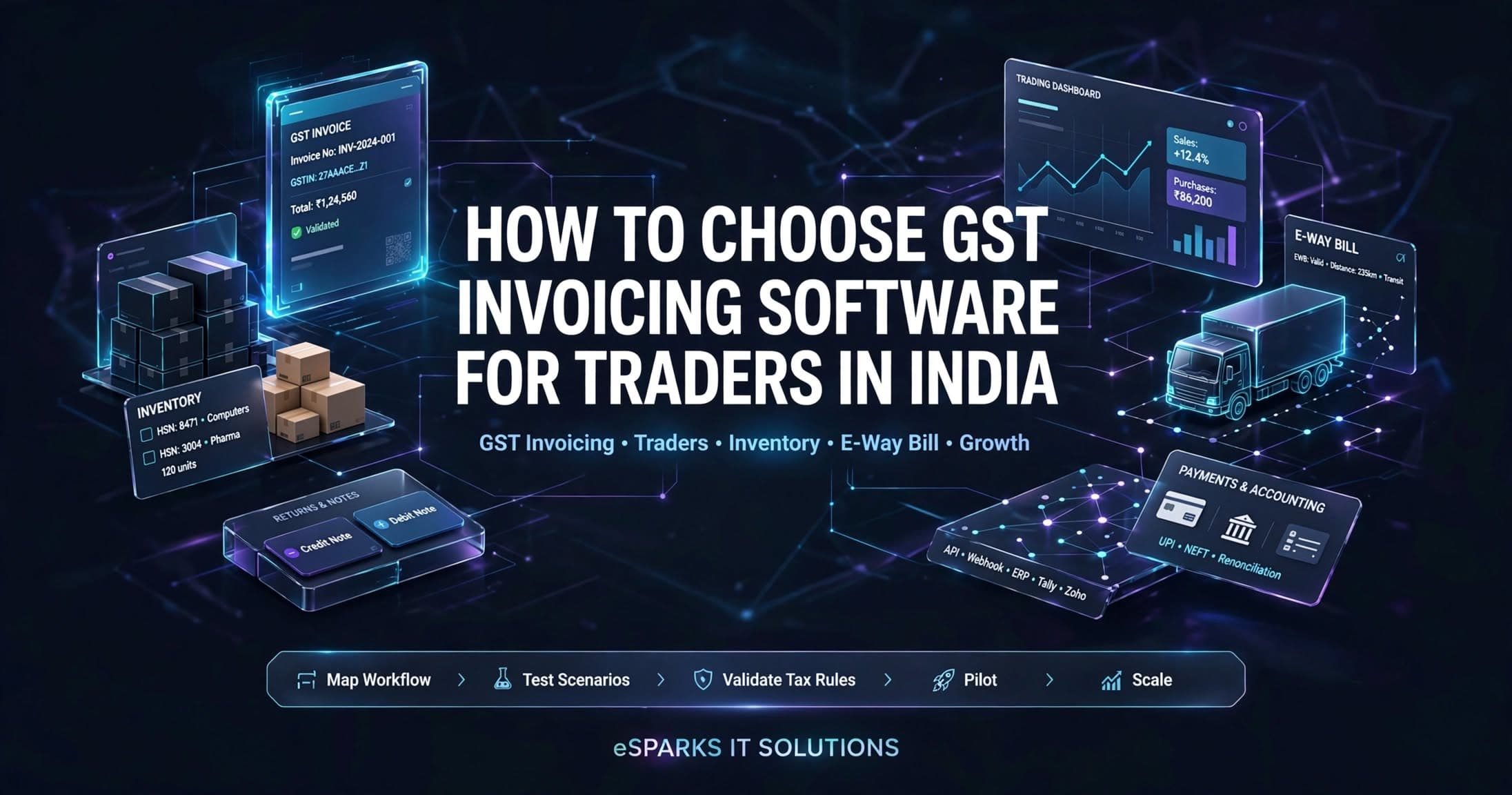
Programming
How to Choose GST Invoicing Software for Traders in India
A practical guide to choosing gst invoicing software for traders in India, with features, architecture, costs, timelines, and implementation risks.
Oct 6, 2026
Read MoreReady to Transform Your Business?
Let's discuss how our expertise can help you achieve your goals