Programming
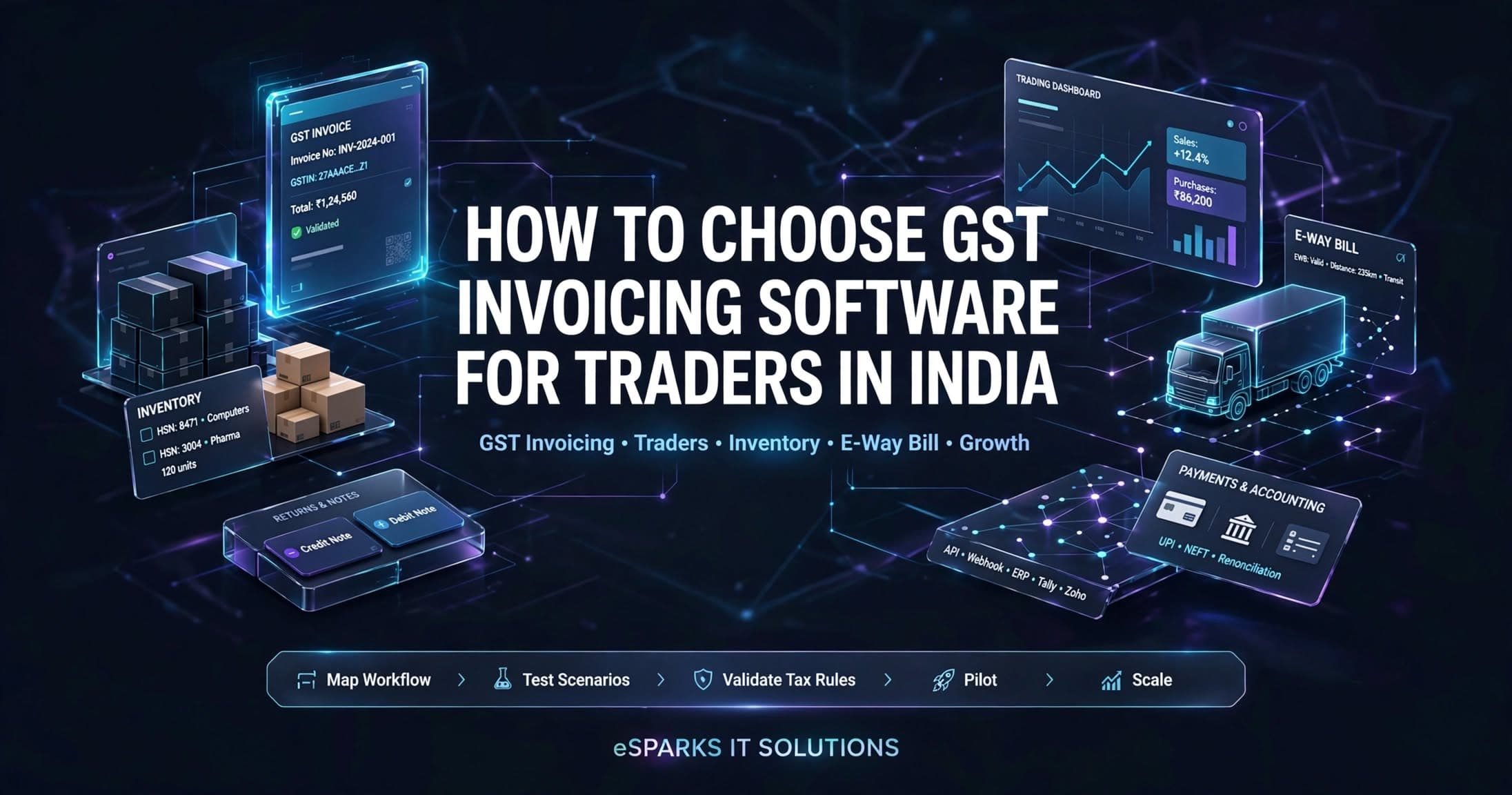
How to Choose GST Invoicing Software for Traders in India
A practical guide to choosing gst invoicing software for traders in India, with features, architecture, costs, timelines, and implementation risks.

Anika Rukhsar
Founder
Oct 6, 2026
10 min read
gst invoicing software for traders should do more than generate tax invoices: it should make GST compliance operationally reliable, connect billing with inventory and payments, and reduce avoidable reconciliation work. For Indian trading businesses, the right system is one that supports real transaction complexity such as multiple GST rates, returns, debit and credit notes, e-invoicing thresholds, and state-wise movement of goods without forcing teams back into spreadsheets.
Key takeaways
- Good gst invoicing software for traders should handle e-invoicing, e-way bills, HSN and GST rate rules, credit notes, purchase reconciliation, and GSTR-ready exports without manual spreadsheet work.
- For growing traders, software fit depends less on a long feature checklist and more on workflow match, integration quality, tax rule configurability, auditability, and implementation discipline.
- A practical evaluation should test real scenarios such as mixed-tax invoices, returns, interstate dispatches, partial payments, stock adjustments, and offline-to-online sync before final selection.
- Typical rollout effort ranges from a few weeks for a focused SMB deployment to a few months for custom integrations, multi-branch controls, and data migration from legacy systems.
- The safest architecture keeps GST logic configurable, records every financial change with timestamps and user trails, and integrates cleanly with accounting, banking, logistics, and reporting tools.
Why traders need more than a simple billing tool
A trader's workflow is usually more complex than a generic invoicing app assumes. In a typical day, the team may create quotations, convert them to sales orders, reserve stock, issue tax invoices, handle partial dispatches, raise e-way bills for interstate movement, track receivables, accept mixed payment methods, and process returns. If the software only covers invoice printing, finance and operations still end up reconciling numbers manually across Excel files, WhatsApp messages, transporter updates, and accounting entries.
GST amplifies that complexity because the tax treatment depends on product classification, place of supply, customer registration status, and transaction type. A trader may sell the same SKU to a local GST-registered buyer, an out-of-state distributor, and a walk-in retail customer, each with different tax implications and documentation expectations. That is why the software has to model business rules, not just store invoice PDFs.
In our experience, decision-makers often underestimate the cost of “almost right” software. The visible subscription fee may look attractive, but the hidden cost appears later as duplicate data entry, month-end correction work, stock mismatches, and delayed compliance. A stronger selection process focuses on workflow integrity from order to tax filing, not only on the invoice screen.
Core capabilities to expect from gst invoicing software for traders
The baseline is straightforward: invoice creation, GST calculations, customer and product masters, and downloadable reports. But for traders evaluating software seriously, the useful question is not whether these features exist; it is whether they hold up under operational edge cases.
Look for the following capabilities as non-negotiable or near non-negotiable:
- GST-aware invoice engine with CGST, SGST, IGST, cess, reverse charge, exempt and zero-rated handling where applicable
- HSN and SAC support, tax rule mapping by product or category, and configurable rounding behavior
- Credit notes, debit notes, sales returns, purchase returns, and adjustment entries linked to original transactions
- E-invoicing and e-way bill readiness, either built in or through stable API-based integration, depending on threshold and business needs
- Inventory linkage with batch, unit, reorder level, valuation method, and stock movement visibility
- Customer-wise pricing, discount policies, payment terms, and overdue tracking
- Purchase entry, vendor GST details, input tax tracking, and reconciliation support for books versus portal data
- Multi-user roles with maker-checker approvals for sensitive actions like tax overrides, discount exceptions, or invoice cancellation
- Audit logs showing who changed what and when
- Export and reporting formats usable for accounting, GSTR workflows, and management review
Two details are often missed during demos. First, test mixed invoices: multiple line items with different GST rates, discounts, freight, and round-off. Second, test reversal scenarios: cancelled invoices, returned goods, short shipments, and partial payments. Many products look polished for the happy path but become messy when real trade operations start hitting them.
Architecture and integrations that matter in the real world
For small teams, a standalone cloud app may be enough initially. For a growing trader, however, software quality depends heavily on how well it integrates with the rest of the business stack. Typical dependencies include accounting systems, payment gateways, bank feeds, warehouse tools, barcode systems, logistics partners, CRM, BI dashboards, and in some cases marketplace connectors or custom dealer portals.
A sound architecture usually has three traits. First, GST rules are configurable instead of hardcoded into screens, so future tax updates or product-category changes do not require invasive rewrites. Second, transactional data is normalized and traceable, with separate entities for orders, invoices, ledger impact, stock movement, and tax breakdown. Third, integrations are API-first or event-driven where possible, rather than dependent on periodic CSV uploads alone.
The underlying technology stack can vary, but the principles are stable. A typical modern build may use React or Angular on the front end, a backend in Node.js, .NET, Java, or Python, PostgreSQL or MySQL for transactional storage, Redis for caching, and queue-based processing for invoice jobs, notifications, and sync tasks. Security fundamentals should include TLS in transit, encryption at rest for sensitive fields where appropriate, role-based access control, secure secret management, backup policies, and immutable audit trails. If the vendor cannot explain these basics clearly, that is a signal worth taking seriously.
Integration depth matters even more than feature count. When we built Sparks Business — Inventory, Sales & GST Invoicing Platform, one recurring lesson was that traders value continuity across stock, sales, and tax flows more than flashy dashboards. If invoice creation, stock deduction, receivable posting, and compliance artifacts do not stay in sync, the reporting layer becomes untrustworthy very quickly.
A practical decision framework for founders, CTOs, and IT managers
Buying business software is usually less about “best product” and more about “best fit for our operating model.” A disciplined evaluation process prevents expensive reversals later.
Use this step-by-step framework:
-
Map your current workflow end to end. Document how quotations, orders, dispatch, invoicing, returns, collections, and reconciliation work today. Include who approves what, which systems are used, and where manual handoffs happen.
-
List transaction patterns, not generic requirements. Capture real scenarios such as interstate B2B sales, local B2C counter billing, branch transfers, replacement against return, partial dispatch, advance receipt, and post-sale discount adjustments.
-
Classify requirements into must-have, should-have, and future-state. Must-haves usually include tax accuracy, stock sync, user controls, and dependable reports. Future-state items might include distributor portals, demand forecasting, AI-based anomaly detection, or advanced BI.
-
Validate data migration complexity early. Legacy customer masters, SKU structures, opening stock, pending receivables, and historical invoices are often harder to migrate than expected. Ask whether migration will be scripted, templated, or manual.
-
Run a scenario-based demo, not a slide demo. Provide sample products, GST rates, customer types, and return cases. Ask the team to execute them live. This reveals workflow friction far better than feature presentations.
-
Examine controls and auditability. Who can edit a posted invoice? How are cancellations handled? Can discounts above a threshold require approval? Can you trace a changed GST number or edited HSN code?
-
Check implementation ownership. Clarify who will configure masters, tax rules, roles, templates, integrations, and training. Many projects slip because both sides assume the other owns setup detail.
Founders often prioritize speed, CTOs prioritize extensibility, and finance teams prioritize correctness. A good decision balances all three. If your operation is evolving quickly, choose software and a partner that can support phased implementation: start with sales, stock, and GST foundations, then add automations, analytics, and custom modules in later sprints.
Common pitfalls and how to avoid them
The most common mistake is selecting based on price or UI polish alone. A clean invoice screen does not guarantee robustness in returns, tax corrections, stock variance handling, or month-end closure. Ask to see exception flows, not just primary flows.
Another common pitfall is weak master data discipline. If product names, units, GST rates, HSN codes, or customer GSTINs are inconsistent, even strong software will produce unreliable output. Before rollout, define master ownership, approval rules, and naming standards. This is boring work, but it prevents many avoidable compliance and reporting issues.
Watch for these operational risks:
- Manual tax overrides without approval or reason capture
- Inventory deduction happening outside invoice or dispatch controls
- No version history for invoice edits and cancellations
- Separate stock and billing systems with delayed sync
- Reports that do not reconcile between sales, tax, and ledger views
- Dependence on spreadsheet imports for recurring core processes
- No sandbox or UAT process before go-live
- Unclear handling of internet outages, retries, or failed sync jobs
A subtler pitfall is over-customization too early. Some businesses request custom workflows before they have stabilized basic processes. That can lock them into brittle logic and higher maintenance. Usually, it is wiser to standardize 70 to 80 percent of the process first, then customize only the parts that truly differentiate operations or control risk.
Typical costs, timelines, and delivery models
Costs vary widely based on whether you choose an off-the-shelf SaaS product, a configurable platform, or a custom-built system. For a small to mid-sized trader with straightforward needs, a SaaS deployment may go live in roughly 2 to 6 weeks if masters are clean and integrations are light. A more tailored implementation with accounting sync, barcode workflows, approval logic, multi-branch operations, and migration can realistically take 6 to 16 weeks. Larger custom programs can extend beyond that, especially if they include dealer apps, warehouse mobility, or enterprise reporting.
Budgeting should account for more than license or development cost. Include discovery, data cleansing, migration, template setup, user roles, integration work, UAT, training, and post-go-live support. For custom or heavily integrated solutions, ongoing costs may include cloud hosting, monitoring, backups, security patching, and support for GST-related rule updates. It is better to ask for these line items upfront than be surprised later.
There are three common delivery models:
- SaaS-first: fastest route for standard needs; lower upfront effort; limited deep customization
- Platform plus configuration: balances speed with workflow fit; good for growing traders with process nuance
- Custom build: suitable when billing, inventory, approvals, and external integrations are central to competitive operations
If you are evaluating an IT partner rather than only a software product, ask how they handle discovery, architecture, security review, rollout, and change management. At eSparks, we have seen projects succeed not because the software was perfect on day one, but because the implementation plan respected operational realities such as branch readiness, finance cutover windows, and training maturity.
Implementation checklist for a low-friction rollout
A smooth rollout is usually procedural, not magical. Teams that treat implementation as a business change project do better than teams that treat it as a login handover.
Use this checklist before go-live:
- Finalize product masters with HSN, units, pricing, and tax mapping
- Validate customer and vendor GST details and state information
- Define role-based permissions for sales, accounts, warehouse, and admin users
- Prepare invoice templates, credit note formats, and document numbering rules
- Test all critical scenarios in UAT, including returns, cancellations, and partial payments
- Reconcile opening stock, outstanding receivables, and payable balances
- Confirm backup, recovery, and support processes for the first month
- Train users by role with task-based examples, not generic walkthroughs
After go-live, monitor three things closely for the first few weeks: tax calculation exceptions, stock mismatches, and report reconciliation. Small issues discovered early are easier to correct before they become habits or month-end surprises. Keep a short daily review loop between operations, accounts, and the implementation team until transaction quality stabilizes.
The long-term value of gst invoicing software for traders comes from clean process design, not software alone. If the tool supports your real trade scenarios, integrates reliably, and preserves auditability, it becomes part of the business control system rather than just another billing screen.
Frequently Asked Questions
What should gst invoicing software for traders include at a minimum?
At a minimum, it should support GST-compliant invoice creation, HSN-based tax mapping, credit and debit notes, sales and purchase tracking, inventory linkage, customer and vendor masters, and exportable reports for accounting and GST workflows. For many traders, e-invoicing and e-way bill support or integration are also important depending on transaction volume and applicable rules.
Is a generic invoicing app enough for a trading business?
A generic invoicing app may work for very simple billing, but many trading businesses outgrow it quickly because stock, returns, state-wise tax treatment, receivables, and compliance need to stay connected. If your team still uses spreadsheets to reconcile inventory, tax, and payments, the software is probably too limited.
How long does implementation usually take?
A basic implementation can often be completed within a few weeks if business rules are simple and data is clean. A more realistic timeline for traders needing migration, inventory controls, approvals, and integrations is several weeks to a few months, depending on scope and internal readiness.
Should we buy SaaS or build a custom solution?
SaaS is usually the faster choice for standard workflows and lower implementation effort. A custom or configurable solution makes more sense when your pricing, dispatch, approvals, inventory logic, or external integrations are central to how the business operates and cannot be handled cleanly by an off-the-shelf product.
Work with eSparks IT Solutions
Planning a project around this? We help businesses across the USA, UK, Canada, Australia and the GCC ship it. See a related project: Sparks Business — Inventory, Sales & GST Invoicing Platform. Explore our Programming services and portfolio, estimate your project cost, or book a free call.
Related development services

Anika Rukhsar
Founder
Passionate technology writer and industry expert with years of experience in software development, cloud computing, and digital transformation. Dedicated to sharing insights and helping developers stay ahead of the curve.
Related Topics
Continue Reading
More insights in Programming

Programming
How to Choose GST Billing Software for Small Business
Learn how to evaluate gst billing software for small business in India, from compliance and integrations to security, cost, rollout, and scale.
Oct 5, 2026
Read More
Programming
Cybersecurity for Growing Businesses: Practical Guide
Learn cybersecurity for growing businesses with practical controls, cost ranges, common pitfalls, and a decision framework for choosing the right IT partner.
Oct 4, 2026
Read More
Programming
Custom Software Programming Services: Smart Buyer’s Guide
Custom software programming services help US businesses build systems that fit workflows, integrations, security needs, and growth plans.
Sep 30, 2026
Read MoreReady to Transform Your Business?
Let's discuss how our expertise can help you achieve your goals