Web Development
Mastering Web Development: Trends, Tools, and Best Practices in 2026
Mastering Web Development: Trends, Tools, and Best Practices in 2026 for business leaders choosing scalable stacks, faster delivery, and secure digital products.
Shayma Parween
Lead Developer
- Published
- Jun 12, 2026
- Reading time
- 12 min read
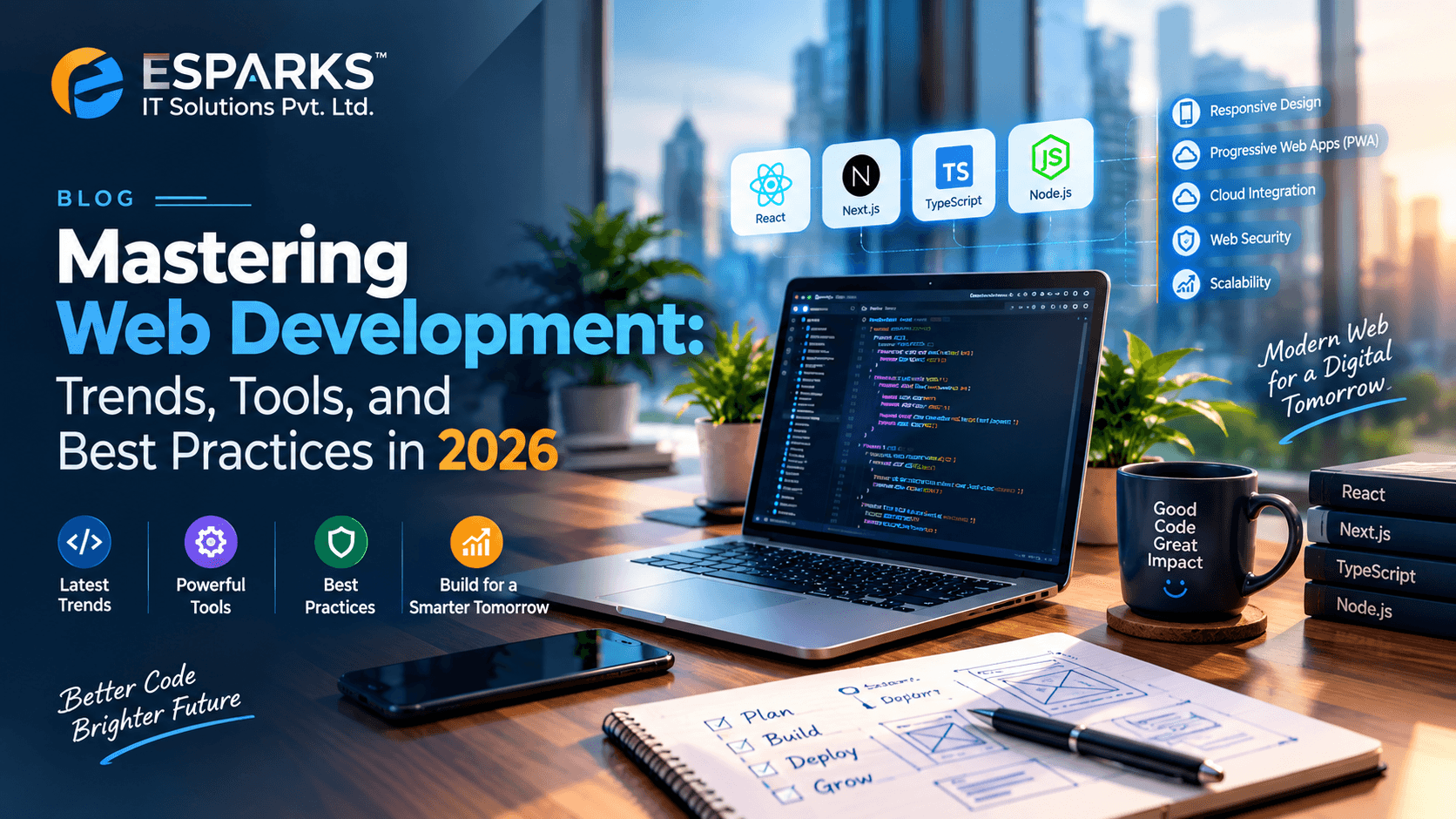
Mastering Web Development: Trends, Tools, and Best Practices in 2026 means building digital products that are fast, secure, adaptable, and easy to evolve as business needs change. For decision-makers, the right answer is not a fashionable framework; it is a delivery approach that balances user experience, integration complexity, team capability, and total cost of ownership.
Key takeaways
- In 2026, strong web development is less about choosing the newest framework and more about building for performance, maintainability, security, and change.
- The best modern stacks usually combine a component-based frontend, an API-first backend, cloud-native infrastructure, and automated delivery pipelines.
- A web project should be judged by business fit, team capability, integration needs, and the total cost of ownership, not by feature lists alone.
- Security, accessibility, and observability are no longer optional add-ons; they are core product requirements from day one.
- The fastest way to miss budget and timelines is to under-specify scope, skip discovery, or choose technology that your team cannot support long term.
What Web Development Means in 2026
Web development in 2026 is no longer just about pages and forms. It is about building customer-facing and internal platforms that connect APIs, automate workflows, support analytics, and scale across devices and regions. For founders, CTOs, and IT managers, the question is not whether a site can be built, but whether it can support product growth, compliance, and operational resilience over time.
The web stack has also become more distributed. Frontends may be built with React, Next.js, Vue, or Angular, while backends often rely on Node.js, .NET, Java, Python, or PHP depending on integration and governance needs. In practice, the best architecture is usually one that stays simple where possible and modular where necessary.
A common mistake is treating web development as a one-time project. In reality, it is an operating capability. The strongest teams plan for releases, monitoring, optimization, and change management from the beginning, because the real cost of a web platform is not launch day; it is everything that comes after.
Mastering Web Development: Trends, Tools, and Best Practices in 2026
The biggest trend in 2026 is not a single framework shift; it is the move toward composable systems. Businesses want to assemble capabilities through APIs, headless CMS platforms, reusable UI libraries, and cloud services rather than rebuild everything from scratch. This approach helps teams ship faster and replace weak components without tearing apart the whole product.
Another important trend is the rise of AI-assisted development and AI-enhanced user experiences. Teams are using tools such as GitHub Copilot, Cursor, Claude-based coding assistants, and automated testing aids to speed up repetitive work. At the product level, AI is increasingly embedded in search, recommendations, content workflows, support automation, and internal knowledge systems. The key is to use AI where it improves utility, not where it adds risk or complexity without clear value.
Tooling has also matured around delivery and governance. Modern teams commonly combine:
- Frontend: React, Next.js, Vue, Angular, Tailwind CSS, Storybook
- Backend: Node.js, .NET, Java Spring Boot, Python FastAPI or Django, Laravel
- APIs: REST, GraphQL, OpenAPI specifications, gRPC for service-to-service use cases
- Cloud and DevOps: AWS, Azure, Google Cloud, Docker, Kubernetes, Terraform, GitHub Actions, GitLab CI, Azure DevOps
- Quality and security: Jest, Playwright, Cypress, SonarQube, Snyk, OWASP testing practices
The important pattern is not to use every tool. It is to use a stack that your team can support, hire for, secure, and extend. In our experience at eSparks IT Solutions, the most durable systems are those with fewer moving parts, clear ownership, and strong automation around testing and deployment.
Choosing the Right Stack for Your Business
The best stack depends on business context, not preference alone. A content-heavy marketing platform may be well served by Next.js plus a headless CMS. A SaaS product with multi-tenant logic may need a more structured backend, robust authentication, and a disciplined database model. An internal portal with complex workflow integrations may prioritize maintainability and API reliability over frontend novelty.
A practical decision framework looks like this:
- Define the business outcome. Is the goal lead generation, self-service, e-commerce, internal productivity, or a product platform?
- Map critical integrations. Consider ERP, CRM, payments, identity providers, data warehouses, and third-party services.
- Match the stack to team skills. The best architecture is the one your current or future team can maintain confidently.
- Estimate lifecycle cost. Include hosting, licensing, observability, security reviews, QA, and future enhancement effort.
- Validate scalability needs. A startup MVP and an enterprise portal should not be built with the same level of infrastructure complexity.
- Plan for replacement, not just launch. Good systems allow individual components to evolve without a full rebuild.
Typical timelines vary widely, but a focused marketing website might take 4 to 8 weeks, a mid-complexity web app 8 to 16 weeks, and a more integrated platform 4 to 9 months or more. Those are estimates, not promises, and complexity grows quickly when approvals, compliance, and external dependencies enter the picture.
Architecture and Delivery Practices That Reduce Risk
Modern web development works best when architecture decisions are made early and documented clearly. Start with a simple blueprint: presentation layer, application layer, data layer, and integration layer. Then decide whether the product needs a monolith, modular monolith, or microservices approach. Many businesses are better off with a modular monolith initially, because it is easier to develop, deploy, and troubleshoot than a prematurely split microservices system.
Delivery quality depends on the pipeline as much as the code. A mature team uses version control, peer review, automated builds, test suites, staging environments, and controlled releases. Continuous integration and continuous delivery should not be buzzwords; they should reduce manual deployment risk and create confidence in every release. Infrastructure as code with Terraform or similar tooling also helps teams reproduce environments consistently across dev, test, and production.
Common pitfalls to avoid include:
- Starting with microservices before the domain boundaries are clear
- Letting the frontend and backend teams work with vague API contracts
- Skipping test automation until defects become expensive
- Building directly in production-like systems without staging discipline
- Ignoring logging, tracing, and alerting until an incident happens
A strong delivery model also includes rollback planning, release notes, and feature flags. For business leaders, these practices translate into fewer outages, easier audits, and more predictable change management.
Security, Compliance, and Accessibility Are Part of Development
Security can no longer be an afterthought added during final testing. The right approach is secure-by-design: role-based access control, least privilege, strong identity management, dependency scanning, secret handling, audit logging, and regular patching. For public-facing products, OWASP Top 10 risks should remain a basic reference point throughout design and implementation.
Compliance requirements vary by market and sector, but businesses operating across the USA, UK, Canada, Australia, UAE, Saudi Arabia, Qatar, and the Netherlands often need to think beyond code quality. Privacy regulations, data residency expectations, and contractual security obligations can shape hosting decisions, authentication design, and vendor selection. It is wise to check early whether data needs to stay in a specific region or whether a third-party service introduces unacceptable risk.
Accessibility is equally important. WCAG-aligned design and development improve usability for everyone, not just users with disabilities. That means semantic HTML, keyboard navigation, sufficient contrast, readable error messages, and screen-reader-friendly forms. Accessibility is also easier and cheaper to implement during development than to retrofit after launch.
A practical security checklist for decision-makers includes:
- Multi-factor authentication for admin and sensitive user access
- Centralized logging and alerting
- Secure secrets management rather than hardcoded credentials
- Regular vulnerability scanning of dependencies and containers
- Backup and recovery testing, not just backup creation
- Least-privilege access for internal teams and service accounts
Performance, UX, and Content Strategy That Move the Needle
Performance is a business issue, not just a technical metric. Slow pages increase friction in lead generation, onboarding, and self-service flows. Teams should pay attention to Core Web Vitals, image optimization, caching, server-side rendering where appropriate, and efficient API design. If a page must fetch too many resources before it becomes usable, the architecture needs to be simplified.
User experience in 2026 is increasingly shaped by expectation, not novelty. Business users want clean navigation, fast search, predictable forms, and mobile-friendly workflows. Customers expect consistency across channels. That makes design systems, reusable components, and clear content models especially valuable because they reduce fragmentation across teams and releases.
Content strategy is another underused lever. A web platform should support structured content, not just static pages. Headless CMS tools can help teams manage landing pages, product content, knowledge bases, and localization without involving developers for every edit. For companies serving multiple regions, content architecture should also account for language variants, legal text, and regional messaging.
When reviewing UX and content decisions, ask three questions: Does this reduce user effort, does it reduce support burden, and does it help the business convert or retain users more effectively? If the answer is no, it may be decorative rather than useful.
How to Evaluate a Web Development Partner
When selecting a software and IT partner, evaluate how they think, not just what they build. A capable team should ask about business goals, workflow complexity, security posture, support expectations, and long-term ownership. If the discussion starts and ends with a framework recommendation, that is a warning sign.
Look for evidence of disciplined discovery, architecture thinking, and delivery transparency. Good partners can explain trade-offs between speed and maintainability, estimate work in ranges rather than false certainty, and identify risks early. They should also be comfortable discussing integration testing, deployment patterns, observability, and how they hand off documentation to internal teams.
A useful vendor evaluation scorecard might include:
- Product understanding: Do they understand your industry and operating model?
- Technical fit: Can they justify the stack based on your constraints?
- Delivery discipline: Do they show clear QA, release, and governance practices?
- Security maturity: Can they describe secure development and compliance handling?
- Team continuity: Will the same people stay engaged after launch?
- Maintainability: Can your team support the product if needed later?
The best engagements are collaborative. Whether you build in-house or with a specialist team, the goal is the same: deliver a platform that is reliable today and adaptable tomorrow. That is the standard we aim for in complex web and digital transformation work.
FAQ
What is the best web development stack in 2026?
There is no single best stack. The right choice depends on your product type, integration landscape, internal skills, and scalability needs. For many businesses, a component-based frontend such as Next.js or React combined with an API-first backend and cloud-native hosting offers a strong balance of speed and maintainability.
How long does a typical web development project take?
A simple marketing website may take 4 to 8 weeks, while a mid-size web application often takes 8 to 16 weeks. Integrated platforms with complex workflows, authentication, or third-party systems usually take several months and should include discovery, testing, and staged rollout time.
Should a business use microservices for a new web product?
Not always. Microservices are useful when teams and domains are large enough to justify the operational overhead, but many new products are better served by a modular monolith. Starting simpler often reduces cost, deployment complexity, and debugging effort.
What matters most when choosing a web development partner?
The most important factors are business understanding, technical fit, security maturity, and delivery discipline. A good partner should be able to explain trade-offs clearly, estimate realistically, and design for long-term maintainability rather than only for launch speed.
Work with eSparks IT Solutions
Planning a project around this? We work with businesses in the United States, Canada and the UAE, as well as the UK and Australia. Explore our Web Development services and portfolio, estimate your project cost, or book a free call.
Written by
Shayma Parween
Lead Developer
Lead Developer at eSparks IT Solutions. Writes from the team's own delivery work across software, cloud, DevOps and security.
Related topics
Continue reading
More in Web Development

Web Development
Progressive Web Apps for Business: A Practical Guide
Learn when progressive web apps for business make sense, what they cost, key trade-offs, and how to choose the right architecture and partner.
Sep 22, 2026Read
Web Development
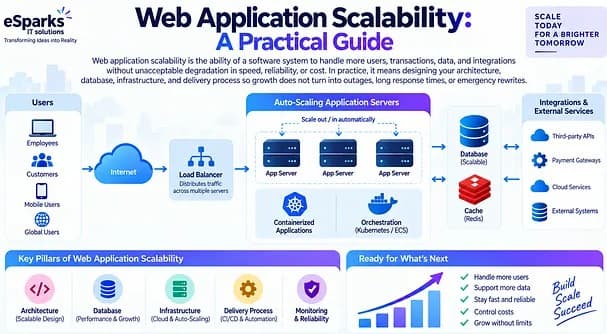
Web Application Scalability: A Practical Guide
Learn what web application scalability means, how to design for growth, and which architecture, cloud, data, and DevOps choices matter most.
Sep 21, 2026Read
Web Development
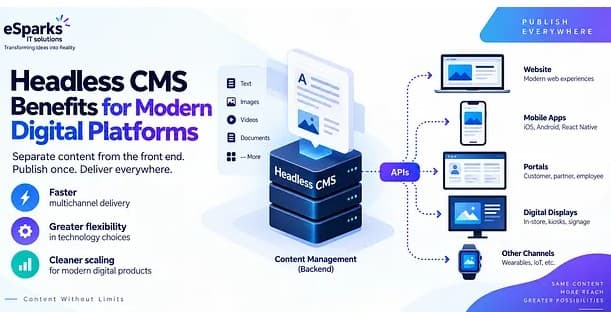
Headless CMS Benefits for Modern Digital Platforms
Explore headless CMS benefits for web, mobile and omnichannel delivery, plus costs, pitfalls and a practical decision framework for leaders.
Sep 20, 2026Read
Work with us
Have a system to build, fix or scale?
Tell us what you are working on and where it hurts. We will tell you how we would approach it.