Cloud Computing
Heterogeneous Database Migration Tools: UK Buyer Guide
A practical UK guide to heterogeneous database migration tools, covering selection, risk, security, timelines and delivery choices.

Tauseef Alam
Chief Technology Officer
- Published
- Nov 6, 2026
- Reading time
- 10 min read

Heterogeneous database migration tools help organisations move data between different database engines, such as Oracle to PostgreSQL or SQL Server to MySQL, with less manual effort and lower cutover risk. The right tools can automate schema conversion, continuous replication, validation and rollback preparation, but they do not remove the need for careful application testing, security controls and migration design. For UK businesses, the best choice is usually the toolchain that matches your specific source systems, downtime tolerance and compliance obligations, not the most feature-heavy platform.
Key takeaways
- Heterogeneous database migration tools are used to move data between different database engines, but the real challenge is preserving application behaviour, performance and governance after the move.
- The best migration approach usually combines schema conversion, change data capture, validation and rollback planning rather than relying on a single product.
- For UK organisations, database migration planning should address UK GDPR, encryption, access control, audit trails and data residency before cutover is scheduled.
- A sound tool choice depends on source and target databases, downtime tolerance, transformation complexity, operational skills and licensing model, not on feature lists alone.
- Most migration delays come from hidden dependencies such as stored procedures, reporting jobs, integration feeds and application-side SQL assumptions rather than from data copy speed.
Why heterogeneous migrations are harder than they look
Moving from one database to another is rarely just a copy-and-paste exercise. A homogeneous migration, such as PostgreSQL to PostgreSQL, mostly preserves data types, indexing patterns and query behaviour. A heterogeneous migration changes engine semantics: Oracle packages do not map neatly to PostgreSQL functions, SQL Server identity handling differs from MySQL auto-increment, and a relational-to-NoSQL move changes the whole data modelling approach.
That matters because business risk sits above the database layer. Billing systems, reporting pipelines, CRM workflows, warehouse feeds, mobile apps and API integrations often contain engine-specific assumptions. In our experience, the migration fails less often because the tool could not move rows and more often because no one surfaced hidden dependencies early enough: collation differences, time zone handling, sequence behaviour, case sensitivity, trigger logic, ETL jobs, or reports that rely on undocumented views.
A sensible programme starts by separating the problem into four layers:
- Data movement: initial load, incremental sync, change data capture and reconciliation
- Schema and code conversion: tables, indexes, views, stored procedures, triggers and jobs
- Application compatibility: ORM mappings, SQL dialect assumptions, latency tolerance and connection behaviour
- Operations and governance: backup, monitoring, access control, retention, auditability and disaster recovery
If a partner or vendor speaks only about transfer speed, they are discussing the easiest part of the work.
Evaluating heterogeneous database migration tools in practice
When buyers compare heterogeneous database migration tools, they often start with a product grid. That is useful, but the better approach is to evaluate by migration pattern. If you need near-zero downtime from Oracle to PostgreSQL on AWS, the shortlist may include AWS Database Migration Service for replication, AWS Schema Conversion Tool or Ora2Pg for code analysis, plus Flyway or Liquibase for controlled deployment. If you are moving SQL Server workloads into Azure, Azure Database Migration Service may fit well operationally. For continuously replicated enterprise environments with stricter operational controls, tools such as Oracle GoldenGate, Qlik Replicate or Striim are commonly assessed.
Open-source options can be strong in the right context. Debezium with Kafka works well where event streaming is already part of the platform. pgloader is often useful for straightforward loads into PostgreSQL. Ora2Pg can accelerate assessment and conversion work. But open source still demands engineering maturity: observability, retries, idempotency, error handling, schema governance and operational ownership do not appear automatically.
A practical evaluation should score tools against the following criteria:
- Supported source and target engines, including versions and managed variants such as Amazon RDS, Azure SQL Database or Cloud SQL
- Change data capture capability, including how it handles deletes, DDL changes and high transaction volumes
- Schema conversion depth for stored procedures, views, functions, indexes, sequences and constraints
- Validation features for row counts, checksums, referential integrity and exception reporting
- Security controls such as encryption in transit, secret management, RBAC and audit logs
- Deployment model: SaaS, self-hosted, cloud-native managed service or hybrid
- Operational fit: monitoring, alerting, restart behaviour, replay, error queues and rollback support
- Commercial model: licensing, throughput limits, connectors, professional services dependency and exit risk
For most business systems, no single tool covers everything elegantly. The strongest solutions usually combine one replication tool, one schema conversion approach, a migration runbook, and automated validation.
A step-by-step decision framework for buyers
Decision-makers need a repeatable way to separate realistic plans from optimistic slideware. A simple framework helps.
First, classify the migration by business criticality and downtime tolerance. A reporting database with a nightly load allows a different approach from a customer-facing transaction platform that cannot tolerate more than a brief maintenance window. This one decision shapes whether you need offline export/import, log-based CDC, dual-running, or phased cutover.
Second, inventory the real migration scope. That means more than table counts. Ask for a catalogue of stored procedures, triggers, scheduled jobs, linked servers, replication chains, ETL pipelines, downstream BI reports, application connection strings, integration users and data quality issues. During one of our own builds, Database Migration Platform, the most valuable work was not the data copy itself but making dependencies visible early enough to plan safe cutovers and retries.
Third, score your target state. Buyers often choose PostgreSQL, MySQL, SQL Server, MongoDB or cloud-managed services for sensible reasons: licensing pressure, cloud alignment, resilience or team familiarity. But the target should be evaluated against workload shape, not trendiness. OLTP, analytics, search-heavy read patterns, geospatial queries and event ingestion all place different demands on indexing, partitioning, consistency and scaling.
Fourth, run a proof of feasibility before committing to a full programme. That proof should test:
- A representative schema, not a toy subset
- Complex objects such as procedures, triggers and views
- Realistic transaction throughput and CDC lag
- Data validation and reconciliation workflows
- Application behaviour under production-like latency
- Failover, restart and rollback scenarios
Finally, choose the delivery model. For small estates, a focused migration sprint may be enough. For larger estates, a factory model works better: standardised assessment templates, repeatable conversion pipelines, a testing harness, controlled releases and governance across multiple databases or business units.
Architecture, security and compliance considerations
For UK businesses, architecture and compliance are often decisive. A migration is not just a technical change; it is a data handling event with governance implications. At minimum, ask how the migration design addresses UK GDPR obligations, least-privilege access, retention rules, auditability, and where transient migration data or logs are stored.
Security questions should be concrete rather than generic. Is data encrypted in transit with modern TLS? Are credentials stored in a vault such as AWS Secrets Manager, Azure Key Vault or HashiCorp Vault rather than in scripts? Are migration operators using named accounts with RBAC and SSO through SAML or OIDC? Are audit logs retained and exportable? If masked or synthetic test data is required, is that included in the plan or assumed away?
On architecture, several patterns are common:
- Offline migration: simplest and often cheapest, but requires a longer outage window
- Online CDC migration: initial load plus continuous replication until cutover; common for business-critical systems
- Blue-green database cutover: build target in parallel, validate, then switch application traffic deliberately
- Phased domain migration: move one bounded context, schema or service at a time to reduce blast radius
- Dual-write transition: occasionally useful, but risky unless consistency semantics are very clear
Standards and controls matter. Mature teams align migration work with ISO 27001-style controls, maintain change records, document rollback criteria and test backup restore on the target platform. If payments, healthcare or sector-specific data is involved, additional controls such as PCI DSS scope handling or stronger pseudonymisation may be necessary.
Common pitfalls and how to avoid them
The most expensive migration mistakes are usually predictable. One is underestimating procedural code. Teams may convert table structures successfully, then discover that business rules live inside PL/SQL packages, T-SQL procedures or triggers that are deeply tied to the source engine. The fix is to assess code objects early, decide what should be rewritten into application services, and avoid line-by-line automated conversion without review.
Another common pitfall is ignoring performance until the end. A schema that is functionally correct may still fail under production load because of indexing differences, query planner behaviour, partitioning choices or transaction isolation settings. Mitigation is straightforward but non-negotiable: capture representative workloads, benchmark realistic queries, and tune the target before cutover rather than after users complain.
Other issues appear repeatedly:
- Data type mismatches, especially dates, timestamps, Unicode, decimals and large objects
- Incomplete CDC setup, causing missed updates or unexpected replication lag
- Reporting and batch jobs still pointing at the source after cutover
- Weak reconciliation, relying on row counts only rather than checksums and business-rule validation
- No rollback threshold or unclear cutover authority
- Insufficient observability on the new platform, making the first incident harder to resolve
A disciplined runbook reduces these risks. It should define pre-cutover checks, freeze periods, validation queries, business sign-off criteria, rollback triggers, communication paths and ownership per system. This sounds operational because it is: migrations are won or lost in execution discipline.
Typical timelines, cost drivers and delivery models
Business leaders usually ask two questions early: how long will this take, and what will drive cost? The honest answer is that timelines vary more by dependency complexity than by raw data volume.
A relatively simple migration, such as a modest SQL Server or MySQL database with limited procedural logic and a tolerable maintenance window, may be planned and delivered in roughly 2 to 6 weeks. A mid-complexity migration involving CDC, non-trivial schema conversion, integration testing and rehearsed cutovers often runs 2 to 4 months. Large estates, highly customised Oracle environments, multi-application dependencies or regulated workloads commonly extend into 4 to 9 months or more, particularly if the programme includes platform redesign rather than like-for-like relocation.
Typical cost drivers include:
- Number and diversity of source systems
- Complexity of procedural code and data transformations
- Downtime tolerance and need for near-zero disruption
- Volume of testing, especially performance and UAT cycles
- Security, compliance and audit requirements
- Licensing for commercial migration products and cloud infrastructure during transition
- Need to refactor application code, ETL or reports alongside the database move
In budget terms, decision-makers should think in ranges rather than false precision. A small contained migration may sit in the tens of thousands of pounds; broader programmes with multiple databases, streaming replication, compliance controls and application remediation can move into low or mid six figures. The wide range is normal. The way to improve confidence is not to demand a prematurely fixed number; it is to pay for a strong discovery and proof phase that turns unknowns into defined work.
What good delivery looks like from a software partner
A capable migration partner should improve clarity, not just capacity. You are looking for evidence that they can connect database work to application, cloud and operational realities. That means they can talk comfortably about schema conversion, but also about Kubernetes deployments, CI/CD pipelines, secrets management, observability, IAM, data contracts and rollback design where those are relevant to the target environment.
Good delivery usually has a recognisable shape. The team begins with discovery and dependency mapping, creates an architecture decision record for the target state, chooses a toolchain deliberately, and proves the approach on representative workloads. They automate repeatable parts with infrastructure as code and migration scripts, keep changes versioned in tools such as Flyway or Liquibase, and establish validation gates that business owners understand. They do not hide risk inside vague language like seamless or turnkey.
At Esparks, we have found that the most valuable migration outcomes come from combining software engineering discipline with pragmatic operations. Buyers should expect candid trade-off discussions: when to use AWS DMS versus custom CDC patterns, when to keep some logic in the application rather than the database, and when a phased migration is safer than a big-bang cutover. If a partner can explain those choices clearly, with concrete assumptions and rollback paths, you are far more likely to end up with a database migration that is not only completed, but supportable.
Frequently Asked Questions
What are heterogeneous database migration tools?
Heterogeneous database migration tools are platforms or utilities used to move data between different database engines, such as Oracle to PostgreSQL or SQL Server to MySQL. They typically support schema conversion, data transfer, change data capture, validation and cutover management, although most real projects still need custom engineering and testing.
Can heterogeneous database migration tools deliver zero downtime?
They can help minimise downtime, but zero downtime is not guaranteed by the tool alone. Near-zero disruption usually requires log-based replication or CDC, careful application cutover planning, validation, and a rollback path that has been tested in advance.
How do I choose between AWS DMS, Azure DMS and specialist products like GoldenGate or Qlik Replicate?
Start with your source and target platforms, operational environment and downtime tolerance. Cloud-native services are often cost-effective and easier to run for common cloud migrations, while specialist products may be better suited to complex enterprise estates, higher throughput, stricter controls or broader connector support.
What is the biggest hidden risk in a heterogeneous database migration?
The biggest hidden risk is usually not the data copy itself but the undocumented dependency landscape around the database. Stored procedures, reporting jobs, ETL feeds, application SQL assumptions, collation settings and security rules can all break after cutover if they are not discovered and tested early.
Work with Esparks IT Solutions
Planning a project around this? We work with businesses in the United States, Canada and the UAE, as well as the UK and Australia. See how we work with clients in the UK. See a related project: Database Migration Platform. Explore our Cloud Computing services and portfolio, estimate your project cost, or book a free call.
Written by

Tauseef Alam
Chief Technology Officer
Chief Technology Officer at Esparks IT Solutions. Writes from the team's own delivery work across software, cloud, DevOps and security.
Related topics
Continue reading
More in Cloud Computing
Cloud Computing
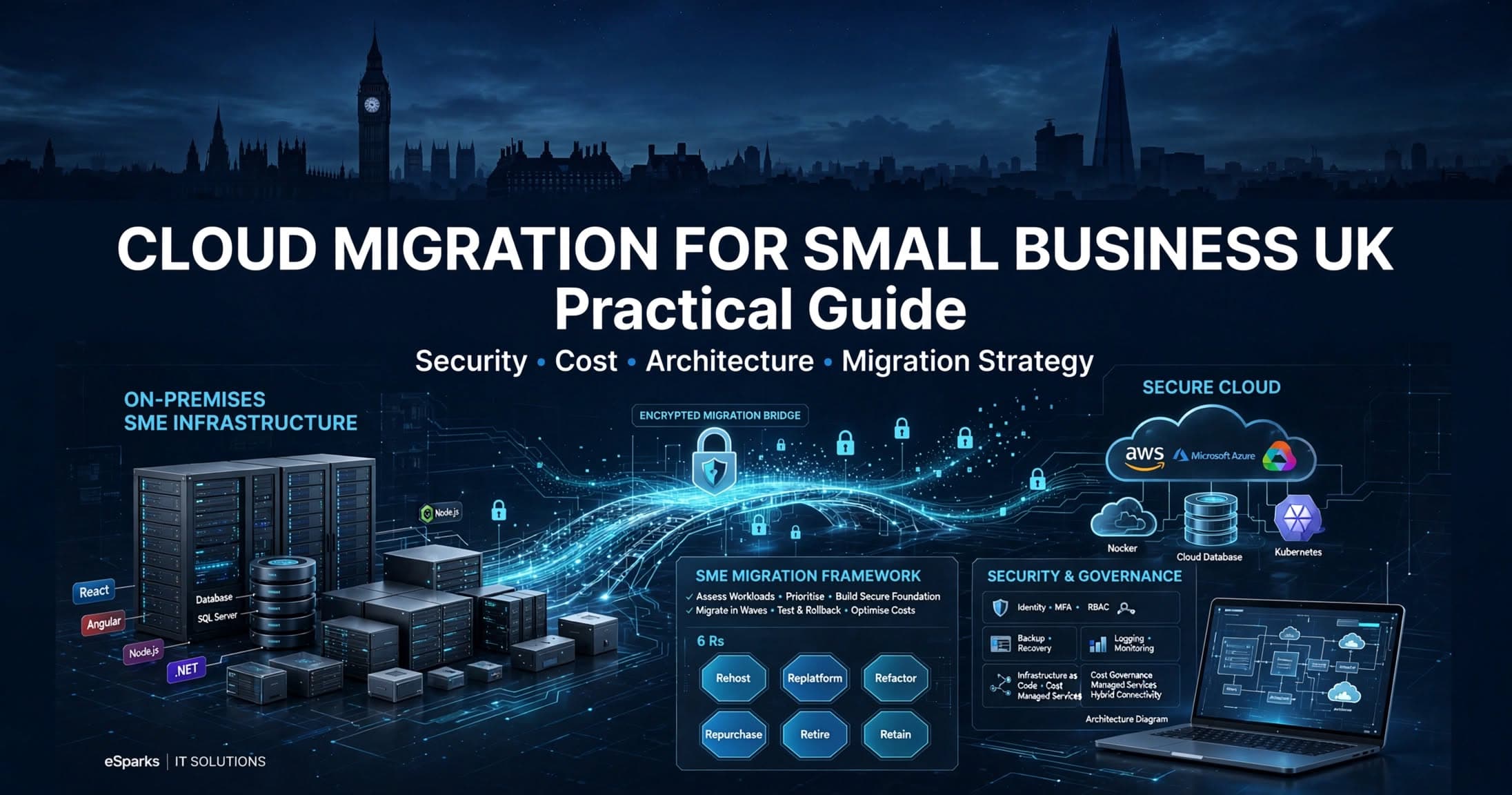
Cloud Migration for Small Business UK: Practical Guide
A practical guide to cloud migration for small business UK leaders, covering costs, timelines, security, architecture choices and common mistakes.
Aug 5, 2026Read
Cloud Computing
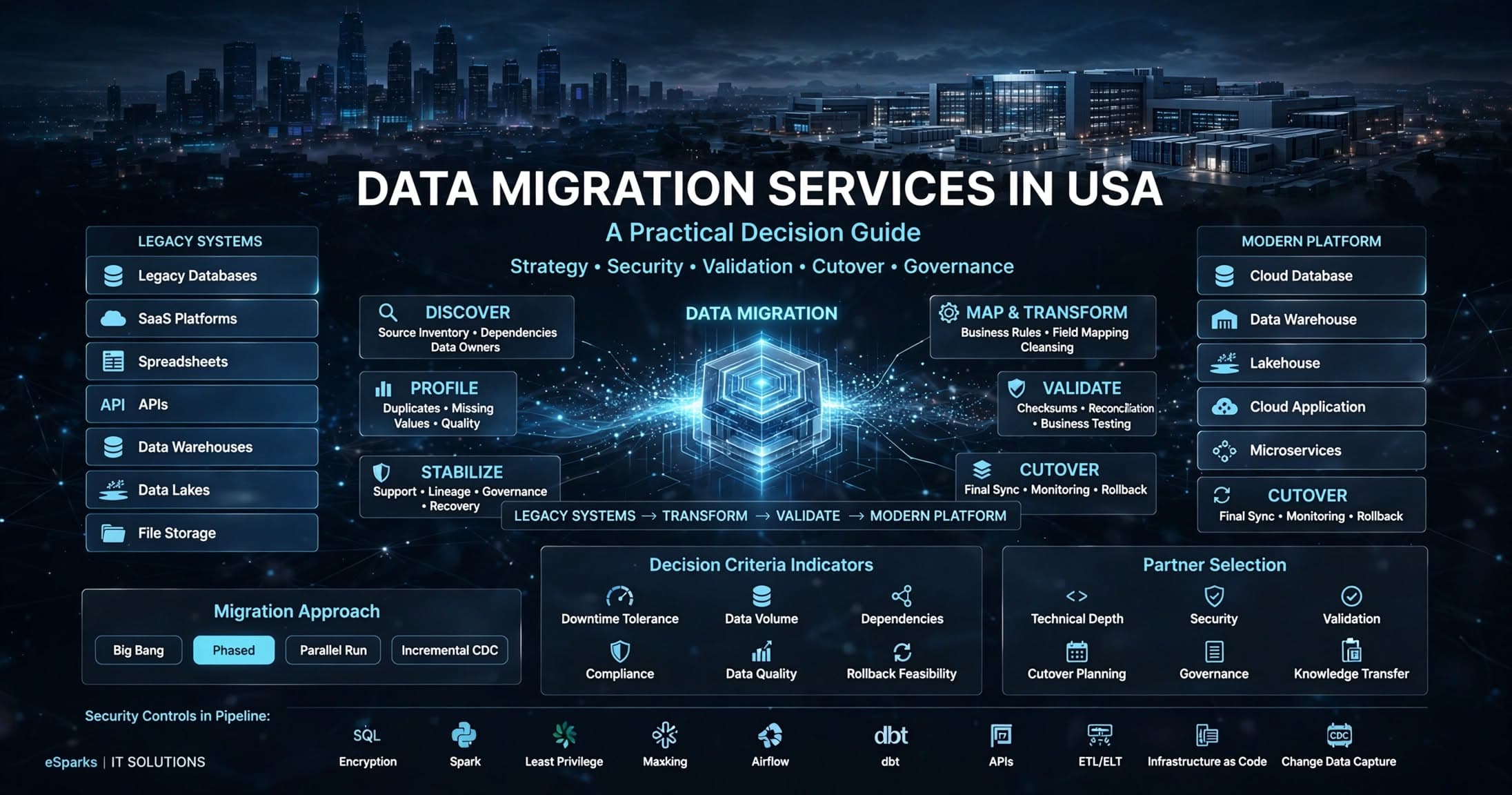
Data Migration Services in USA: A Practical Decision Guide
Evaluate data migration services in usa with a practical guide to strategy, tools, timelines, security, costs, and partner selection criteria.
Jul 11, 2026Read

Cloud Computing
Mysql to Postgresql Migration Service: UK Decision Guide
A practical UK guide to choosing a mysql to postgresql migration service, covering risks, cost, timelines, tooling and delivery approach.
Sep 14, 2026Read
Work with us
Have a system to build, fix or scale?
Tell us what you are working on and where it hurts. We will tell you how we would approach it.