Cloud Computing
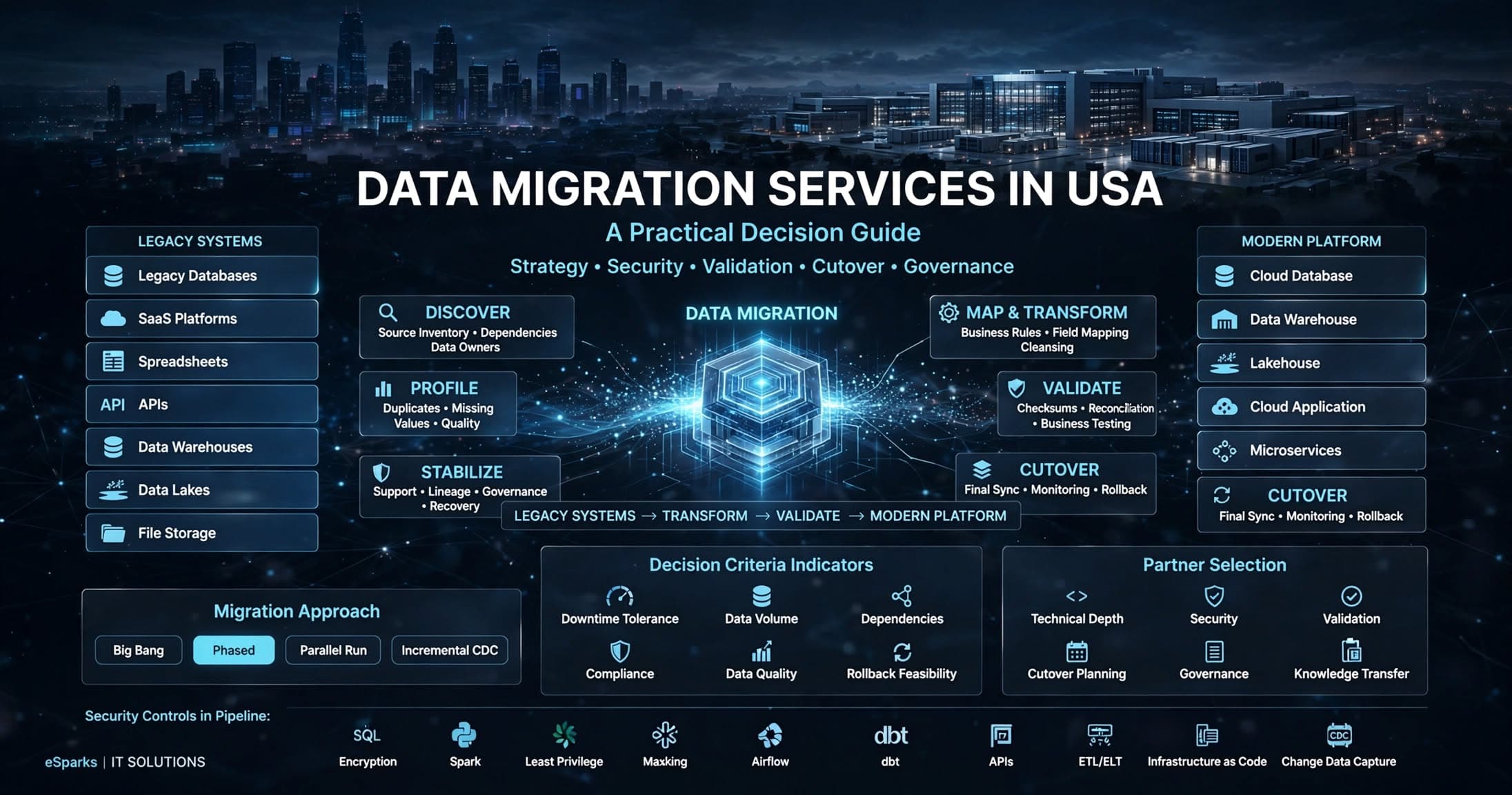
Data Migration Services in USA: A Practical Decision Guide
Evaluate data migration services in usa with a practical guide to strategy, tools, timelines, security, costs, and partner selection criteria.

Tauseef Alam
Chief Technology Officer
Jul 11, 2026
8 min read
What data migration services in usa typically include
Key takeaways
- Data migration is a business continuity and compliance decision, not just a technical file transfer.
- Professional data migration usually includes discovery, profiling, mapping, validation, cutover planning, and post-migration support.
- Migration urgency often rises during events like cloud moves, ERP or CRM replacements, mergers, and regulatory audits.
- Big bang, phased, parallel run, and incremental CDC migrations each trade off speed, risk, downtime, and complexity.
- Successful migration depends on preserving business rules, resolving duplicates, and aligning source definitions before cutover.
Selecting data migration services in usa is not only a technical sourcing decision; it is a business continuity, compliance, and operating model decision. For founders, CTOs, and IT managers, the goal is to move data from legacy systems, spreadsheets, on-premises databases, SaaS platforms, warehouses, or data lakes into a target environment without disrupting revenue operations, reporting, customer experience, or regulatory obligations.
A professional migration program usually covers discovery, data profiling, architecture design, extraction, transformation, validation, cutover planning, and post-migration support. Depending on the organization, the target may be a cloud-native application, an enterprise resource planning platform, a customer relationship management system, a modern data warehouse, a data lakehouse, or a microservices platform. The work often involves relational databases, document stores, object storage, message queues, REST APIs, SFTP feeds, change data capture, and batch processing pipelines.
The most important distinction is that data migration is not the same as simply copying files. Business rules must be preserved, duplicate records must be reconciled, fields must be mapped, security permissions must be translated, and downstream reports must still make sense. A customer record, for example, may exist in billing, support, marketing, and product analytics systems with different identifiers. If those relationships are not resolved before migration, the new system may technically function but produce unreliable operational decisions.
When migration becomes a strategic business priority
Data migration typically becomes urgent during major business events. Common triggers include replacing a legacy application, consolidating systems after a merger, moving infrastructure to cloud platforms, modernizing analytics, adopting a new ERP or CRM, separating business units, improving cybersecurity posture, or preparing for regulatory audits. In these moments, data quality directly affects speed, risk, and adoption.
Consider a regional healthcare provider moving from an older patient scheduling platform to a cloud-based system. The migration must preserve appointment history, patient identifiers, consent records, insurance details, audit logs, and retention requirements. A retail business migrating e-commerce, inventory, and loyalty data faces different concerns: product catalog structures, customer profiles, order history, discount rules, and real-time stock synchronization. A manufacturing firm moving from spreadsheets and an aging database into an integrated planning system must validate bills of materials, supplier codes, production schedules, and historical purchase orders.
Migration can also be strategic when executives need better visibility. Many organizations operate with fragmented reporting across finance, sales, operations, and customer service. Moving data into a governed warehouse or lakehouse can improve decision-making, but only if source definitions are aligned. Terms such as active customer, recurring revenue, churn, open ticket, or fulfilled order must be defined consistently before they are embedded into dashboards and automated workflows.
Core migration approaches and how to choose between them
Most migrations use one of several proven approaches. A big bang migration moves all selected data and users at once during a planned cutover window. It can be efficient for smaller systems with limited dependencies, but it carries higher operational risk if validation is weak. A phased migration moves modules, regions, departments, or data domains in waves, reducing risk while extending the overall timeline. A parallel run keeps old and new systems operating together for a defined period, which helps compare outputs but increases support complexity.
For high-availability systems, teams often use incremental migration with change data capture. Historical data is loaded first, then ongoing changes are replicated until the final cutover. This model is common when downtime windows are limited, such as order processing, logistics, SaaS products, banking workflows, or customer support platforms. Event-driven architectures may use streams and queues to keep systems synchronized while services are gradually refactored.
A practical selection framework should evaluate:
- Downtime tolerance: Can the business accept hours of downtime, or is near-continuous operation required?
- Data volume and velocity: Is the migration measured in gigabytes, terabytes, or continuously changing transactional data?
- System dependency: How many applications, reports, integrations, and user groups rely on the source system?
- Compliance exposure: Are records subject to HIPAA, PCI DSS, GDPR, CCPA, SOC 2 controls, or contractual retention rules?
- Data quality: Are duplicates, missing values, conflicting formats, or undocumented business rules already known issues?
- Rollback feasibility: Can the organization safely return to the old system if cutover fails?
No single approach is best for every environment. The right method balances operational risk, budget, timeline, regulatory obligations, and the organization’s ability to support change.
Step-by-step framework for evaluating a migration partner
Decision-makers should evaluate a migration partner through a structured process rather than relying on broad claims about experience. Start with a discovery workshop that identifies source systems, target platforms, owners, data domains, integration points, reporting dependencies, security constraints, and known pain points. The output should include an inventory of databases, file stores, APIs, scheduled jobs, business-critical reports, and systems of record.
Next, request a migration assessment that includes data profiling. Profiling should examine null values, duplicate entities, referential integrity, format inconsistencies, outliers, encoding issues, field length mismatches, and personally identifiable information. For example, a customer migration may reveal multiple date formats, duplicate emails, invalid addresses, and records tied to inactive accounts. A strong assessment also identifies transformation rules, such as converting legacy status codes into target workflow states.
A practical decision framework includes these steps:
- Define the business outcome: application replacement, analytics modernization, cloud migration, consolidation, compliance remediation, or product scaling.
- Classify data by criticality: customer, financial, operational, historical, archived, regulated, and disposable data.
- Confirm target architecture: relational database, document store, warehouse, lakehouse, object storage, or hybrid model.
- Review migration tooling: ETL and ELT platforms, scripting, database replication, API-based extraction, data validation tools, and orchestration systems such as Airflow.
- Examine delivery governance: roles, approval gates, risk logs, test cycles, incident response, and escalation paths.
- Require a cutover plan: freeze periods, final sync, user access changes, monitoring, rollback criteria, and support coverage.
- Validate knowledge transfer: runbooks, data dictionaries, lineage documentation, and operational handover.
The evaluation should include technical depth, but also communication discipline. Migration programs fail when assumptions remain undocumented. Clear ownership, issue tracking, and sign-off criteria are as important as scripts and pipelines.
Technologies, standards, and controls that matter
Modern data migration uses a mix of database utilities, ETL or ELT pipelines, orchestration, automation, and validation tooling. Common building blocks include SQL-based extraction, Python scripts for transformation, Spark for distributed processing, Kafka-style streaming patterns for event movement, Airflow-style scheduling, dbt-style transformation modeling, containerized jobs, infrastructure as code, and API integration layers. For cloud environments, object storage is often used as a staging layer before data is transformed and loaded into the final system.
Security must be designed into each stage. Data should be encrypted in transit with TLS and encrypted at rest using strong key management practices. Access should follow least privilege, with temporary credentials wherever possible. Sensitive fields such as Social Security numbers, payment card data, health data, employee records, or authentication details may require masking, tokenization, pseudonymization, or selective exclusion. Logs should not expose secrets or personal data.
Standards and frameworks provide structure. ISO 27001, SOC 2, NIST Cybersecurity Framework, HIPAA, PCI DSS, GDPR, and CCPA may be relevant depending on the industry and geography. Organizations operating in the USA, UK, Canada, Australia, UAE, Saudi Arabia, Qatar, or the Netherlands should also consider data residency, cross-border transfer mechanisms, contractual data processing terms, audit retention, and regulator expectations. A migration plan should include a data protection impact review when regulated or sensitive data is involved.
Validation is another critical technical layer. Effective validation compares record counts, checksums, sampled records, referential integrity, business aggregates, reconciliation reports, and application-level behavior. For instance, invoice totals in the new system should match approved financial records, not just row counts in a table. A technically complete migration is not successful until business users confirm that essential workflows and reports remain accurate.
Common pitfalls and how to avoid them
One of the most common pitfalls is underestimating data quality problems. Legacy systems often contain years of workarounds, free-text fields, unused columns, manual corrections, and inconsistent identifiers. Avoid this by running profiling early and assigning business owners to resolve ambiguous rules. Technical teams can identify duplicates, but only business stakeholders can decide which customer, supplier, or product record is authoritative.
Another frequent issue is treating migration as an IT-only project. Data affects sales, finance, operations, compliance, customer service, and executive reporting. If users are not involved until acceptance testing, critical business logic may be discovered too late. The better approach is to involve data stewards and process owners during mapping, cleansing, validation, and cutover rehearsal.
Additional pitfalls include:
- Weak rollback planning: Define objective rollback triggers before cutover, not during an incident.
- Overloaded cutover windows: Practice cutover in a non-production environment and measure actual task duration.
- Uncontrolled scope expansion: Separate must-have migration scope from future enrichment and reporting improvements.
- Poor lineage documentation: Record where each field came from, how it changed, and who approved the rule.
- Ignoring downstream systems: Validate integrations, dashboards, exports, and scheduled jobs, not only the target database.
- Inadequate security review: Review access, encryption, retention, and logging before any production extraction.
Avoiding these issues requires disciplined governance. A migration steering group should review risks, approve mapping decisions, track defects, and confirm readiness at each stage. The team should also maintain a decision log so future audits or support teams can understand why certain records were transformed, merged, archived, or excluded.
Typical timelines, cost ranges, and planning assumptions
Timelines vary significantly by data volume, complexity, compliance, and organizational readiness. As a typical planning estimate, a small migration involving one or two systems, limited data cleansing, and a standard target platform may take four to eight weeks. A mid-sized migration involving multiple systems, custom mappings, integration testing, and business validation may take eight to sixteen weeks. Complex enterprise migrations involving regulated data, high availability, multiple regions, and many dependencies can take six months or longer.
Cost ranges should also be treated as planning estimates rather than fixed benchmarks. A focused migration for a smaller application may fall in the tens of thousands of US dollars. A mid-market migration with several data sources, validation cycles, and integration work may range from the high five figures into the low six figures. Large enterprise programs with legacy modernization, compliance controls, custom tooling, and extended parallel runs can move into several hundred thousand dollars or more. Licensing, infrastructure, internal staff time, data cleansing, testing, security reviews, and post-migration stabilization all influence the final budget.
The most reliable way to control cost is to reduce uncertainty early. A paid discovery or assessment phase often prevents expensive surprises by identifying data defects, hidden integrations, undocumented reports, and unrealistic downtime assumptions. Leaders should also separate migration necessities from transformation ambitions. Cleansing critical customer records may be necessary before go-live; redesigning every dashboard or enriching every historical field may be better handled in a later phase.
A realistic plan should include contingency for defects, additional test cycles, stakeholder availability, and source system limitations. Older systems may have slow exports, limited APIs, character encoding issues, or undocumented schemas. These constraints can affect both time and budget more than raw data size.
Building a migration plan that supports long-term value
A strong migration plan should leave the organization with cleaner data, clearer ownership, and more reliable operations than it had before. That requires attention to governance beyond go-live. Data dictionaries, ownership models, retention schedules, access policies, integration documentation, and quality checks should become part of normal operations. Without these controls, the new platform can accumulate the same quality issues that existed in the old environment.
Post-migration stabilization is equally important. After cutover, teams should monitor application performance, data synchronization, failed jobs, user access, reporting discrepancies, and support tickets. Reconciliation should continue for a defined period, especially for finance, orders, inventory, customer accounts, and compliance records. The organization should also confirm that backup, disaster recovery, audit logging, and incident response procedures are functioning in the target environment.
For decision-makers, the central question is not whether a provider can move data from one place to another. The real question is whether the migration will protect operations, preserve trust in reporting, meet regulatory expectations, and create a foundation for future digital transformation. A well-run migration combines architecture, security, governance, testing, and business accountability. When those elements are planned together, data migration becomes more than a technical transition; it becomes a controlled path toward a more scalable and reliable technology environment.
Frequently Asked Questions
What are data migration services in usa?
They are professional services that help organizations move data between systems, databases, applications, or cloud environments while preserving quality, security, and business continuity. They typically include discovery, mapping, cleansing, transformation, validation, cutover planning, and post-migration support.
How long does a typical data migration project take?
A small migration may take four to eight weeks, while mid-sized projects often require eight to sixteen weeks. Complex enterprise migrations with regulated data, many integrations, or near-zero downtime requirements can take six months or longer.
What should decision-makers check before selecting a migration partner?
Evaluate discovery depth, data profiling methods, security controls, validation approach, cutover planning, rollback strategy, and documentation practices. A qualified partner should be able to explain risks clearly and provide a structured plan before production data is moved.
How can businesses reduce data migration risk?
Start with data profiling, involve business owners early, rehearse cutover, validate both technical and business results, and define rollback criteria in advance. Strong governance and clear sign-off checkpoints reduce the chance of operational disruption.
Work with eSparks IT Solutions
Planning a project around this? We help businesses across the USA, UK, Canada, Australia and the GCC ship it. Explore our Cloud Computing services and portfolio, estimate your project cost, or book a free call.
Related cloud & DevOps services

Tauseef Alam
Chief Technology Officer
Passionate technology writer and industry expert with years of experience in software development, cloud computing, and digital transformation. Dedicated to sharing insights and helping developers stay ahead of the curve.
Related Topics
Continue Reading
More insights in Cloud Computing
Cloud Computing
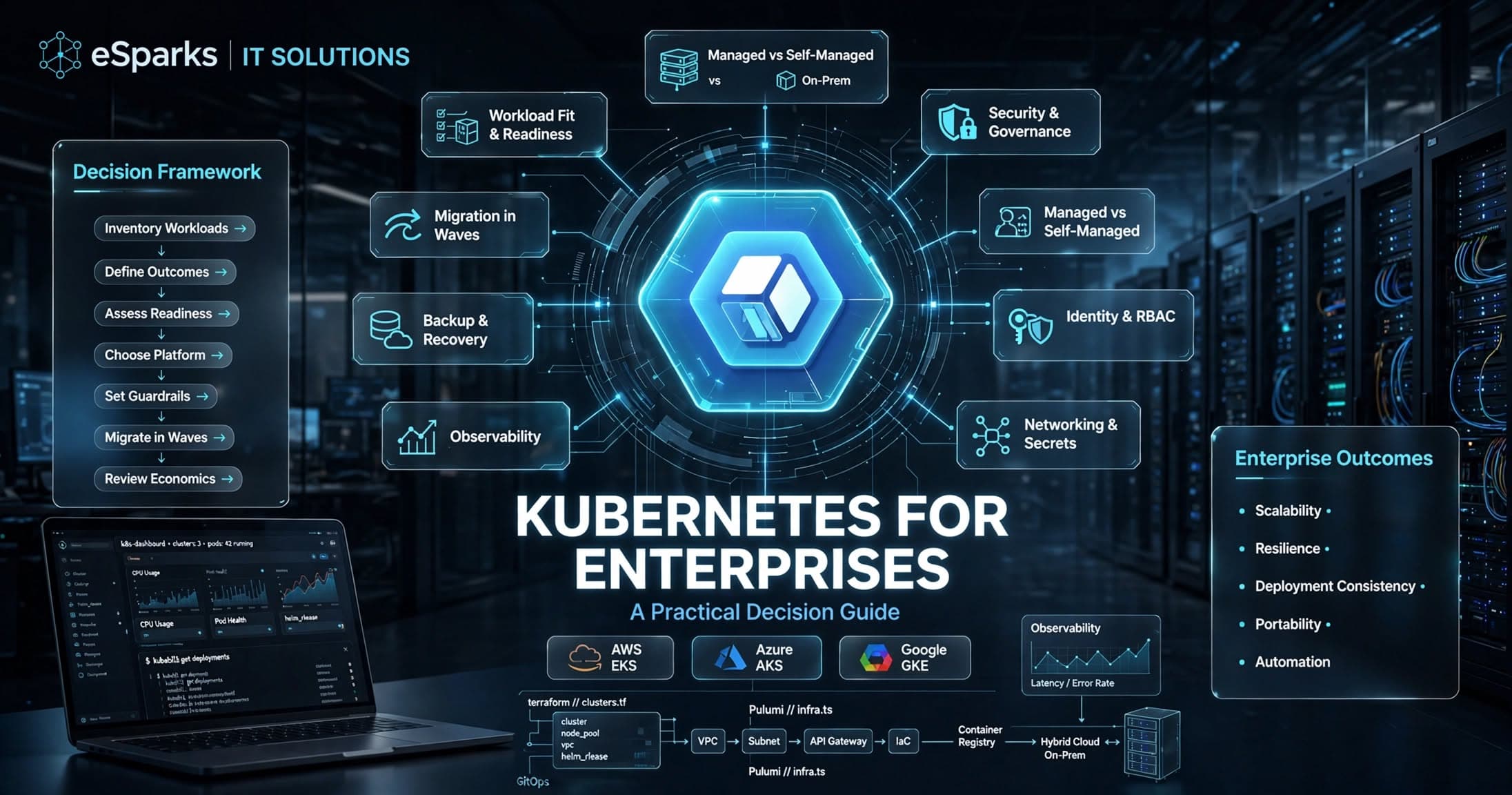
Kubernetes for Enterprises: A Practical Decision Guide
Kubernetes for enterprises can improve scalability, resilience, and release speed—but only when platform maturity, security, and operating model align.
Sep 26, 2026
Read More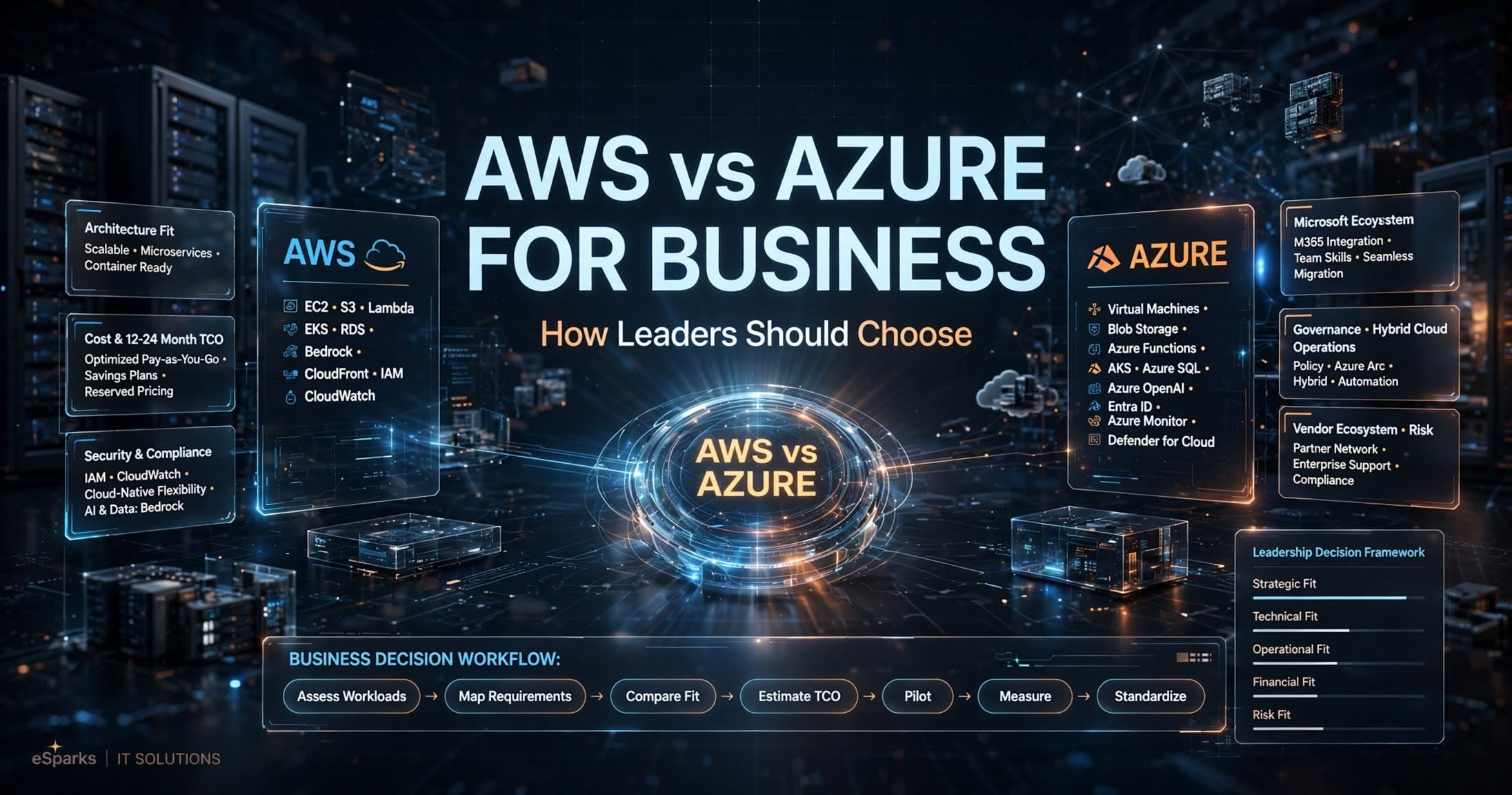
Cloud Computing
AWS vs Azure for Business: How Leaders Should Choose
Compare aws vs azure for business across cost, security, Microsoft fit, AI, and operations with a practical decision framework for leaders.
Sep 25, 2026
Read More
Cloud Computing
Mysql to Postgresql Migration Service: UK Decision Guide
A practical UK guide to choosing a mysql to postgresql migration service, covering risks, cost, timelines, tooling and delivery approach.
Sep 14, 2026
Read MoreReady to Transform Your Business?
Let's discuss how our expertise can help you achieve your goals