
Cloud Computing
Choosing an Oracle to PostgreSQL Migration Tool
Learn how to choose an oracle to postgresql migration tool, plan schema and code conversion, control downtime, and reduce migration risk.

Tauseef Alam
Chief Technology Officer
Oct 19, 2026
10 min read
If you are evaluating an oracle to postgresql migration tool, the short answer is this: the right tool should assess Oracle dependencies, convert schemas and code where possible, move data reliably, and support validation with minimal downtime. It should also fit your application architecture, because successful migration depends as much on handling PL/SQL, performance tuning, security, and cutover planning as it does on copying tables.
Key takeaways
- An oracle to postgresql migration tool can accelerate schema and data conversion, but it does not remove the need to redesign Oracle-specific SQL, PL/SQL, security, and operations.
- The highest-risk part of Oracle to PostgreSQL migration is usually application behavior, especially around stored procedures, transaction semantics, indexing strategy, and reporting queries.
- A low-risk migration plan includes discovery, assessment, proof of concept, code conversion, data validation, performance testing, and a clearly rehearsed cutover and rollback path.
- Typical timelines range from a few weeks for narrow, low-dependency databases to several months for business-critical systems with large data volumes and complex integrations.
- The best migration tooling supports assessment, schema conversion, data movement, validation, and repeatable automation, but final success depends on disciplined testing and operational readiness.
Why businesses move from Oracle to PostgreSQL
For many organizations, the move is not only about licensing. It is often about reducing platform lock-in, standardizing on open infrastructure, improving cloud portability, and giving engineering teams more flexibility in CI/CD, automation, and observability. PostgreSQL fits well into modern stacks on AWS, Azure, Google Cloud, Kubernetes, and managed database platforms, while still offering enterprise-grade features such as ACID transactions, replication, partitioning, JSON support, row-level security, and strong extension ecosystems.
The business case becomes stronger when Oracle is part of a wider modernization effort. We often see migration tied to application refactoring, data platform consolidation, or DevOps adoption. A company may be retiring legacy middleware, replacing batch-heavy reporting, or exposing APIs to mobile and web applications. In those cases, PostgreSQL is not just a cheaper destination; it is a practical foundation for cloud-native delivery, infrastructure as code, and more transparent operational control.
That said, not every Oracle workload should be moved as-is. Highly customized ERP-adjacent databases, systems with heavy PL/SQL logic, or applications that rely on Oracle-only features may need redesign rather than direct conversion. The right decision starts with understanding what the database actually does in production, not just what is documented.
What an oracle to postgresql migration tool should actually do
A good migration tool should help across the full journey, not only the data-copy stage. Decision-makers should look for capabilities in five areas:
- Discovery and assessment: inventory schemas, tables, indexes, constraints, packages, views, jobs, triggers, sequences, synonyms, and Oracle-specific objects.
- Conversion support: map data types, convert DDL, flag unsupported features, and provide guidance for PL/SQL to PL/pgSQL rewrites.
- Data movement: support full load, incremental sync or change data capture where needed, and resumable transfers for large datasets.
- Validation: compare row counts, checksums, schema objects, constraints, and sample query outputs between source and target.
- Automation and repeatability: integrate with scripts, CI/CD pipelines, and runbooks so test migrations can be repeated consistently.
In practice, no single tool fully automates complex Oracle migrations. Teams commonly combine vendor utilities, cloud migration services, SQL parsers, custom scripts, ETL jobs, and test harnesses. Examples in the market include AWS Schema Conversion Tool, Oracle SQL Developer migration features, ora2pg, pgloader, cloud-native Database Migration Services, and bespoke validation frameworks. The best choice depends on whether your workload is mostly tables and views, or a heavily procedural application with packages, jobs, and performance-sensitive SQL.
What matters most is transparency. A useful tool should tell you what it can convert, what it cannot, and where manual work is required. If a tool promises near-total automation without surfacing incompatible code paths, treat that as a risk signal rather than a benefit.
A practical decision framework for selecting the right approach
Before comparing products, classify the migration itself. Start with four questions: How large is the database? How much business downtime is acceptable? How much Oracle-specific logic exists? How many applications, reports, and integrations depend on it? The answers usually determine whether you need a straightforward migration utility, a replication-enabled migration stack, or a broader modernization program.
A practical decision framework looks like this:
-
Establish workload criticality.
- Noncritical internal systems can usually tolerate a shorter outage window.
- Revenue-impacting systems usually need staged rehearsal, fallback, and near-zero data-loss planning.
-
Measure Oracle dependence.
- Low dependence: mostly standard SQL, basic procedures, limited use of packages.
- Medium dependence: moderate PL/SQL, jobs, triggers, some proprietary functions.
- High dependence: deep use of packages, materialized views, advanced partitioning patterns, scheduler jobs, hints, and tightly coupled application behavior.
-
Choose a migration pattern.
- Offline migration for small or low-change databases.
- Hybrid full load plus incremental sync for systems with limited outage tolerance.
- Phased modernization when the database and application need redesign together.
-
Score tooling against your requirements.
- Does it convert DDL correctly?
- Does it identify incompatible objects early?
- Can it handle large objects, character sets, and sequences?
- Does it support validation and reruns?
- Can your team operate it confidently during cutover?
-
Run a proof of concept.
- Convert a representative schema.
- Migrate a production-like subset of data.
- Execute business queries, reports, and batch jobs.
- Record manual remediation effort.
This framework avoids a common procurement mistake: selecting the flashiest tool before understanding the migration shape. In our experience, the proof of concept reveals more value than a feature checklist because it exposes procedural code issues, indexing differences, and query planner behavior under realistic load.
The technical gaps tools rarely solve automatically
Schema conversion is usually the easiest layer. The harder work is behavioral compatibility. Oracle and PostgreSQL differ in procedural language features, sequence handling, date arithmetic, optimizer behavior, transaction patterns, and some DDL conventions. Even when a tool converts syntax, the result may not be production-ready without review.
Common areas that need manual attention include:
- PL/SQL packages and procedures: PostgreSQL supports PL/pgSQL, but package structures, exception patterns, dynamic SQL, and cursor usage often need redesign.
- Data types: NUMBER, CLOB, BLOB, RAW, DATE, TIMESTAMP WITH TIME ZONE, and XML-related structures need careful mapping based on real usage, not only declared type.
- SQL idioms: CONNECT BY, MERGE behavior, outer join syntax, ROWNUM, dual, decode, and proprietary functions may require rewrites.
- Jobs and scheduling: DBMS_SCHEDULER jobs often move to pg_cron, application schedulers, or external orchestration such as Airflow.
- Security models: roles, grants, auditing, encryption, secrets handling, and row-level controls need revalidation under PostgreSQL conventions.
Performance tuning also changes. Oracle execution plans, hints, and indexing strategies do not transfer directly. PostgreSQL may perform better with different composite indexes, partitioning schemes, VACUUM and ANALYZE settings, autovacuum tuning, connection pooling through PgBouncer, and query rewrites that suit its planner. Materialized views, denormalization for reporting, or separating OLTP and analytics workloads may become sensible where Oracle previously masked inefficiencies.
When we built Database Migration Platform, one lesson stood out clearly: teams benefit most when migration is treated as a repeatable engineering process rather than a one-time data move. Assessment, conversion, validation, and reruns need to be systematic, because the first pass almost never becomes the production pass.
Planning downtime, validation, and cutover without surprises
For business stakeholders, the biggest concern is usually not conversion quality but operational risk. Can the system be cut over safely? Can the team prove data integrity? Is rollback realistic? These questions should be answered before production weekend, not during it.
A sound cutover plan typically includes:
- A source-of-truth inventory: what tables, jobs, integrations, and reports are in scope.
- A migration sequence: schema creation, full data load, incremental sync, code deployment, validation, and switch-over order.
- Rehearsals: at least one full dry run in a production-like environment.
- Validation gates: row counts, referential integrity checks, sequence positions, checksum or hash-based comparisons, and functional test cases for key business flows.
- Rollback criteria: explicit conditions under which traffic is switched back and how data divergence will be handled.
For lower-downtime needs, teams often use a full-load plus replication approach. Initial data is copied ahead of time, then ongoing changes are synchronized until cutover. The final outage is used for delta catch-up, application switch, smoke testing, and release sign-off. This pattern reduces cutover risk, but it adds complexity around conflict handling, transaction ordering, and consistency checks, especially if writes continue across multiple systems.
Validation should go beyond row counts. For example, an invoicing platform may need exact agreement on monetary precision, tax calculations, posting dates, and reconciliation outputs. A customer portal may need to verify search behavior, pagination, time-zone display, and audit logs. The migration is successful only when the business behaviors match what users and downstream systems expect.
Typical timelines, cost drivers, and resourcing realities
Timelines vary widely, but business leaders should expect broad ranges rather than one-size-fits-all promises. A small, low-dependency database with limited procedural code may be assessed, converted, tested, and moved in a few weeks. A larger operational system with multiple integrations, stored procedures, reports, and strict cutover requirements can take several months. Programs that combine database migration with application modernization often run longer because they involve code refactoring, environment changes, and organizational approvals.
The main cost drivers are usually:
- Volume and complexity of database objects, not just data size.
- Amount of PL/SQL and Oracle-specific SQL that must be rewritten.
- Number of consuming applications, ETL jobs, dashboards, and external interfaces.
- Downtime constraints and the need for replication or rehearsal environments.
- Testing depth, especially for regulated, financial, healthcare, or audit-sensitive workloads.
Resourcing matters as much as tools. A reliable migration often needs database engineers, application developers, QA, DevOps, and business-side testers who understand critical workflows. Security and compliance stakeholders should also review access controls, retention rules, backup strategy, and disaster recovery in the target platform. If managed PostgreSQL is the destination, decisions around high availability, read replicas, maintenance windows, patching, and observability should be made early rather than after go-live.
A realistic estimate should therefore separate the work into assessment, remediation, data migration, validation, cutover, and hypercare. That structure gives executives a clearer view of what is fixed, what is variable, and where contingency is justified.
Common pitfalls and how experienced teams avoid them
The most common pitfall is assuming the migration is primarily a database administrator task. In reality, the riskiest issues often appear in application logic, reports, and integrations. Teams avoid this by identifying business-critical queries and user journeys early, then testing them repeatedly as the target environment evolves.
Another frequent mistake is migrating schema faithfully without rethinking operational practices. PostgreSQL needs its own backup, restore, monitoring, connection management, maintenance, and performance baselines. A successful team defines these before cutover, including metrics for locks, replication lag, slow queries, storage growth, vacuum behavior, and failover procedures.
A final set of practical safeguards can prevent expensive surprises:
- Freeze unnecessary source changes during the final migration window.
- Standardize character encoding and time-zone handling before conversion.
- Review sequence alignment after data loads to avoid duplicate-key failures.
- Benchmark representative write-heavy and report-heavy workloads separately.
- Test restore from backup, not just backup creation.
- Document every manual remediation step so it can be repeated exactly.
For founders, CTOs, and IT managers, the key takeaway is simple: pick an oracle to postgresql migration tool as part of a migration method, not as a substitute for one. The tool should accelerate analysis and execution, but the real success factors are dependency visibility, realistic rehearsals, application-aware testing, and disciplined cutover planning. That is the difference between a migration that merely completes and one that stays stable in production.
Frequently Asked Questions
What is the best oracle to postgresql migration tool?
There is no single best tool for every case. The right choice depends on your Oracle feature usage, amount of PL/SQL, data volume, acceptable downtime, and whether you need simple data transfer, continuous replication, or broader application modernization.
Can Oracle schemas and stored procedures be migrated automatically to PostgreSQL?
Schema objects can often be converted partially with automated tooling, but stored procedures and Oracle-specific SQL usually need review and manual refactoring. Automated conversion speeds up the first pass, but production readiness still depends on testing business logic and performance.
How long does an Oracle to PostgreSQL migration usually take?
A small, low-dependency migration may take a few weeks, while a business-critical system with complex code, integrations, and strict downtime limits can take several months. The timeline depends more on dependency complexity and testing depth than on raw database size alone.
How do teams reduce downtime during Oracle to PostgreSQL migration?
Teams typically reduce downtime by loading most data in advance, then synchronizing ongoing changes until cutover. The final outage window is reserved for last-change catch-up, application switchover, validation, and rollback decision points.
Work with eSparks IT Solutions
Planning a project around this? We work with businesses in the United States, Canada and the UAE, as well as the UK and Australia. See a related project: Database Migration Platform. Explore our Cloud Computing services and portfolio, estimate your project cost, or book a free call.
Related cloud & DevOps services

Tauseef Alam
Chief Technology Officer
Passionate technology writer and industry expert with years of experience in software development, cloud computing, and digital transformation. Dedicated to sharing insights and helping developers stay ahead of the curve.
Related Topics
Continue Reading
More insights in Cloud Computing

Cloud Computing
Zero Downtime Database Migration: Practical Guide
Learn how zero downtime database migration works, when it is realistic, key patterns, risks, timelines, and how to plan a safe cutover.
Oct 20, 2026
Read More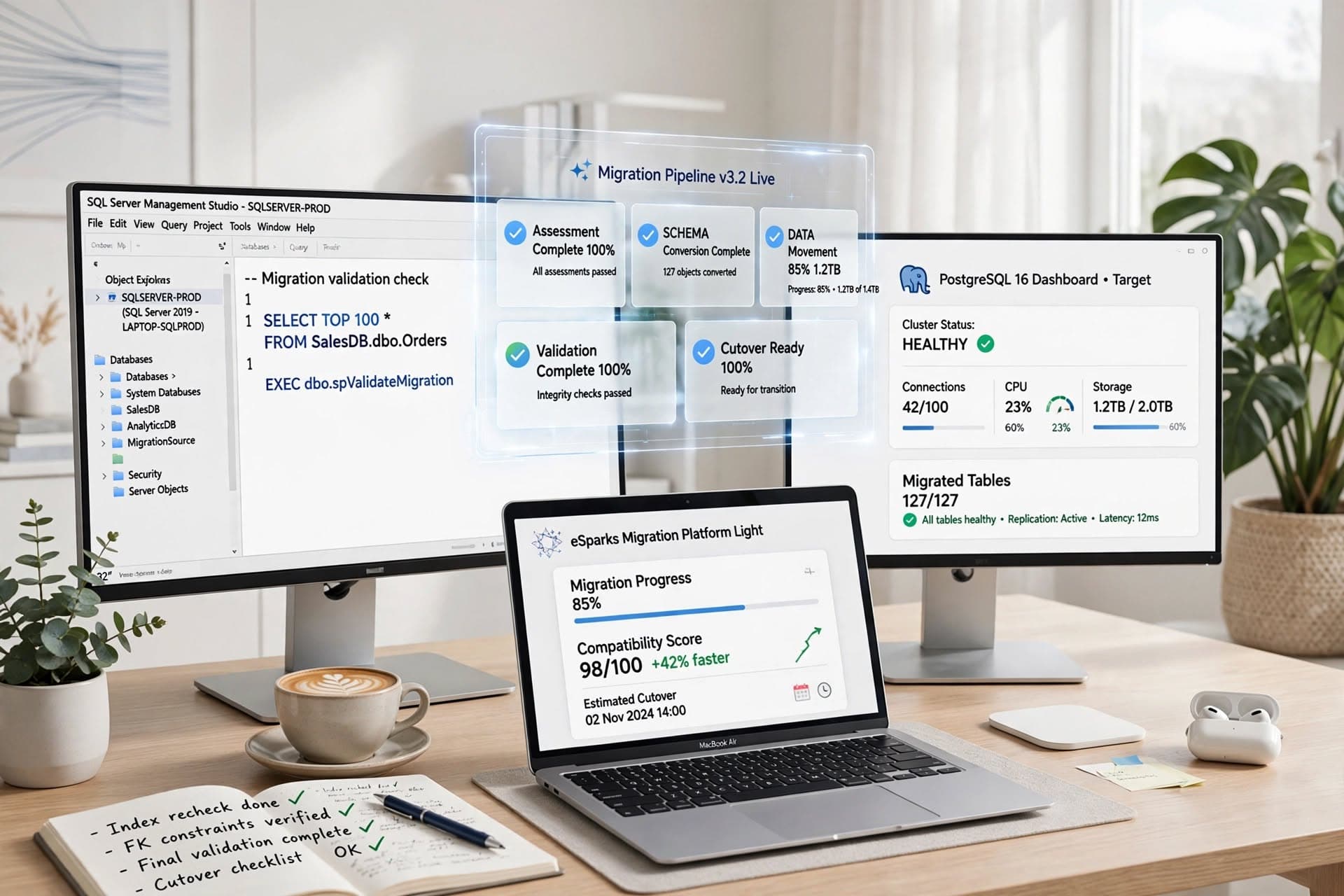
Cloud Computing
SQL Server to PostgreSQL Migration: Business Guide
A practical guide to sql server to postgresql migration, covering planning, code changes, risks, timelines, costs, and execution choices.
Oct 18, 2026
Read More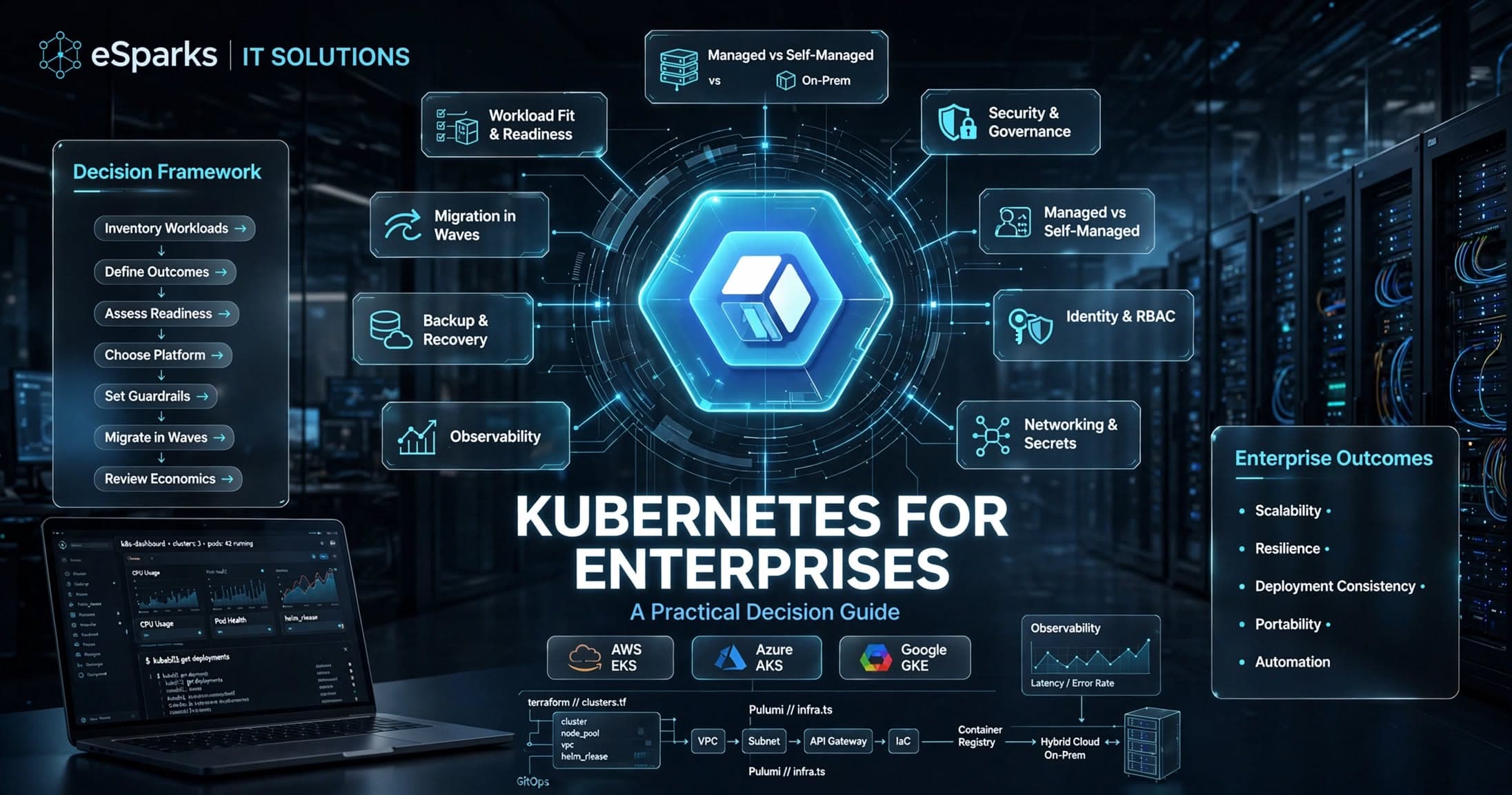
Cloud Computing
Kubernetes for Enterprises: A Practical Decision Guide
Kubernetes for enterprises can improve scalability, resilience, and release speed—but only when platform maturity, security, and operating model align.
Sep 26, 2026
Read MoreReady to Transform Your Business?
Let's discuss how our expertise can help you achieve your goals