Cloud Computing
SQL Server to PostgreSQL Migration: Business Guide
A practical guide to sql server to postgresql migration, covering planning, code changes, risks, timelines, costs, and execution choices.

Tauseef Alam
Chief Technology Officer
Oct 18, 2026
10 min read
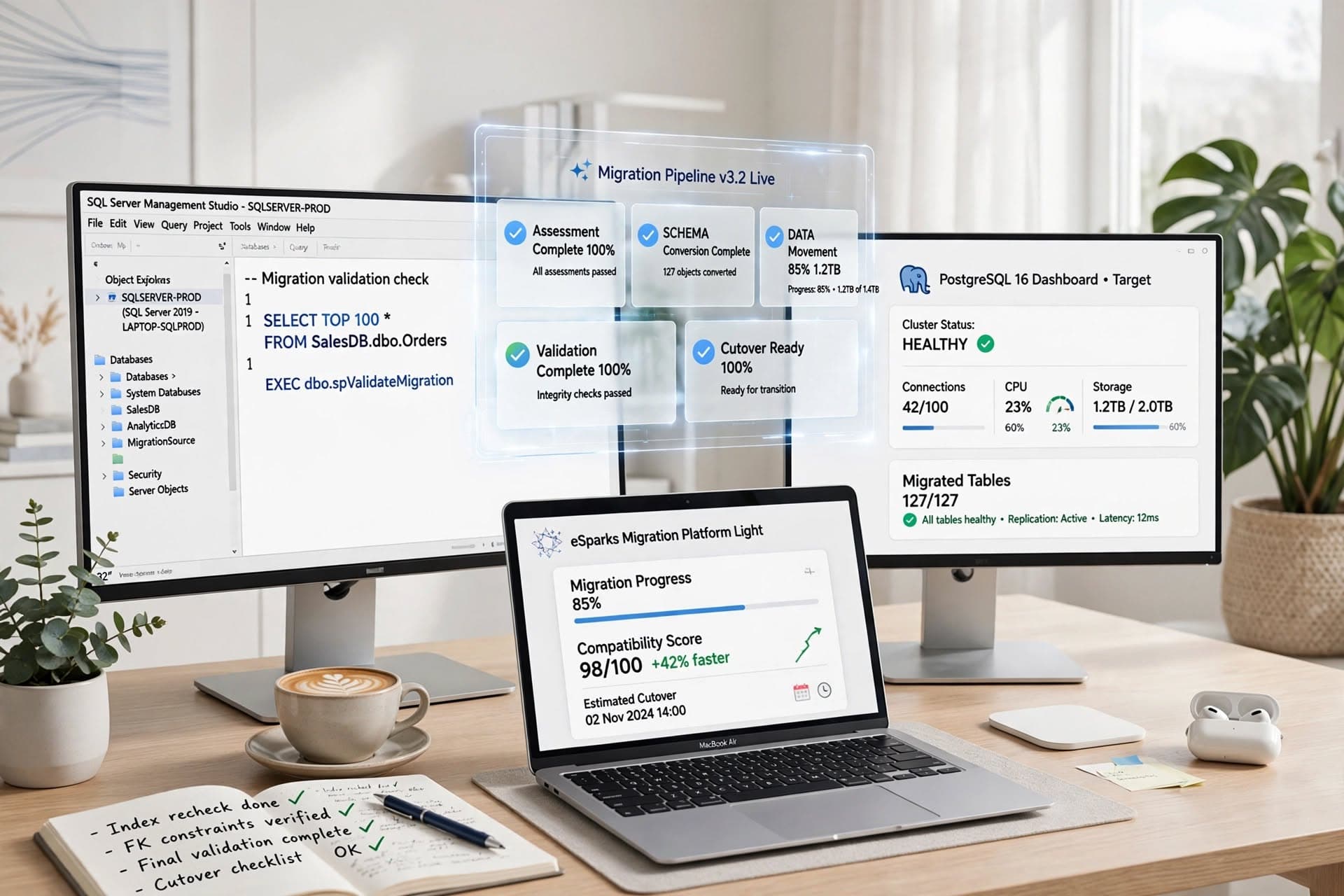
SQL Server to PostgreSQL migration is the process of moving schema, data, code, security, and operational workflows from Microsoft SQL Server to PostgreSQL without breaking business-critical applications. For most organizations, it is achievable and often worthwhile, but the real effort is rarely the raw data move; it is validating application compatibility, rewriting SQL Server-specific logic, and planning a low-risk cutover.
Key takeaways
- SQL Server to PostgreSQL migration is usually feasible for line-of-business systems, but schema conversion is only one part of the work; stored procedures, ETL, security, and application behavior often drive complexity.
- The safest migration approach is an assessment-led plan that inventories SQL features, ranks application dependencies, tests code compatibility early, and rehearses cutover before production.
- PostgreSQL can replace many SQL Server capabilities through native features such as partitioning, JSONB, logical replication, roles, and extensions, but the design patterns are not always one-to-one.
- Typical timelines range from a few weeks for a simple application database to several months for multi-system estates with heavy T-SQL, reporting, integrations, and strict uptime requirements.
- A successful migration should be measured by functional parity, data integrity, acceptable performance, and operational readiness after go-live, not by schema conversion alone.
Why businesses choose SQL Server to PostgreSQL migration
Business leaders usually evaluate this move for a mix of commercial, technical, and strategic reasons. PostgreSQL is mature, widely supported, cloud-friendly, and flexible enough for transactional systems, analytics-adjacent workloads, and modern application stacks. It also fits well when organizations want more deployment choice across AWS, Azure, Google Cloud, private cloud, or managed services such as Amazon RDS for PostgreSQL, Azure Database for PostgreSQL, and Cloud SQL.
In practice, the decision is rarely just about licensing. We typically see broader drivers: reducing platform lock-in, standardizing across engineering teams, improving portability for SaaS products, or aligning with containerized and DevOps-oriented delivery. PostgreSQL also offers strong capabilities around MVCC, indexing options, JSONB, partitioning, logical replication, extensions, and a large ecosystem of tooling. Those strengths make it attractive for businesses modernizing legacy systems, building new digital products, or consolidating fragmented data estates.
A sensible business case usually weighs several factors together:
- Current SQL Server edition and support posture
- Dependence on Windows-only or Microsoft-specific components
- Amount of T-SQL, SQL Server Agent jobs, SSIS, SSRS, and linked servers in use
- Planned cloud or multi-cloud direction
- Internal team skills in PostgreSQL operations and tuning
- Tolerance for refactoring, testing effort, and cutover risk
sql server to postgresql migration: what actually changes
The most common misconception is that a migration is a simple export/import exercise. Moving tables and rows is often the easiest part. The harder work sits around dialect differences, surrounding services, and application expectations that have grown around SQL Server over time.
At the database layer, teams must translate data types, constraints, indexes, identity behavior, collations, sequences, defaults, and transaction semantics. T-SQL objects such as stored procedures, scalar functions, table-valued functions, triggers, and views may need partial or full rewrites in PL/pgSQL, standard SQL, or application code. Operational features matter too: SQL Server Agent jobs might move to cron, pg_cron, or an external orchestrator; SSIS packages might shift to Airflow, Azure Data Factory, dbt, or custom pipelines.
A few examples show where surprises appear:
- SQL Server NVARCHAR, DATETIME, MONEY, UNIQUEIDENTIFIER, and BIT often map cleanly, but not always identically, to PostgreSQL types such as TEXT/VARCHAR, TIMESTAMP, NUMERIC, UUID, and BOOLEAN.
- IDENTITY usage may translate to GENERATED AS IDENTITY or sequences, but applications that assume exact sequence behavior can still need changes.
- GETDATE(), ISNULL(), TOP, MERGE, CROSS/OUTER APPLY, temp tables, and T-SQL error handling patterns often require query rewrites.
- Case sensitivity and collation rules can affect search, sorting, and uniqueness in ways users notice immediately after go-live.
- SQL Server security models, Active Directory integrations, and ownership chains may need redesign using PostgreSQL roles, grants, schemas, and connection-level controls.
This is why serious migrations begin with a compatibility assessment rather than a conversion script. When we built Database Migration Platform, one of the clearest lessons was that automated transformation accelerates discovery and repeatability, but it does not remove the need for human review of business logic, edge cases, and runtime behavior.
A decision framework before you commit
For founders, CTOs, and IT managers, the key question is not whether PostgreSQL is good. It is whether your specific estate can move with acceptable risk, cost, and disruption. A structured decision framework keeps the discussion grounded in engineering reality.
Start with application criticality and dependency mapping. Identify which systems read from or write to SQL Server directly, which rely on reporting replicas, and which integrations depend on proprietary features. A CRM with light custom SQL is a very different candidate from an ERP with deep stored procedure logic, nightly SSIS workflows, and dozens of downstream reports.
Use this step-by-step framework:
-
Inventory the estate.
- Databases, schemas, table sizes, growth rates
- Stored procedures, functions, triggers, jobs, ETL packages, reports
- Application connection patterns, drivers, ORM behavior, and peak load windows
-
Score complexity.
- Low: mostly standard SQL, modest data volume, few integrations
- Medium: some T-SQL logic, moderate ETL/reporting, limited downtime tolerance
- High: heavy procedural code, many cross-system dependencies, strict RPO/RTO, 24/7 operations
-
Define migration goals.
- Cost optimization
- Cloud portability
- Modernization of legacy code
- Performance or scalability improvements
- Vendor strategy and compliance requirements
-
Choose target architecture.
- Self-managed PostgreSQL on VMs or Kubernetes
- Managed database service
- HA topology with streaming replication, read replicas, backups, and PITR
-
Run a proof phase.
- Convert a representative schema
- Rewrite the top 10-20 risky queries and procedures
- Validate performance, locking behavior, and operational tooling
-
Decide the migration pattern.
- Big-bang cutover for smaller, simpler systems
- Phased migration for multi-service applications
- Dual-write or CDC-assisted cutover where downtime must be minimized
This framework lets non-database stakeholders make an informed decision without hand-waving. If the proof phase exposes too much application coupling, you can still pause, narrow scope, or migrate only selected workloads first.
Architecture and code areas that usually need work
Most budget overruns come from underestimating code and integration changes. Schema conversion tools can generate a starting point, but business applications depend on many SQL Server-specific assumptions that only show up when tests are realistic.
Stored procedures are often the first hotspot. T-SQL and PL/pgSQL are both capable, but syntax, temporary object handling, dynamic SQL, exception handling, cursors, and transaction behavior differ. MERGE statements, table variables, XML methods, and SQL Server-specific system functions frequently need redesign. If the application uses Entity Framework, Hibernate, Sequelize, or another ORM, query generation should also be tested against PostgreSQL because pagination, date handling, and identifier quoting can change SQL emitted by the framework.
The second hotspot is surrounding platform services:
- ETL and integration: SSIS packages, linked servers, BCP jobs, CLR integrations
- Reporting: SSRS datasets, Power BI models, direct query assumptions, custom exports
- Security: AD auth models, row-level security design, auditing, secrets management
- Operations: backup policies, monitoring, failover runbooks, maintenance tasks, index and vacuum strategy
- Data semantics: collations, Unicode handling, time zones, decimal precision, NULL behavior
Performance tuning also needs a mindset shift. SQL Server and PostgreSQL optimize queries differently. PostgreSQL relies heavily on VACUUM, ANALYZE, planner statistics, index selection, and query shape. A query that performed well under SQL Server may need a different index strategy, explicit batching, or a rewrite using CTEs, window functions, partitioning, materialized views, or JSONB operators. Teams should benchmark realistic read/write mixes rather than isolated queries.
Execution plan: from assessment to cutover
A strong migration plan has clear phases, entry criteria, and rollback thinking. For most business systems, the safest path is assessment, conversion, validation, rehearsal, then production cutover. Skipping rehearsal is where avoidable surprises multiply.
A practical execution sequence looks like this:
-
Discovery and assessment
- Run schema and code analysis tools
- Classify unsupported or high-effort features
- Estimate data movement method and downtime envelope
-
Target design
- Define PostgreSQL version, hosting model, HA, backup, encryption, network design
- Set standards for schemas, roles, naming, partitioning, and observability
-
Schema and code conversion
- Convert DDL and baseline indexes
- Rewrite procedures, jobs, functions, and integration scripts
- Build repeatable migration scripts in version control
-
Data migration and synchronization
- Initial bulk load using native exports, logical tools, or cloud migration services
- Optional CDC or incremental sync to keep source and target aligned until cutover
-
Testing
- Data validation: row counts, checksums, aggregates, referential integrity
- Functional testing: application workflows, reports, interfaces, permissions
- Nonfunctional testing: performance, failover, backup restore, security controls
-
Cutover and stabilization
- Freeze writes or enable planned switchover pattern
- Redirect applications and monitor aggressively
- Keep rollback conditions explicit and time-bound
Tool choice depends on the environment. Common options include pgloader, AWS DMS, Azure Database Migration Service, ora2pg-style analysis approaches adapted for discovery, custom ETL pipelines, and vendor-neutral schema diff tools. For enterprise teams, repeatability matters more than clever one-off scripts. Treat migration code like product code: version it, review it, test it, and rehearse it.
Common pitfalls and how to avoid them
The biggest pitfall is assessing only the database and not the full application landscape. Teams often discover late that reporting tools, background jobs, integration middleware, or third-party packages contain hard-coded SQL Server syntax, ODBC assumptions, or vendor-specific drivers. The fix is simple in principle: perform dependency mapping early and include business workflows, not just database objects.
Another common issue is assuming feature parity means behavior parity. Data type mappings may be technically valid but still produce user-visible differences. Examples include string comparisons under different collations, timestamp handling across time zones, identity reseeding behavior, and implicit conversion rules. These are not academic details; they affect search results, invoice calculations, duplicate detection, and audit trails.
To reduce risk, watch for these failure patterns:
- Converting schema before understanding application query patterns
- Treating stored procedure rewrites as mechanical translation work
- Under-testing reporting, exports, and month-end or quarter-end jobs
- Ignoring backup restore drills and failover procedures until after launch
- Moving to PostgreSQL without operational readiness around VACUUM, indexing, monitoring, and capacity planning
- Setting unrealistic cutover windows for very large databases without rehearsal or incremental sync
In our experience, the most reliable migrations are the ones that define acceptance criteria up front: functional parity for critical workflows, validated data integrity, acceptable response times for top queries, and documented operational runbooks. That prevents “technically migrated” systems from becoming business incidents.
Typical timelines, costs, and team model
Decision-makers usually want a realistic range, even before a detailed assessment. For a relatively simple application database with limited procedural code and manageable data volume, a migration can take a few weeks. For a mid-sized production system with custom procedures, ETL, reporting, and multiple integrations, a typical range is several weeks to a few months. Large estates or heavily customized core systems can extend beyond that, especially if downtime must be minimized or phased rollout is required.
Cost follows complexity more than size alone. A 200 GB database with straightforward SQL may be less expensive to migrate than a smaller database with dense business logic in T-SQL, SSIS packages, and reporting dependencies. The true drivers are usually discovery effort, code conversion, testing depth, cutover design, and post-migration stabilization. This is why fixed estimates without an assessment are often misleading.
A practical delivery team often includes:
- A database architect familiar with SQL Server and PostgreSQL internals
- An application engineer who understands ORM and service-layer impact
- A DevOps or cloud engineer for environments, secrets, networking, CI/CD, and observability
- A QA lead for regression, data validation, and performance testing
- A product or business owner to approve workflow parity and cutover timing
If you are evaluating a partner, look for evidence they can cover the whole migration path, not just schema conversion. The right team should be comfortable discussing T-SQL refactoring, PostgreSQL tuning, managed cloud options, CDC patterns, backup/restore strategy, and how to prove business continuity before go-live. That end-to-end view matters far more than promises of a “push-button” migration.
Frequently Asked Questions
How difficult is SQL Server to PostgreSQL migration?
The difficulty depends less on raw database size and more on SQL Server-specific logic around stored procedures, ETL, reporting, security, and integrations. A mostly standard SQL application can migrate relatively smoothly, while systems with heavy T-SQL and tightly coupled downstream processes require more redesign and testing.
Can schema conversion tools fully automate the migration?
No. Tools can accelerate schema conversion, object discovery, and some query translation, but they do not fully solve business logic rewrites, application behavior differences, performance tuning, or cutover planning. Most production migrations require both automation and experienced engineering review.
How much downtime is usually required?
Downtime can range from a short maintenance window for smaller systems to longer planned cutovers for complex estates. Organizations that need minimal downtime often use an initial bulk load plus change data capture or incremental synchronization, then switch applications during a controlled cutover.
What should success look like after migration?
Success means more than moving tables and data. The target PostgreSQL system should preserve critical business workflows, maintain data integrity, meet agreed performance expectations, and have operational readiness for backup, restore, monitoring, security, and incident response.
Work with eSparks IT Solutions
Planning a project around this? We work with businesses in the United States, Canada and the UAE, as well as the UK and Australia. See a related project: Database Migration Platform. Explore our Cloud Computing services and portfolio, estimate your project cost, or book a free call.
Related cloud & DevOps services

Tauseef Alam
Chief Technology Officer
Passionate technology writer and industry expert with years of experience in software development, cloud computing, and digital transformation. Dedicated to sharing insights and helping developers stay ahead of the curve.
Related Topics
Continue Reading
More insights in Cloud Computing
Cloud Computing
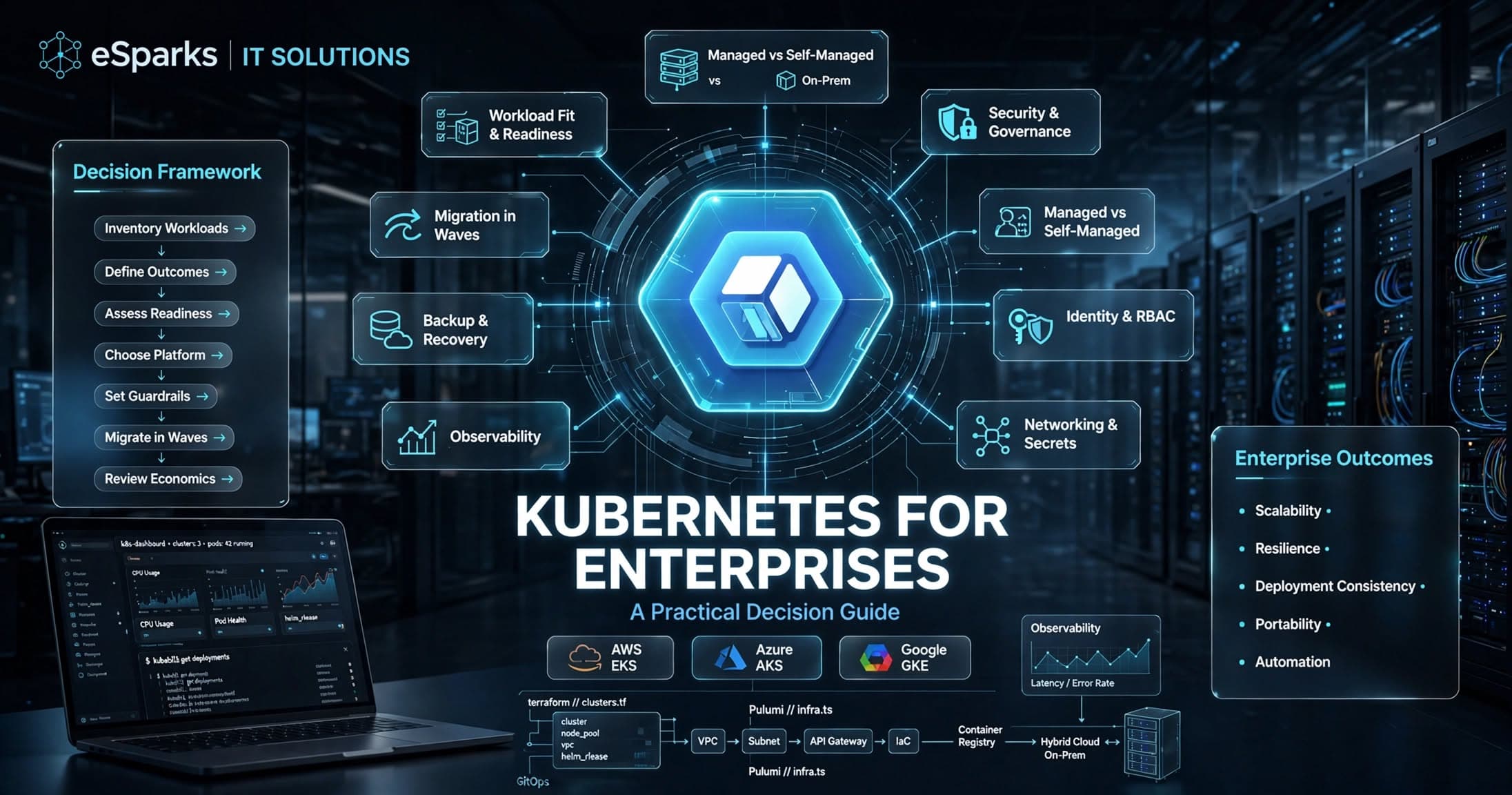
Kubernetes for Enterprises: A Practical Decision Guide
Kubernetes for enterprises can improve scalability, resilience, and release speed—but only when platform maturity, security, and operating model align.
Sep 26, 2026
Read More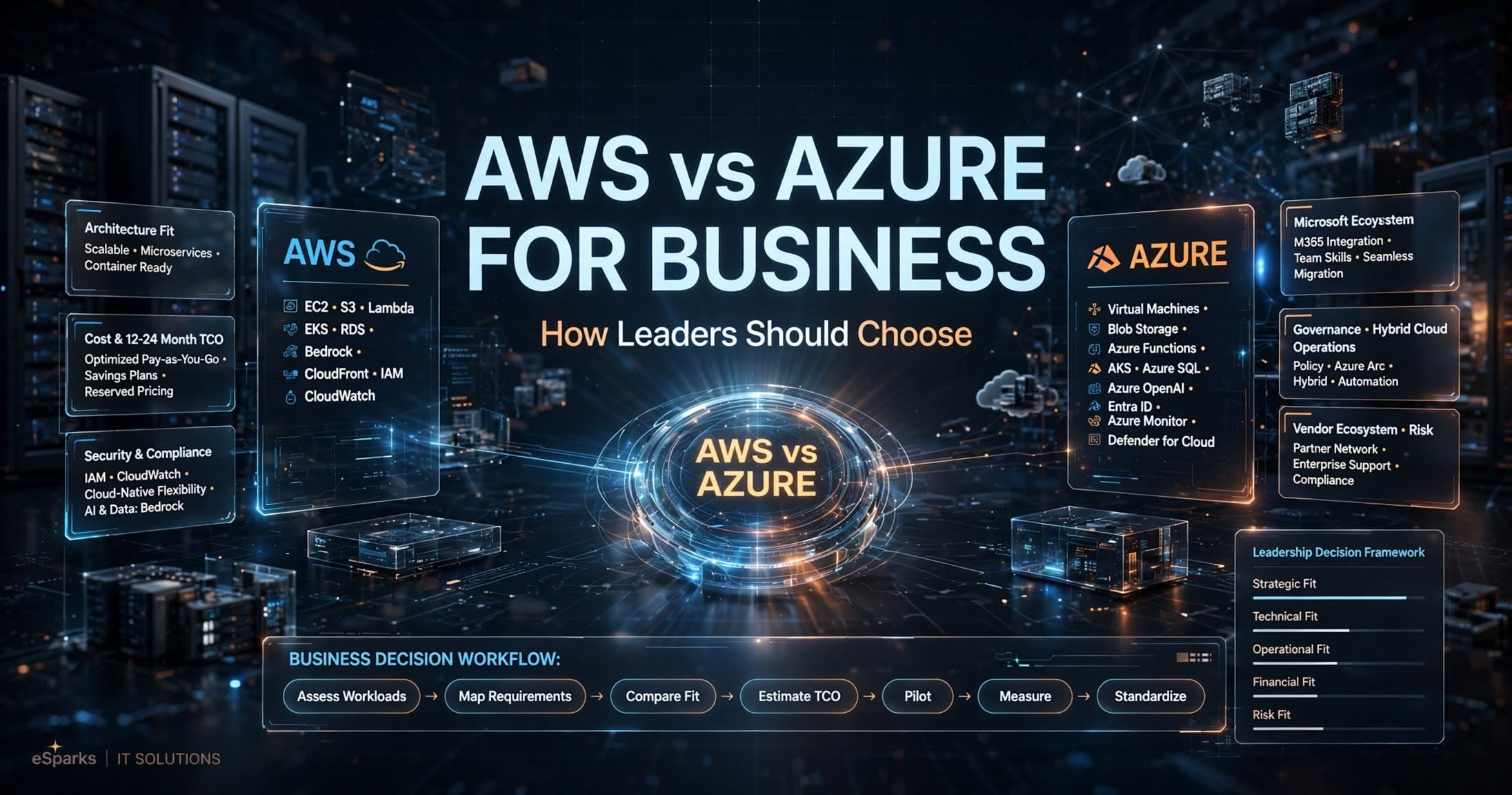
Cloud Computing
AWS vs Azure for Business: How Leaders Should Choose
Compare aws vs azure for business across cost, security, Microsoft fit, AI, and operations with a practical decision framework for leaders.
Sep 25, 2026
Read More
Cloud Computing
Mysql to Postgresql Migration Service: UK Decision Guide
A practical UK guide to choosing a mysql to postgresql migration service, covering risks, cost, timelines, tooling and delivery approach.
Sep 14, 2026
Read MoreReady to Transform Your Business?
Let's discuss how our expertise can help you achieve your goals