AI & Machine Learning
AI Project Developments: A Practical Guide for Leaders
Learn how to plan ai project developments with the right use cases, architecture, security, timelines, and delivery approach.

Tauseef Alam
Chief Technology Officer
Aug 24, 2026
10 min read
AI project developments succeed when they start with a specific business outcome, dependable data, and a delivery plan that treats AI as part of a real software system, not a demo. For most companies, the right path is to choose one high-value use case, validate it with a small pilot, and only then invest in production-grade integration, security, and governance.
Key takeaways
- Successful ai project developments begin with a narrow business problem, clear success criteria, and data readiness rather than a broad mandate to use AI everywhere.
- For most business use cases, the right architecture combines existing systems, governed data pipelines, and human review instead of relying on a standalone model.
- Security, privacy, and model governance should be designed into AI delivery from day one, especially when customer data, regulated workflows, or internal knowledge are involved.
- Typical AI initiatives move faster when teams separate proof of concept, pilot, and production phases, each with different goals, risks, and budget expectations.
- The best software partners for AI can explain trade-offs in models, infrastructure, integration, and compliance in plain business language, not just technical jargon.
Why AI projects fail or succeed in real business settings
Business leaders often hear that AI can automate support, improve forecasting, speed up software delivery, or unlock insights from unstructured data. All of that can be true, but in practice, results depend less on the model itself and more on whether the problem is narrow enough, the data is usable, and the workflow is designed around how teams actually operate.
In our experience, failed AI initiatives usually share a few patterns. The scope is too broad, such as “use AI across the business.” Teams start with model selection before defining measurable value. Or a proof of concept works in a notebook, but no one plans for authentication, APIs, data lineage, monitoring, access controls, or change management. That is why decision-makers should evaluate AI as a product and platform effort, not just a machine learning exercise.
A useful rule is to separate three questions early:
- What business decision or task should improve?
- What data, systems, and human approvals does that workflow require?
- What level of reliability, explainability, and compliance is acceptable?
When those answers are clear, AI becomes easier to evaluate. When they are vague, budgets disappear into experiments that never make it into production.
How to scope ai project developments the right way
The best-scoped projects start with a workflow, not a model. For example, a sales operations team may need faster lead qualification. A healthcare-adjacent company may need document classification with strong auditability. A logistics firm may need exception detection in shipment data. Each of these points to a different architecture, data strategy, and risk profile.
A practical scoping framework looks like this:
- Define the business event. Example: “When a support ticket arrives, classify it, summarize it, and route it to the right queue.”
- Define the user and action. Who uses the output, and what decision do they make from it?
- Define the required accuracy threshold. Does the AI assist a human, or act automatically?
- Define the failure cost. A wrong marketing suggestion is different from a wrong financial or compliance decision.
- Define the data sources. CRM, ERP, PDFs, emails, call transcripts, knowledge bases, IoT streams, or SQL warehouses.
- Define the integration points. Web app, mobile app, Slack, Microsoft Teams, ServiceNow, Salesforce, SAP, or custom APIs.
This framework also helps leaders classify use cases into four common categories:
- Generative AI: summarization, drafting, search, knowledge assistants, coding help
- Predictive AI: demand forecasting, churn risk, anomaly detection, lead scoring
- Computer vision: defect detection, document extraction, image moderation
- Intelligent automation: combining AI with workflows, RPA, rules engines, and approvals
For many USA-based businesses, the fastest wins are internal knowledge search, support triage, document workflows, and analytics copilots because they improve existing operations without requiring a complete operating model change. More ambitious projects, such as autonomous decisioning or large-scale forecasting, usually need stronger governance and better historical data before they can be trusted.
Choosing the right architecture, models, and tech stack
A common mistake is assuming every AI project needs custom model training. In reality, many business systems get better economics and faster delivery by combining foundation models, retrieval, business rules, and application logic. The right choice depends on sensitivity of data, performance needs, and how specialized the task is.
For generative AI, a typical production stack may include:
- Application layer: React, Next.js, Angular, Flutter, or native mobile apps
- Backend services: Node.js, Python FastAPI, .NET, Java Spring Boot
- Model access: OpenAI-compatible APIs, Azure OpenAI, Anthropic, Google Vertex AI, or open-source models served privately
- Retrieval layer: vector databases such as Pinecone, Weaviate, pgvector, or OpenSearch
- Data layer: PostgreSQL, SQL Server, Snowflake, BigQuery, S3, Azure Blob Storage
- Orchestration: LangChain, LlamaIndex, Semantic Kernel, custom pipelines
- Observability: Prometheus, Grafana, OpenTelemetry, model tracing, prompt/version tracking
For predictive use cases, teams often use Python, scikit-learn, XGBoost, PyTorch, TensorFlow, MLflow, Airflow, dbt, and feature pipelines connected to a warehouse or lakehouse. For enterprise deployments, containerization with Docker and orchestration on Kubernetes, Amazon EKS, Azure AKS, or Google GKE is common. Smaller projects may be perfectly served by managed cloud platforms with serverless APIs and scheduled jobs.
The architecture should fit the job. If you need a customer support copilot that references internal documents, retrieval-augmented generation is usually more practical than fine-tuning from scratch. If you need highly structured predictions on historical tabular data, classic machine learning may outperform a large language model. If you need near-real-time inference inside an existing SaaS workflow, latency and integration patterns matter more than benchmark headlines.
Data readiness, security, and governance are the real project core
The strongest AI demos often fail in production because the data behind them is fragmented, stale, duplicated, or poorly governed. Before approving a roadmap, leaders should ask whether the organization can identify authoritative sources, define access boundaries, and maintain a repeatable data pipeline.
A useful readiness checklist includes:
- Data inventory: what systems hold the required information?
- Data quality: completeness, duplicates, labeling quality, missing values, formatting consistency
- Freshness: batch, hourly, daily, or real-time needs
- Permissions: who can access what, and under which identity system?
- Retention: how long prompts, outputs, and logs are stored
- Auditability: how decisions are explained and reviewed
- Compliance: sector rules, contractual obligations, and regional privacy requirements
For US businesses, AI security should be discussed in concrete engineering terms. That may include SSO with SAML or OAuth 2.0, role-based access control, encryption in transit and at rest, secrets management, private networking, DLP controls, redaction of sensitive fields, and logging policies that avoid exposing proprietary information. Teams working in regulated environments may also need documented model risk procedures, vendor assessments, and approval workflows.
Governance does not have to mean bureaucracy. It means deciding who can ship prompts or models, how versions are reviewed, when human oversight is required, and what happens when outputs drift. Standards and practices often referenced in enterprise programs include SOC 2 controls, ISO 27001-aligned processes, NIST AI risk guidance, secure SDLC practices, and policy guardrails for acceptable use. These are not just legal concerns; they directly affect timeline, architecture, and vendor choice.
Delivery model: from proof of concept to production
Leaders evaluating a software partner should expect a phased plan, because a prototype and a production AI system are very different things. A proof of concept mainly answers, “Can this work at all?” A pilot answers, “Does this work with real users and real data?” Production answers, “Can this run reliably, securely, and cost-effectively at scale?”
A realistic delivery sequence often looks like this:
- Discovery and solution design, usually 2 to 4 weeks. This phase covers use case selection, data audit, architecture options, constraints, and success criteria.
- Proof of concept, often 4 to 8 weeks. The goal is technical feasibility, not polish. Teams test prompts, retrieval quality, model candidates, and early workflow logic.
- Pilot or MVP, often 6 to 12 weeks. The product is integrated into a limited workflow with selected users, basic analytics, and guardrails.
- Production hardening, often 4 to 10 weeks or more. This includes security review, observability, CI/CD, scaling, fallback logic, and support processes.
- Ongoing optimization. Prompts, thresholds, retrieval quality, feature engineering, and cost controls are continuously improved.
Budget ranges vary widely by complexity, but leaders should be wary of quotes that ignore integration and governance. A narrowly scoped internal assistant or classification workflow may be feasible with a modest pilot budget. Multi-system enterprise platforms with custom workflows, role-based permissions, data engineering, and cloud infrastructure require materially larger investment. The key is not chasing the cheapest prototype; it is understanding the full path to operational value.
This is also where a capable partner matters. At eSparks, we have seen clients benefit most when the engineering team includes product thinking, cloud architecture, DevOps, and security from the start, because those disciplines determine whether an AI feature remains a demo or becomes part of a dependable business system.
Common pitfalls in AI initiatives and how to avoid them
Many problems in AI delivery are predictable. Leaders who know the warning signs can avoid months of rework.
Pitfall 1: Starting with the model instead of the process. If the underlying workflow is messy, AI will automate confusion. Map the business process first, then insert AI where it reduces friction or improves decisions.
Pitfall 2: Assuming one benchmark means business readiness. A model may perform well in generic testing but struggle with your terminology, document formats, or user behavior. Always validate on your own data and edge cases.
Pitfall 3: Ignoring human-in-the-loop design. For sensitive workflows, outputs should be reviewed, approved, or scored by a user. Build feedback loops into the interface, not as an afterthought.
Pitfall 4: Underestimating integration work. Connecting to Salesforce, HubSpot, SAP, SharePoint, legacy SQL databases, or proprietary APIs often takes more effort than the AI logic itself.
Pitfall 5: No cost controls. Token usage, inference frequency, vector searches, GPU workloads, and logging can expand quickly. Set budgets, caching rules, rate limits, and model routing policies.
Pitfall 6: Weak observability. Teams need to monitor response quality, latency, failed retrievals, prompt changes, drift, and fallback rates. Without this, production issues become hard to diagnose.
Pitfall 7: Treating AI as a one-time delivery. Models change, data changes, and business language changes. Plan for iteration, not a single launch date.
The practical fix is disciplined engineering: versioned prompts or models, test datasets, staging environments, rollback plans, analytics, and clear ownership after release. AI benefits from the same delivery rigor as modern software, with a few extra layers of governance and evaluation.
How to evaluate an AI software partner before you sign
When founders, CTOs, or IT managers compare vendors, demos are the easiest thing to buy and the least useful thing to trust on their own. The better evaluation method is to test how a partner thinks through trade-offs: build versus buy, managed API versus private deployment, RAG versus fine-tuning, batch versus real-time, and automation versus assisted decision-making.
Ask potential partners questions such as:
- How would you scope the first use case and define success?
- What data dependencies do you see, and how would you assess readiness?
- Which architecture options fit our risk and compliance profile?
- How will you secure prompts, outputs, logs, and access controls?
- What is your plan for CI/CD, testing, and monitoring in production?
- How do you control usage cost and prevent model sprawl?
- What should remain human-reviewed, and why?
- Which parts would you build custom versus use existing services for?
Strong partners answer with specifics. They can explain where Python is better than .NET for a given AI service, when Kubernetes is worth the operational overhead, why a vector database is or is not necessary, and how to fit the solution into your current cloud and identity stack. They also speak plainly about uncertainty. If a team promises exact business outcomes before validating your data and process reality, that is a red flag.
The best engagement model is usually collaborative. Your internal stakeholders know the workflows, risk tolerance, and operational constraints. The delivery team brings architecture, software engineering, AI implementation, cloud, DevOps, and security expertise. When both sides align on a phased plan and measurable outcomes, AI project developments become much easier to govern and far more likely to create durable value.
Frequently Asked Questions
What are ai project developments in a business context?
AI project developments are the planning, building, integration, security, testing, and ongoing improvement activities required to turn an AI idea into a usable business system. In practice, that includes data pipelines, application code, workflows, governance, cloud infrastructure, and human oversight, not just the model itself.
How long does a typical AI project take?
A focused proof of concept often takes several weeks, while a pilot with real integrations and user testing usually takes a few months. Production timelines depend on data quality, compliance needs, and the number of systems involved, so integration and governance often drive the schedule more than model setup.
Do companies need to train custom AI models for most use cases?
No, many business use cases work well with existing foundation models, retrieval-augmented generation, rules, and standard application logic. Custom training or fine-tuning is usually justified when the task is highly specialized, the data is proprietary, or quality requirements cannot be met with an off-the-shelf approach.
What should business leaders ask before hiring an AI development partner?
Leaders should ask how the partner will scope the first use case, assess data readiness, secure sensitive information, integrate with existing systems, and monitor quality in production. It is also important to ask how the partner controls cost, handles human review, and decides between managed services and more customized infrastructure.
Work with eSparks IT Solutions
Planning a project around this? We help businesses across the USA, UK, Canada, Australia and the GCC ship it. Explore our AI & Machine Learning services and portfolio, estimate your project cost, or book a free call.
Related AI services & solutions

Tauseef Alam
Chief Technology Officer
Passionate technology writer and industry expert with years of experience in software development, cloud computing, and digital transformation. Dedicated to sharing insights and helping developers stay ahead of the curve.
Related Topics
Continue Reading
More insights in AI & Machine Learning

AI & Machine Learning
AI Document Automation: A Practical Guide for Business
Learn how ai document automation works, where it fits, common pitfalls, costs, timelines, and how to evaluate the right delivery approach.
Oct 1, 2026
Read More
AI & Machine Learning
AI Adoption for Small Business: A Practical Guide
AI adoption for small business works best when you target one clear use case, secure your data, and roll out in measured phases with ROI checks.
Sep 28, 2026
Read More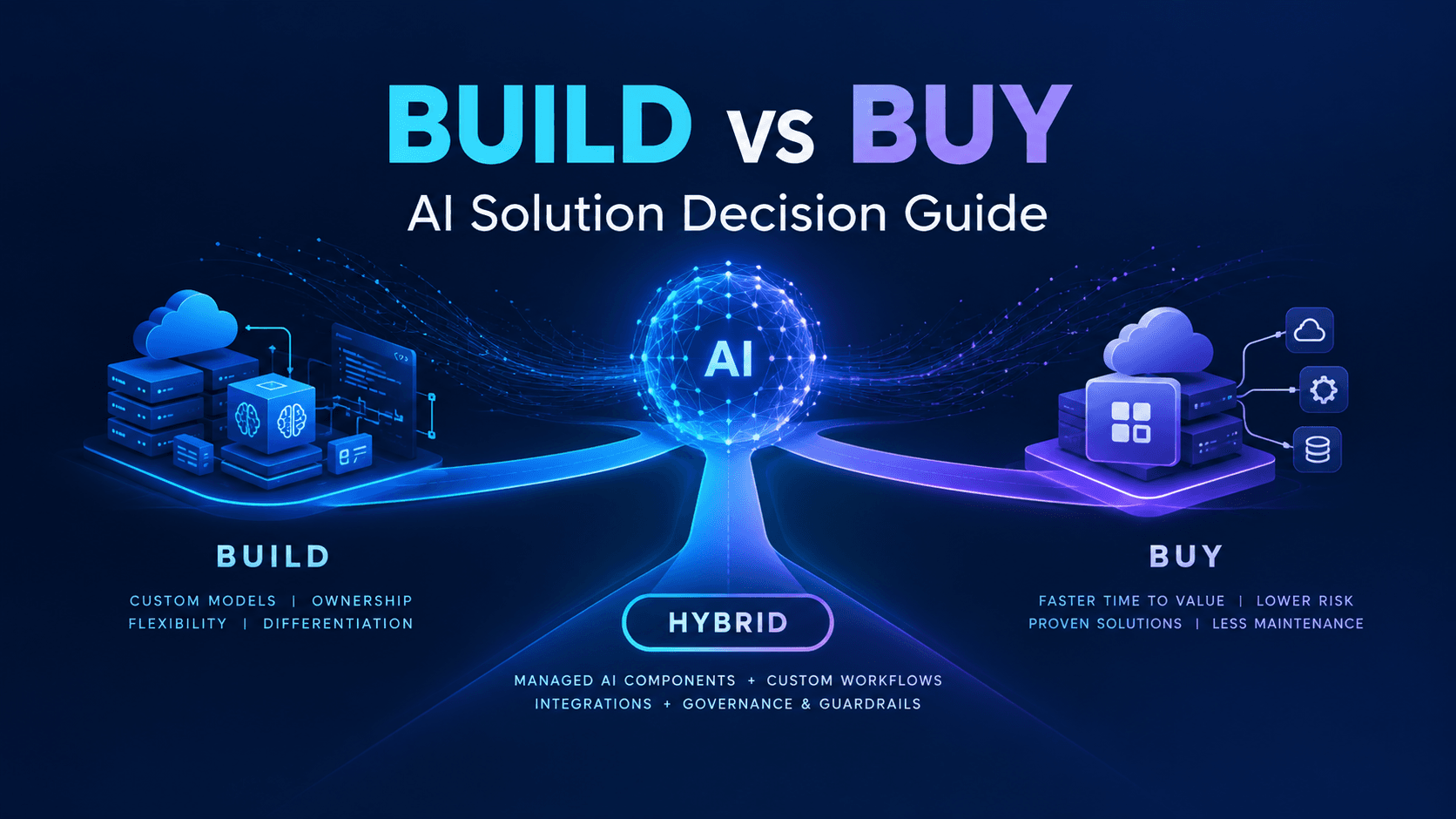
AI & Machine Learning
Build vs Buy AI Solution: A Practical Decision Guide
How to decide build vs buy ai solution for your business: costs, timelines, risks, architecture, and a practical framework for leaders.
Sep 10, 2026
Read MoreReady to Transform Your Business?
Let's discuss how our expertise can help you achieve your goals