Cloud Computing
Unlocking the Power of Cloud Computing for Modern Enterprises
Unlocking the Power of Cloud Computing for Modern Enterprises: a practical guide to strategy, security, cost control, and execution for business leaders.

Tauseef Alam
Chief Technology Officer
- Published
- Jun 12, 2026
- Reading time
- 10 min read
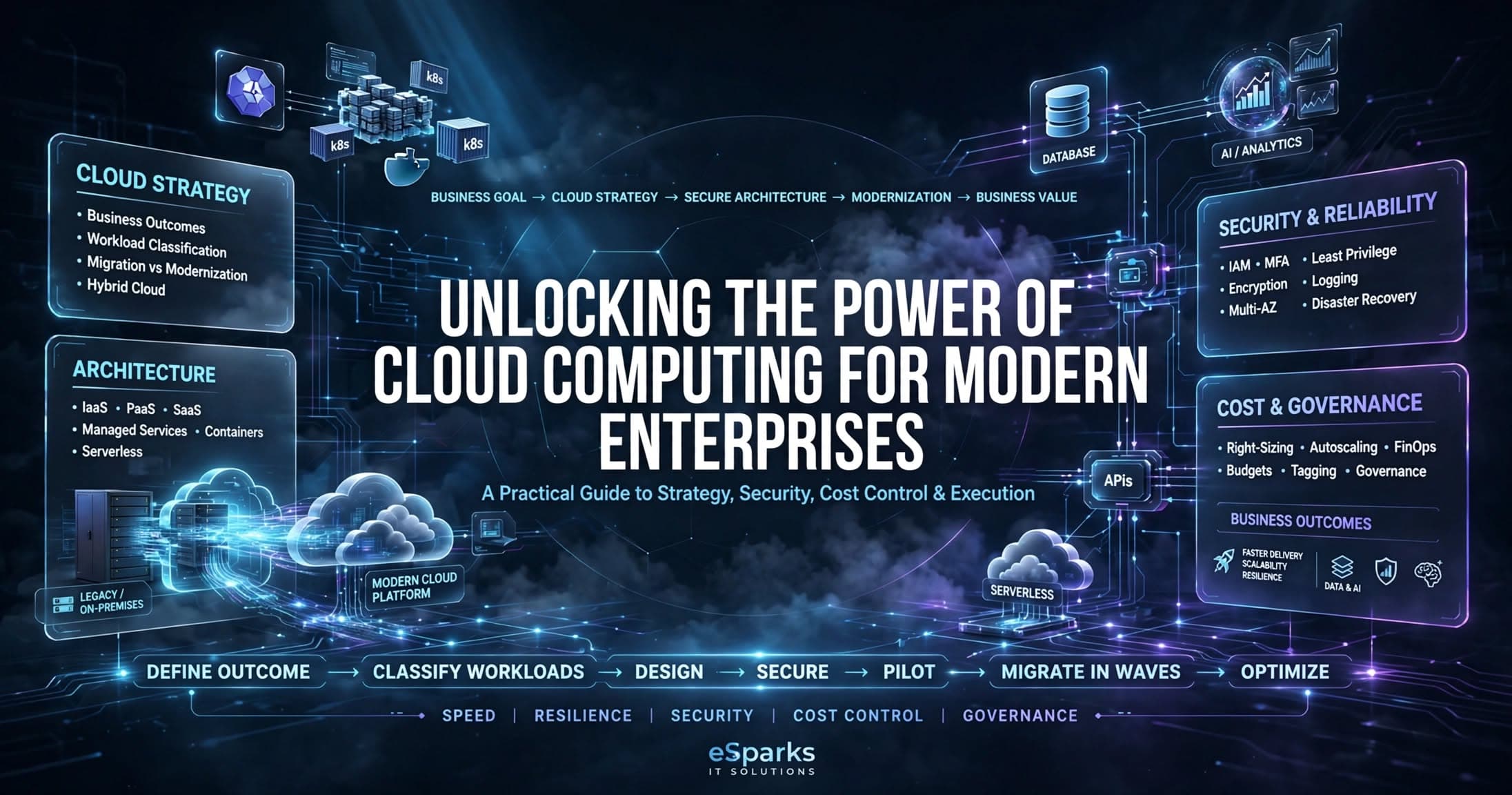
Unlocking the Power of Cloud Computing for Modern Enterprises
Key takeaways
- Cloud computing delivers value when it is tied to a specific business outcome, not treated as a generic infrastructure upgrade.
- The best cloud programs start with application and data classification, then choose the right mix of migration, modernization, and managed services.
- Security in the cloud depends on shared responsibility, least privilege, encryption, logging, and configuration discipline.
- Cost control in the cloud comes from architecture choices, right-sizing, and governance, not from after-the-fact billing reviews alone.
Unlocking the Power of Cloud Computing for Modern Enterprises means using cloud platforms to improve agility, resilience, security, and speed to market without rebuilding everything at once. The real advantage is not “moving to the cloud” in the abstract; it is choosing the right workloads, controls, and operating model so the business can launch faster, recover quicker, and scale predictably. For most enterprises, the cloud becomes powerful when it reduces decision friction across product, operations, and IT.
That is why the most successful cloud programs are built around business priorities such as opening new digital channels, modernizing legacy systems, supporting remote teams, or improving data access. In practice, this often means a mix of infrastructure as a service, platform services, managed databases, containerization, and selective SaaS adoption rather than a one-size-fits-all migration.
Why cloud matters beyond infrastructure
For decision-makers, cloud should be evaluated as an operating model. It changes how quickly teams can provision environments, test ideas, recover from failure, and deploy updates. Instead of waiting weeks for hardware or a new server stack, teams can spin up environments in minutes, especially when using infrastructure as code tools like Terraform, AWS CloudFormation, Azure Resource Manager, or Google Cloud Deployment Manager.
The business case usually shows up in three places. First, time to market improves when development, testing, and production environments are standardized. Second, resilience improves when workloads are distributed across availability zones, backed by automated backups, and monitored continuously. Third, collaboration becomes easier because engineering, data, and security teams can work from a common platform with clearer visibility.
We have seen this especially when organizations need to support growth across multiple regions. A retail or services company serving the USA, UK, Canada, Australia, UAE, Saudi Arabia, Qatar, and the Netherlands often needs latency-aware deployment, data residency planning, and region-specific access controls. Cloud makes this much easier to design than traditional single-datacenter setups.
The architecture choices that actually drive value
Cloud strategy usually succeeds or fails on architecture, not brand choice. The first decision is whether a workload should be rehosted, refactored, replaced, retired, or retained. A customer portal might benefit from containerized microservices on Kubernetes or a managed container service like Amazon ECS, Azure Container Apps, or Google Cloud Run. A stable internal finance system may be better left on a virtual machine with careful hardening and backup.
The second decision is the platform layer. Typical modern stacks include managed relational databases such as PostgreSQL or MySQL, object storage for files and backups, identity services like Azure Entra ID or AWS IAM combined with SSO, and observability tooling such as Datadog, Prometheus, Grafana, or cloud-native monitoring. For teams building new digital products, serverless services such as AWS Lambda or Azure Functions can be a strong fit for event-driven tasks, but they should not be used everywhere just because they are fashionable.
The third decision is data architecture. Enterprises often underestimate how much cloud value depends on clean data flows. A practical approach is to separate operational data, analytics data, and archival data; use ETL or ELT pipelines thoughtfully; and enforce cataloging, lineage, and access controls. When we built Esparks Edu — School Management ERP, cloud architecture helped align application services, role-based access, and modular workflows in a way that would have been much harder to manage in a rigid on-premise model.
Unlocking the Power of Cloud Computing for Modern Enterprises: a practical decision framework
A good cloud decision framework starts with business intent, not technology inventory. We usually advise leaders to work through five questions before approving a migration or modernization program:
- Which business outcome matters most: speed, resilience, cost predictability, compliance, or innovation?
- Which applications are cloud-ready, cloud-suitable, or better kept on-premise for now?
- Which data sets have residency, privacy, or regulatory constraints?
- What level of operational ownership will the internal team keep, and what should be managed externally?
- How will success be measured in architecture, security, delivery speed, and spend governance?
From there, sequence the work in waves. The first wave often includes low-risk systems such as collaboration tools, development environments, static websites, or backup and disaster recovery. The second wave usually covers customer-facing applications, APIs, and supporting databases. The third wave is where deeper modernization happens, such as decomposing monoliths, introducing event streaming with Kafka or managed equivalents, and moving toward platform engineering.
A realistic timeline depends on scope. A small cloud foundation or proof of concept may take 2 to 6 weeks. A carefully managed migration of a few applications often takes 6 to 16 weeks. A broader modernization program with governance, security baselines, and data platform work can stretch across several months. Those ranges are typical estimates, not guarantees, because complexity is driven by legacy dependencies, compliance, and internal readiness.
Security, compliance, and reliability without overcomplication
One of the biggest misconceptions is that cloud is automatically secure. In reality, cloud security follows a shared responsibility model: the provider secures the underlying platform, while the enterprise remains responsible for identity, configuration, data protection, application security, and access governance. That means strong cloud programs put IAM design, MFA, least privilege, secret management, and logging in place early.
Security controls should be practical, not theatrical. Use encryption in transit with TLS 1.2 or above, encryption at rest for databases and object storage, centralized key management through KMS or equivalent services, and audit logging across admin and application activity. Add vulnerability scanning, dependency checks, container image scanning, and policy-as-code where possible. For sensitive systems, network segmentation, private endpoints, and zero-trust access patterns are often more effective than trying to hide everything behind a perimeter.
Reliability also needs discipline. Multi-AZ deployment is a baseline for many production workloads. Disaster recovery should be tested, not just documented, with clear recovery time objective and recovery point objective targets. Incident response runbooks, automated alerts, and capacity planning all matter. In regulated environments such as finance, healthcare, or public-sector-adjacent work, cloud success often comes from combining technical safeguards with documented controls mapped to standards like ISO 27001, SOC 2, NIST, or CIS benchmarks.
Cost control and governance that finance teams can trust
Cloud costs become unpredictable when teams treat cloud like a bottomless utility. The best way to avoid that is to build governance into the platform. Tagging standards, budget alerts, account or subscription separation, and approval policies should be defined before broad usage starts. FinOps practices help technical and finance stakeholders work from the same data rather than arguing over invoices after the fact.
The biggest levers are usually architectural. Right-size compute instances, use autoscaling where traffic is variable, reserve or commit capacity for steady workloads when appropriate, and delete idle resources aggressively. For storage, choose lifecycle policies and tiering so old files move to cheaper classes. For databases, tune indexes and connection usage before adding more hardware. For environments used only during business hours, schedule shutdowns to avoid paying for overnight idle time.
Typical savings opportunities are highly situational, but a well-governed program often identifies waste within the first few weeks, especially in non-production environments. More importantly, governance gives leaders confidence to scale. The goal is not merely lower spend; it is better unit economics, clearer accountability, and fewer surprises as usage grows.
How to choose the right cloud partner or internal model
The right partner is not the one with the loudest cloud logo; it is the one that can explain trade-offs clearly. Ask whether they start with application assessment, security baseline design, landing zone setup, CI/CD pipelines, observability, and operating model design. If they jump straight to migration without discussing identity, backups, and cost controls, that is a warning sign.
A strong team should be comfortable across AWS, Azure, and Google Cloud, and should understand how cloud connects with software engineering, DevOps, data, and cybersecurity. For example, a partner should be able to design a pipeline using GitHub Actions, GitLab CI, or Azure DevOps; deploy via blue-green or canary releases; and support rollback plans that are actually executable. They should also be able to discuss API security, secrets handling, SSO integration, and logging retention in plain language.
In our experience at eSparks IT Solutions, the most successful engagements are collaborative. The client owns business priorities and governance expectations; the delivery team owns architecture, implementation, and enablement. That partnership model helps enterprises modernize without creating dependency on a single vendor or an opaque black box.
Common mistakes to avoid before you migrate
The first mistake is migrating everything at once. That usually creates risk, confuses teams, and makes it hard to show value. Start with a portfolio view, then prioritize applications by business impact, complexity, and technical fit.
The second mistake is lifting and shifting without redesigning. A virtual machine moved to the cloud but left unmanaged, unmonitored, and overprovisioned often costs more than expected and performs no better than before. Even small improvements such as autoscaling, managed backups, and better network design can materially improve the outcome.
The third mistake is leaving security, compliance, and operations until the end. Cloud landing zones, identity models, logging, and backup policies should be established early. The fourth mistake is ignoring adoption. If developers, QA teams, and operations staff are not trained on the new platform, the organization may own cloud infrastructure but still behave like it is on-premise.
A simple pre-launch checklist can reduce pain:
- Define the business outcome and success criteria.
- Classify applications by complexity and risk.
- Set identity, network, logging, and backup standards first.
- Use infrastructure as code for repeatability.
- Test disaster recovery and rollback procedures.
- Establish cost tags, budgets, and alerts before production use.
FAQ on cloud computing for modern enterprises
What is the main business value of cloud computing?
Cloud computing helps enterprises launch faster, scale more flexibly, and improve resilience without buying and maintaining as much physical infrastructure. The best value appears when cloud is aligned to specific business outcomes such as speed to market, global reach, or stronger continuity planning.
Should we move everything to the cloud?
No. Many enterprises benefit from a hybrid approach that combines cloud, SaaS, and retained systems. The right choice depends on application complexity, compliance requirements, integration needs, and whether the workload is a good candidate for modernization.
How long does a typical cloud migration take?
A small proof of concept may take a few weeks, while a structured migration of several applications often takes a few months. Larger modernization programs can take longer because identity, security, data, and process changes need to be planned carefully.
What should we prioritize first in a cloud project?
Prioritize identity, security baselines, observability, backups, and cost governance before broad production rollout. These foundations make it much easier to migrate workloads safely and avoid expensive rework later.
Work with eSparks IT Solutions
Planning a project around this? We work with businesses in the United States, Canada and the UAE, as well as the UK and Australia. See a related project: Esparks Edu — School Management ERP. Explore our Cloud Computing services and portfolio, estimate your project cost, or book a free call.
Written by

Tauseef Alam
Chief Technology Officer
Chief Technology Officer at eSparks IT Solutions. Writes from the team's own delivery work across software, cloud, DevOps and security.
Related topics
Continue reading
More in Cloud Computing

Cloud Computing
Change Data Capture Database Migration Guide
Learn when change data capture database migration is the right strategy, how it works, typical costs, risks, and the architecture choices that matter.
Oct 24, 2026Read

Cloud Computing
Zero Downtime Database Migration: Practical Guide
Learn how zero downtime database migration works, when it is realistic, key patterns, risks, timelines, and how to plan a safe cutover.
Oct 20, 2026Read

Cloud Computing
Choosing an Oracle to PostgreSQL Migration Tool
Learn how to choose an oracle to postgresql migration tool, plan schema and code conversion, control downtime, and reduce migration risk.
Oct 19, 2026Read
Work with us
Have a system to build, fix or scale?
Tell us what you are working on and where it hurts. We will tell you how we would approach it.