
Programming
Legacy Database Modernization Services: A Practical Guide
Learn how legacy database modernization services reduce risk, improve performance, and support cloud, AI, and compliance goals.

Faiz Akram
Founder
Sep 15, 2026
10 min read
Legacy database modernization services help organizations move aging, high-risk databases to platforms that are easier to maintain, scale, secure, and integrate with modern applications. In practice, that means assessing the current estate, choosing the right target architecture, cleaning up data and schema debt, and executing migration with minimal business disruption.
Key takeaways
- Legacy database modernization services replace risky, aging data platforms with secure, supportable architectures that fit current application, cloud, and analytics needs.
- The right modernization path depends on business criticality, data quality, integration complexity, compliance obligations, and acceptable downtime during cutover.
- A successful database modernization program starts with discovery, then prioritizes schema remediation, migration testing, security controls, and rollback planning before production release.
- Common failure points in database modernization include underestimating hidden dependencies, skipping data quality work, and treating rehosting as a complete long-term strategy.
- Typical modernization timelines range from a few weeks for narrow migrations to several months for complex, business-critical estates with integrations, refactoring, and governance requirements.
Why legacy databases become a business problem
Most legacy database estates did not become “legacy” because they stopped working. They became legacy because the business moved on while the data layer stayed tied to older assumptions: on-premises hardware, monolithic applications, manual backups, hard-coded integrations, vendor lock-in, or unsupported versions of Oracle, SQL Server, MySQL, PostgreSQL, Informix, DB2, Sybase, or proprietary line-of-business platforms.
For leadership teams, the issue is rarely just technical debt. It shows up as slower product delivery, brittle reporting, rising infrastructure costs, audit pressure, and operational risk when only a few people still understand the system. Teams often discover that simple changes take too long because table structures are inconsistent, stored procedures hold core business logic, replication is fragile, or downstream systems depend on undocumented extracts.
Common business signals that modernization is overdue include:
- End-of-support database versions or operating systems
- Backup and disaster recovery processes that rely on manual steps
- Performance issues during normal growth or seasonal spikes
- Security gaps such as weak encryption, excessive privileges, or patching delays
- Difficulty exposing data to cloud apps, mobile apps, analytics, or AI pipelines
- High licensing or hardware renewal costs with little strategic value
- Mergers, acquisitions, or regional expansion creating fragmented data estates
Modernization is not only about moving to the cloud. Sometimes the right outcome is managed database hosting, engine conversion, schema redesign, operational hardening, or decomposition into domain-specific data services. The core goal is the same: make the data layer reliable enough for the business you run now, not the one you ran ten years ago.
What legacy database modernization services typically include
The phrase legacy database modernization services covers more than a database migration project. A capable team should address architecture, operations, governance, security, and application impact together, because database changes ripple across systems quickly.
A typical service scope includes:
- Discovery and assessment: inventory databases, versions, schemas, dependencies, jobs, interfaces, SLAs, recovery objectives, and compliance constraints
- Data profiling and quality review: identify duplicates, null patterns, invalid codes, encoding issues, orphaned records, and inconsistent reference data
- Platform strategy: compare options such as Amazon RDS or Aurora, Azure SQL, Google Cloud SQL, managed PostgreSQL, SQL Server, Oracle modernization, or hybrid patterns
- Schema and code analysis: review indexes, partitioning, data types, views, triggers, stored procedures, ETL jobs, and ORM compatibility
- Migration design: choose rehost, replatform, refactor, or rebuild approaches system by system
- Security and governance: encryption at rest and in transit, RBAC, auditing, secrets handling, retention rules, and regional compliance requirements
- Performance engineering: workload testing, query tuning, connection pooling, failover design, and capacity planning
- Cutover planning: rehearsal migrations, rollback strategy, synchronization windows, and validation criteria
- Managed transition support: observability, incident handling, post-go-live optimization, and knowledge transfer
In our experience, organizations get better outcomes when database modernization is treated as a product delivery initiative rather than a one-time infrastructure task. That means mapping database decisions directly to business capabilities: order processing, finance close, patient records, inventory visibility, customer support, or partner integrations.
Legacy database modernization services: choosing the right path
There is no single “best” modernization pattern. The right approach depends on database size, uptime tolerance, application coupling, compliance needs, and how much technical debt you are willing to carry forward.
The four most common paths are:
- Rehost
- Move the existing database to newer infrastructure or a cloud VM with minimal schema change.
- Best for urgent exits from failing hardware or unsupported operating systems.
- Fastest path, but it preserves many design problems.
- Replatform
- Move to a managed database service with limited engine changes, such as self-managed SQL Server to Azure SQL Managed Instance or EC2-hosted MySQL to Amazon RDS.
- Good when you want operational relief without deep application rewrites.
- Usually improves backups, patching, monitoring, and availability faster than a full redesign.
- Refactor
- Modify schema, SQL code, ETL, and application logic to fit a more modern engine or architecture.
- Typical when moving Oracle workloads to PostgreSQL, reducing stored procedure dependence, or redesigning for high availability and analytics.
- Higher effort, but often the best long-term balance of agility and cost control.
- Rebuild or decompose
- Replace the old data model entirely, often while breaking a monolith into domain-aligned services or event-driven workflows.
- Best when the old system blocks business growth and process redesign is already underway.
- Highest change impact, but sometimes the only sensible option.
A practical selection framework is to score each candidate system across five dimensions: business criticality, integration complexity, data quality risk, downtime tolerance, and future strategic value. Low-complexity, low-risk systems can often be replatformed first to build momentum. Highly coupled core systems may need a phased refactor with replication, dual writes, or change data capture using tools such as AWS DMS, Azure Database Migration Service, Debezium, Kafka Connect, Qlik Replicate, or native engine replication.
The step-by-step decision framework leaders should use
Executives and IT managers usually do not need every implementation detail, but they do need a disciplined way to make decisions. The following framework is the one we recommend most often because it turns a vague modernization goal into a governed program.
Step 1: Define the business driver Be explicit about why this project exists. Common drivers include end-of-support risk, cloud strategy, M&A consolidation, analytics readiness, cybersecurity remediation, or application modernization. If the driver is unclear, technical teams will optimize for the wrong outcome.
Step 2: Baseline the current estate Inventory every database instance, schema owner, scheduled job, API dependency, report feed, file export, and recovery process. Hidden dependencies are one of the biggest reasons migrations miss timelines. Include batch jobs, BI extracts, vendor connectors, and regional data residency constraints.
Step 3: Classify workloads Separate operational transaction processing, reporting, archival, search, event logging, and analytics. Not every workload belongs on the same engine. For example, a transactional PostgreSQL core plus object storage for archives and a warehouse such as Snowflake, BigQuery, or Redshift may serve the business better than one oversized relational instance.
Step 4: Decide the target state Choose the future architecture by workload, not by fashion. Questions to answer include:
- Do we need relational integrity, or is a document or key-value store more appropriate for some services?
- Is managed cloud acceptable for compliance and latency requirements?
- What recovery point objective and recovery time objective are required?
- Which integrations need real-time replication versus daily batch?
- Will AI, BI, or customer-facing applications need governed access to the same data?
Step 5: Prove migration feasibility Run schema conversion assessment, SQL compatibility review, and representative test migrations. Validate character sets, collation, time zones, BLOB handling, identity columns, partitioning, and transaction semantics before committing to the plan.
Step 6: Execute in waves Move lower-risk systems first, then more critical workloads. Use rehearsals, automated testing, CDC where needed, and a documented rollback plan. When we built Database Migration Platform, one of the most valuable lessons was that repeatable validation workflows matter as much as the data move itself.
Step 7: Optimize after cutover The first stable production release is not the finish line. Query plans change, indexes need tuning, storage classes may be adjusted, and access patterns often reveal application issues that were masked by the old environment.
Architecture, security, and compliance details that matter
A modern database platform should reduce operational risk, not just relocate it. That is why architecture and controls need to be designed together from the start, especially for businesses operating across the USA, UK, Canada, Australia, UAE, Saudi Arabia, Qatar, and the Netherlands where contractual, residency, and audit expectations may differ.
Key architecture and security considerations include:
- High availability design: multi-AZ deployment, read replicas, failover testing, quorum models, and connection retry behavior
- Backup strategy: point-in-time recovery, immutable backups where appropriate, retention schedules, and restore drills
- Encryption: TLS for in-transit traffic, KMS-backed encryption at rest, and key rotation policies
- Identity and access: least-privilege roles, just-in-time admin access, service account segregation, and MFA for privileged paths
- Network controls: private subnets, peering rules, bastion restrictions, WAF and API gateway protections where data is exposed through services
- Auditability: query audit logs, admin action logs, schema change tracking, and integration with SIEM tools such as Splunk, Sentinel, or Elastic
- Compliance mapping: GDPR obligations, sector-specific retention needs, contractual residency requirements, and internal policy alignment
There is also a design choice between “lift and secure” versus “redesign and secure.” For a business under time pressure, adding robust IAM, encryption, monitoring, and backup discipline during a managed replatform may be enough for phase one. But if sensitive data is scattered across tables without classification, or if application accounts use broad database owner privileges, modernization should include data access redesign rather than postponing it indefinitely.
Common pitfalls and how to avoid them
Most troubled modernization programs fail for predictable reasons. The technology may be sound, but planning assumptions are wrong. Knowing the usual traps helps decision-makers ask better questions before work begins.
Pitfall 1: Treating schema conversion as the whole project Converting DDL is only part of the work. Stored procedures, reports, ETL pipelines, APIs, data contracts, and user workflows all need validation. Avoid this by building a dependency map early and assigning owners for every integration.
Pitfall 2: Underestimating data quality debt Migrating bad data faster just creates a cleaner-looking problem. Profile the data before migration and define rules for duplicates, invalid values, inconsistent dates, and reference data conflicts. Create a remediation backlog instead of discovering issues during cutover weekend.
Pitfall 3: Ignoring application behavior Applications often rely on engine-specific SQL, locking behavior, isolation levels, or timestamp precision. Run integration and performance tests using realistic workloads, not only unit tests or schema checks.
Pitfall 4: No rollback or coexistence plan Some systems can tolerate a short outage; others cannot. For business-critical workloads, plan cutover patterns such as blue-green deployment, read replicas, CDC-based sync, or temporary dual-run periods.
Pitfall 5: Over-modernizing low-value systems Not every legacy database deserves a full refactor. Some archival or low-change systems can be contained, documented, and replatformed with minimal investment while resources focus on strategic workloads.
Pitfall 6: Neglecting operational ownership After migration, who handles performance tuning, schema changes, backup validation, and incidents? Define the post-go-live operating model in advance, including observability with tools such as CloudWatch, Azure Monitor, Datadog, Grafana, or Prometheus-based stacks.
Typical timelines, costs, and what “done right” looks like
Leaders naturally ask two questions: how long will this take, and what should it cost? Honest answers depend heavily on scope. A single low-complexity database replatform may take a few weeks including testing. A multi-database estate with application refactoring, CDC, security remediation, and regional compliance review may take several months and should be planned as a phased program.
Typical effort drivers include:
- Number of databases and total data volume
- Complexity of stored procedures, triggers, and engine-specific SQL
- Count of upstream and downstream integrations
- Downtime tolerance and whether near-zero-downtime cutover is required
- Compliance, residency, and audit documentation needs
- Data cleansing and master data reconciliation effort
- Need for parallel application modernization or API redesign
Cost models also vary. Rehosting is usually cheapest in the short term but can leave meaningful debt behind. Refactoring or rebuilding costs more upfront because it includes analysis, remediation, testing, and change management. However, those paths often make future delivery faster because teams no longer spend so much time working around obsolete schemas, opaque jobs, or unsupported tooling.
What good looks like at the end is not simply “the database moved.” A successful outcome usually has these characteristics:
- The target platform is supported, monitored, and recoverable
- Security controls are stronger and easier to audit
- Performance is predictable under expected load patterns
- Data flows to applications, reporting, and analytics through documented interfaces
- Operational runbooks, ownership, and escalation paths are clear
- The business can introduce new features without reopening the same legacy constraints
That is the standard decision-makers should use when evaluating modernization options or a delivery partner. The best legacy database modernization services do not just execute a migration plan; they lower operational risk while making the data platform genuinely more useful to the business.
Frequently Asked Questions
What are legacy database modernization services?
Legacy database modernization services are consulting and engineering activities that assess, redesign, migrate, secure, and optimize aging database environments. They typically cover discovery, platform selection, schema and code remediation, migration execution, testing, cutover, and post-launch support.
How do I know whether to rehost, replatform, or refactor a legacy database?
The right path depends on business criticality, integration complexity, downtime tolerance, and how much technical debt the organization can accept after migration. Rehosting is fastest, replatforming improves operations quickly, and refactoring is better when the existing schema, SQL logic, or licensing model is a long-term constraint.
How long does a legacy database modernization project usually take?
A narrow, low-complexity migration can often be completed in a few weeks, while complex estates with application dependencies, data quality issues, and near-zero-downtime requirements commonly take several months. Timelines are driven more by dependencies, testing, and governance than by raw data size alone.
Can legacy databases be modernized without major downtime?
Yes, many can be modernized with limited downtime by using approaches such as change data capture, replication, phased cutover, blue-green deployment, or temporary coexistence between old and new environments. The feasibility depends on application behavior, transaction patterns, and how well dependencies are understood before migration.
Work with eSparks IT Solutions
Planning a project around this? We help businesses across the USA, UK, Canada, Australia and the GCC ship it. See how we work with clients in the USA. See a related project: Database Migration Platform. Explore our Programming services and portfolio, estimate your project cost, or book a free call.
Related development services

Faiz Akram
Founder
Passionate technology writer and industry expert with years of experience in software development, cloud computing, and digital transformation. Dedicated to sharing insights and helping developers stay ahead of the curve.
Related Topics
Continue Reading
More insights in Programming

Programming
Thin Client vs Desktop PC Cost: Business Guide
A practical guide to thin client vs desktop pc cost for business leaders, covering hardware, licensing, support, security, and rollout trade-offs.
Sep 13, 2026
Read More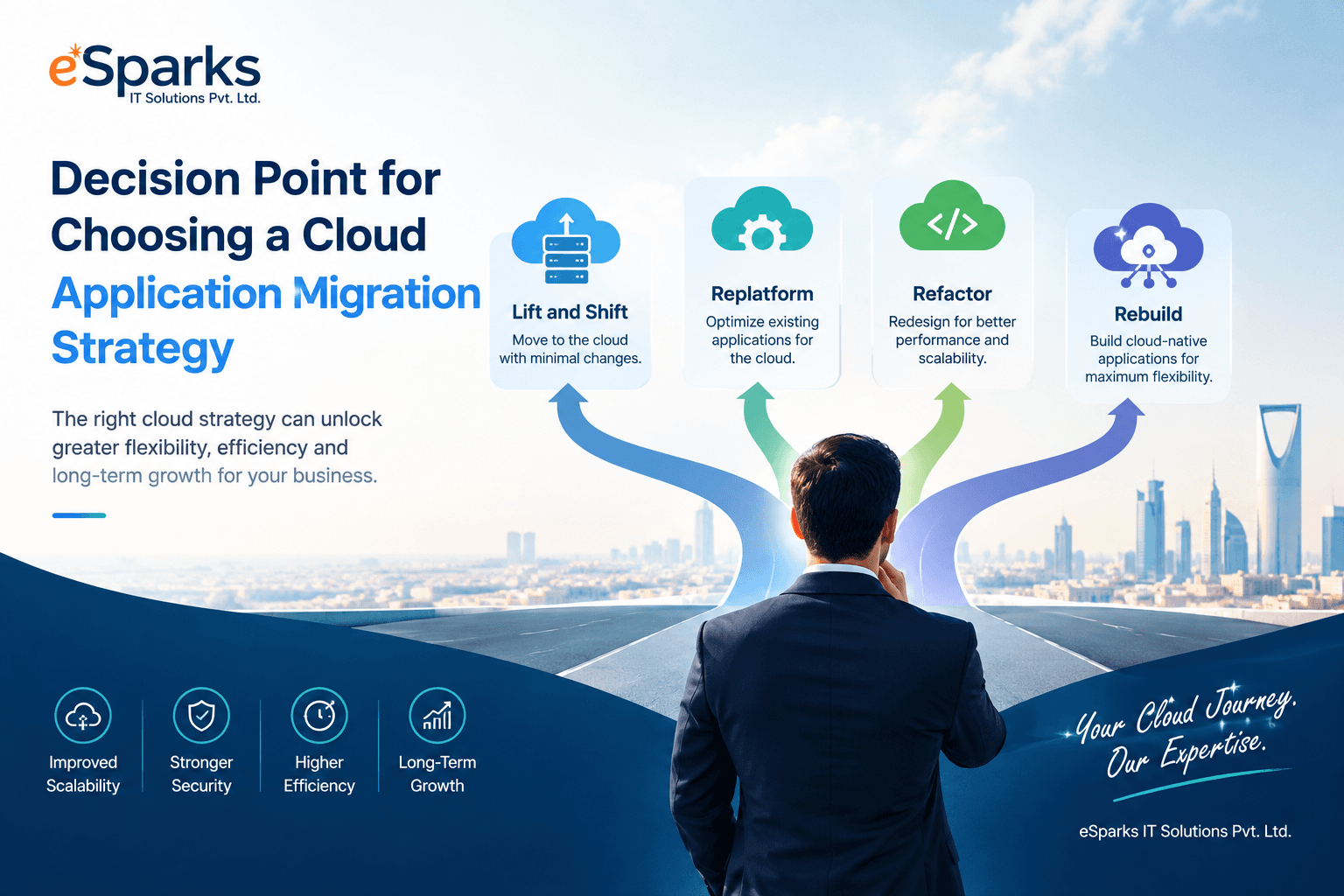
Programming
Secure Software Development Lifecycle: A Buyer’s Guide
Learn how a secure software development lifecycle reduces risk, improves release quality, and helps buyers evaluate software partners.
Sep 11, 2026
Read More
Programming
Custom Software Engineering Dammam: A Practical Guide
Learn how to evaluate custom software engineering Dammam partners, costs, timelines, architecture, security, and delivery risks.
Sep 6, 2026
Read MoreReady to Transform Your Business?
Let's discuss how our expertise can help you achieve your goals