Back to Portfolio
Data Platform
● Live in productionPhone Vault
Bulk phone-number dedup & vendor-delivery tracking
~1M-row uploads
Layered Go architecture
Three-tier dedup pipeline
Overview
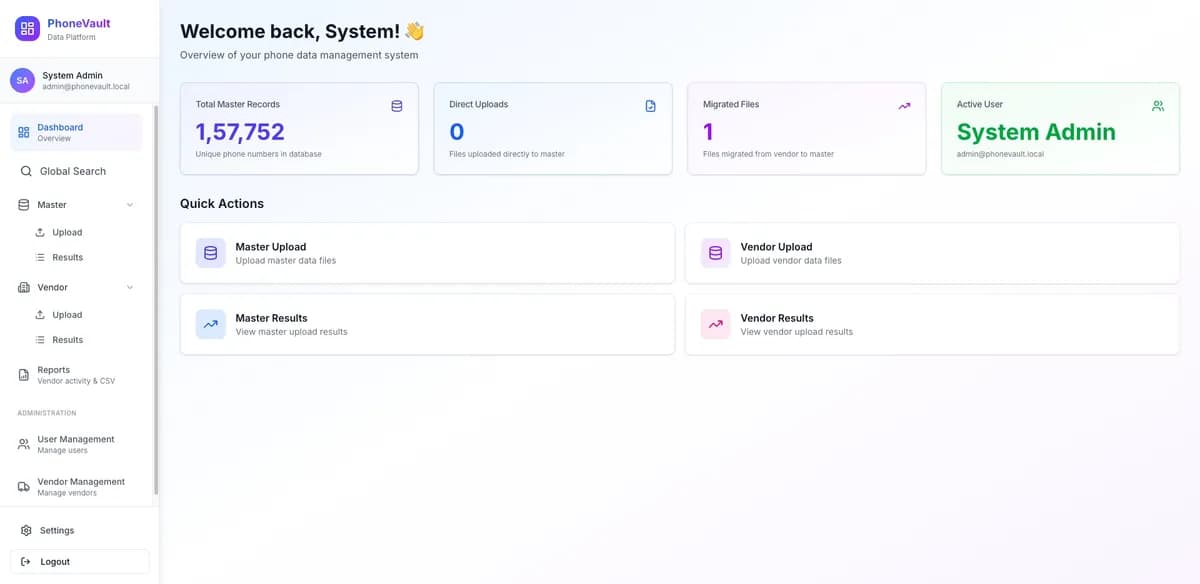
Phone Vault is a data-operations platform built by eSparks IT Solutions to turn bulk vendor CSV and Excel uploads into one clean, deduplicated phone-number master list. A Go/Gin API normalizes every number to real E.164 format with a genuine phone-number parsing library, then runs a three-tier deduplication check — within the uploaded file, against the master dataset, and against what that vendor has delivered before — before anything is migrated out of staging. The Next.js dashboard covers upload, staged review, vendor management, and date-ranged per-vendor reporting with CSV export. The stack is intentionally simple: a single Go API, a single Next.js frontend, and PostgreSQL as the only datastore, run via Docker Compose behind Nginx.
A folder of vendor CSVs isn't a clean phone list.
The same number arrives twice.
Without cross-referencing against what was already delivered, a vendor gets credited again for a number they sent last month.
Formatting is never consistent.
One file has +91, another has a leading 0, another has spaces — comparing numbers as plain strings misses obvious duplicates.
Nobody can prove what was reviewed.
Without a staging step, duplicate or bad rows get mixed into the master list with no way to tell which upload they came from.
A dedup pipeline that doesn't actually normalize phone numbers first isn't a dedup pipeline — it's a false sense of security.
Why it matters
The outcomes that actually move the needle
Three-tier dedup, not one.
Within-file, against the master list, and against what a vendor has already delivered — each checked separately.
Real E.164 normalization.
Built on a genuine phone-number parsing library, not a strip-non-digits shortcut, so formatting differences never hide a duplicate.
Nothing skips staging.
Every upload is categorized before it can reach the master table, and migration into it is an explicit, reviewable action.
Handles real file sizes.
Chunked, cancelable uploads and extended request timeouts, sized for uploads in the hundreds of thousands of rows.
Vendor accountability built in.
A per-vendor report shows exactly how many of their delivered numbers were actually new.
Key Capabilities
What we designed, built and shipped
Bulk CSV & Excel upload, chunked and cancelable, with real-time progress
Real E.164 phone normalization (libphonenumber), not string stripping
Three-tier dedup: within-file, against master, against vendor history
Staging → master review flow with per-vendor duplicate/dispute reporting
Technology Stack
Every choice made for a reason — not just what's trendy
| Layer | Technology | Why |
|---|---|---|
| API | Go 1.25 + Gin | Low-memory footprint for high-volume file processing |
| Web | Next.js 15 + React 18 | Dashboard for uploads, review, vendors and reports |
| Database | PostgreSQL 17 | Single datastore; schema applies idempotently on boot |
| Phone parsing | libphonenumber (Go port) | Real E.164 normalization, not string stripping |
| Excel handling | excelize | Genuine .xlsx parsing, converted to CSV before processing |
| Auth | JWT access + refresh tokens over bcrypt | Stateless sessions sized for an internal tool |
| Deployment | Docker Compose, Nginx-fronted | Containers bind to localhost only in production |
| Logging | zap (structured, Go) | Structured logs instead of unstructured console output |
Architecture
A simple pipeline, on purpose
One API, one database — every upload is normalized and checked in three passes before it can reach the master table.
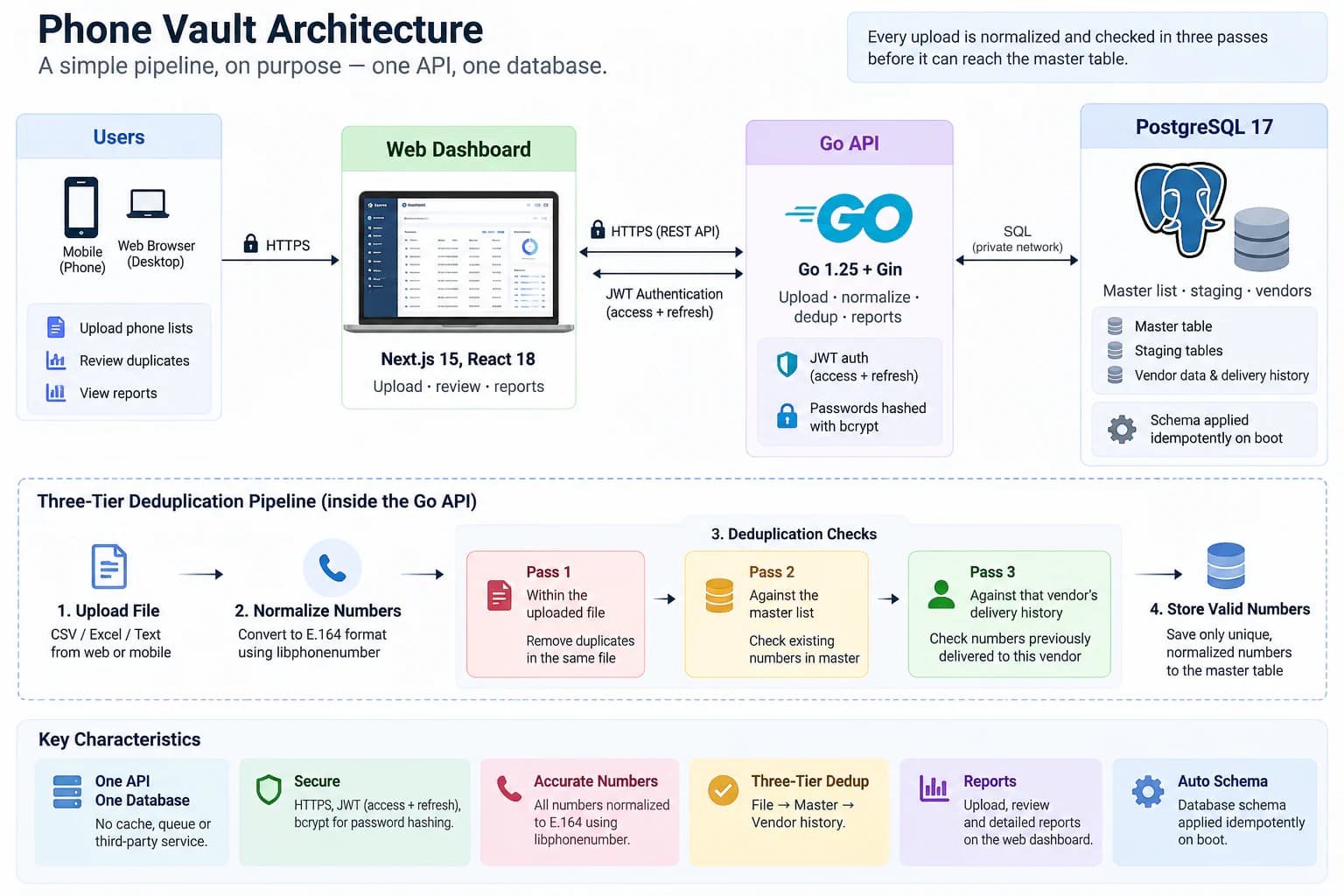
Every uploaded file is parsed in-process, normalized to E.164, and run through the three-tier dedup pipeline before anything touches the master table in PostgreSQL — the product's only datastore.
How it works
From a vendor file to a clean master list
1
Upload a vendor file
CSV or Excel, in parallel chunks, with cancelable progress.
2
Numbers get normalized
Every number is parsed to E.164 before anything else happens.
3
Three dedup checks run
Within-file, against master, against that vendor's history.
4
Review in staging
Results are categorized as unique, self-duplicate, master-duplicate or vendor-duplicate.
5
Migrate to master
Reviewed unique rows move into the authoritative list, individually or as a group.
6
Report and export
Pull a per-vendor report or export any result set to CSV.
Deployment
How it runs
Self-hosted via Docker Compose.
The API, web app and database each run in their own health-checked container, with production containers bound to localhost behind an Nginx TLS reverse proxy.
Operational details
- Docker Compose — API, web and Postgres each in their own health-checked container
- Idempotent schema-on-boot — no separate migration step to run or forget
- Standalone CLI tools: a phone-number backfill/normalize utility and a one-time legacy-database migrator
- Extended request timeouts and a slowloris guard, sized for large file uploads
See the dedup pipeline on real vendor files.
We'll walk through an upload, the three-tier dedup, and a vendor report — on a call.
Complete feature guide
Everything the platform does
Phone Vault turns a folder of vendor CSV and Excel exports into one clean, deduplicated master list — with a record of who delivered which number, and whether it was actually new. Here is everything the platform does.
Ingestion & dedup
From raw vendor files to a clean master list
Bulk upload, real phone normalization, and three-tier deduplication — nothing reaches the master table without being checked.
Bulk upload
- Chunked, cancelable uploads. Large CSV and Excel files upload in parallel chunks with live progress, and a running upload can be canceled mid-flight.
- Real Excel parsing. Uploaded workbooks are converted and parsed with a real Excel library, not assumed to already be CSV.
Three-tier deduplication
- Within-file duplicates. Repeats inside the same upload are caught before anything is written.
- Against the master list. Every number is checked against the authoritative, deduplicated master dataset.
- Against vendor history. A per-vendor delivery index remembers what each vendor has already sent, so re-deliveries are flagged, not re-billed.
Real phone normalization
- E.164 everywhere. Numbers are parsed and normalized with a real phone-number library, not a strip-non-digits shortcut.
- Backfill tool. A standalone CLI can re-normalize existing records if formatting rules change.
Staging → master review
- Nothing skips review. Every upload lands in staging first, categorized as unique, self-duplicate, master-duplicate or vendor-duplicate.
- Explicit migration. Reviewed rows move into the master table individually or as a group — never silently.
Vendor & operations
Know who sent what
Vendor-level reporting, search, and the day-to-day admin tools a data-operations team actually needs.
Vendor tracking
- One record per vendor. Vendor master data ties every delivered number back to who sent it.
- Delivery memory. A per-vendor phone index is the source of truth for whether a vendor has sent a number before.
Reporting & export
- Date-ranged vendor reports. Unique, self-duplicate, master-duplicate, vendor-duplicate and error counts, per vendor, over any date range.
- CSV export. Reports and result sets both export to CSV for downstream use.
Search & discovery
- Field discovery. Search across the fields actually present in an uploaded file, not a fixed schema.
- Per-file search. Look up specific records inside a specific upload result.
User management
- Full admin control. Admins can create, update, lock, unlock, activate or deactivate user accounts.
- Role-aware dashboard. The dashboard adapts what it shows based on admin vs. standard-user role.
Storage maintenance
- Admin-triggered compaction. A maintenance job reclaims storage without needing a maintenance window.
- Configurable limits. Upload size and file-extension allow-list are admin-configurable.
Security & privacy
- Passwords hashed with bcrypt; the hash is never returned in API responses.
- Configurable upload size and file-extension allow-list, enforced server-side.
- Security response headers (X-Frame-Options, X-Content-Type-Options, Referrer-Policy, Permissions-Policy) on every page.
- Production containers bind to localhost only, behind Nginx TLS termination — the database port is never exposed publicly.
- Stateless JWT auth with a short-lived access token and a separate refresh token.
Reliability
- Health-checked containers so the API and database are monitored automatically.
- Idempotent schema-on-boot — the database schema applies safely on every start, with no manual migration step to forget.
- Sized for large uploads: extended request timeouts and a slowloris guard on every connection.
- A standalone normalize tool can backfill phone-number formatting across existing data without downtime.
Ready to Start Your Project?
Let's discuss how we can help you achieve similar results for your business
More Success Stories
Explore our other data platform projects
Data Platform
Database Migration Platform
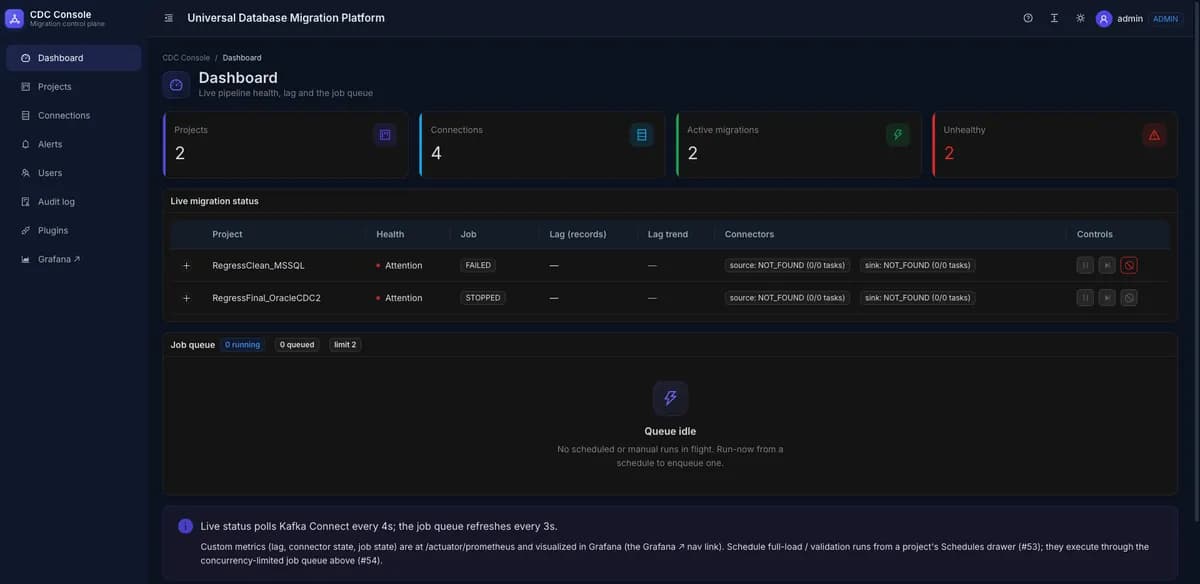
eSparks IT Solutions built a browser-operated data platform for planning, running, monitoring, and validating real-time migrations between heterogeneous databases. Five relational engines (SQL Server, PostgreSQL, MySQL, Oracle, Db2) migrate in either direction; MongoDB is supported as a CDC source. Its Java 21 and Spring Boot 3 control plane orchestrates jobs, while a React interface supports operation through the browser. For real-time CDC, the data plane uses Debezium, Kafka, and a JDBC sink, with PostgreSQL in the stack and deployment via Docker Compose or Kubernetes (Strimzi). The platform includes end-to-end integrity validation with drift detection, custom Java SMTs, AES-GCM secret encryption, Prometheus/Grafana, and JWT/RBAC security. SQL Server, PostgreSQL, MySQL and MongoDB migrations are live-verified end-to-end — including a production programme that moved roughly 960 million rows across 405 tables from SQL Server to PostgreSQL with zero rows missing at validation; Oracle and Db2 connectors are implemented and tested at the unit/config level, pending live verification.
Read Full Case Study
DevOps & Infrastructure
ThinClient OS + Fleet Manager
A production-grade Linux appliance that boots straight into a full-screen Windows RDP session — no desktop, no shell, no login prompt — backed by a self-healing watchdog and an infinite reconnect loop. On machines with Secure Boot and a TPM 2.0 chip the whole disk is encrypted (LUKS2, AES-256) with the key sealed in the machine's own TPM, and the encrypted install has been attack-tested against disk theft and boot tampering. Lost or stolen machines are wiped remotely, crypto-erasing the disk on encrypted installs. Optional per-account policy adds lock-screen password rules with a three-strike lockout, Windows-server certificate pinning, USB-storage and clipboard blocking, and memory hardening. New machines can be required to wait for administrator approval (on by default for new accounts), operating-system security patches can roll out through canary machines, and signed kernel updates roll back on their own if they fail to start. It ships as a reproducible ISO with a graphical installer and pairs with a Next.js fleet manager that provisions, monitors, secures and remotely controls the machines and the AWS, Azure and VPS Windows servers they connect to.
Read Full Case Study
AI Platform
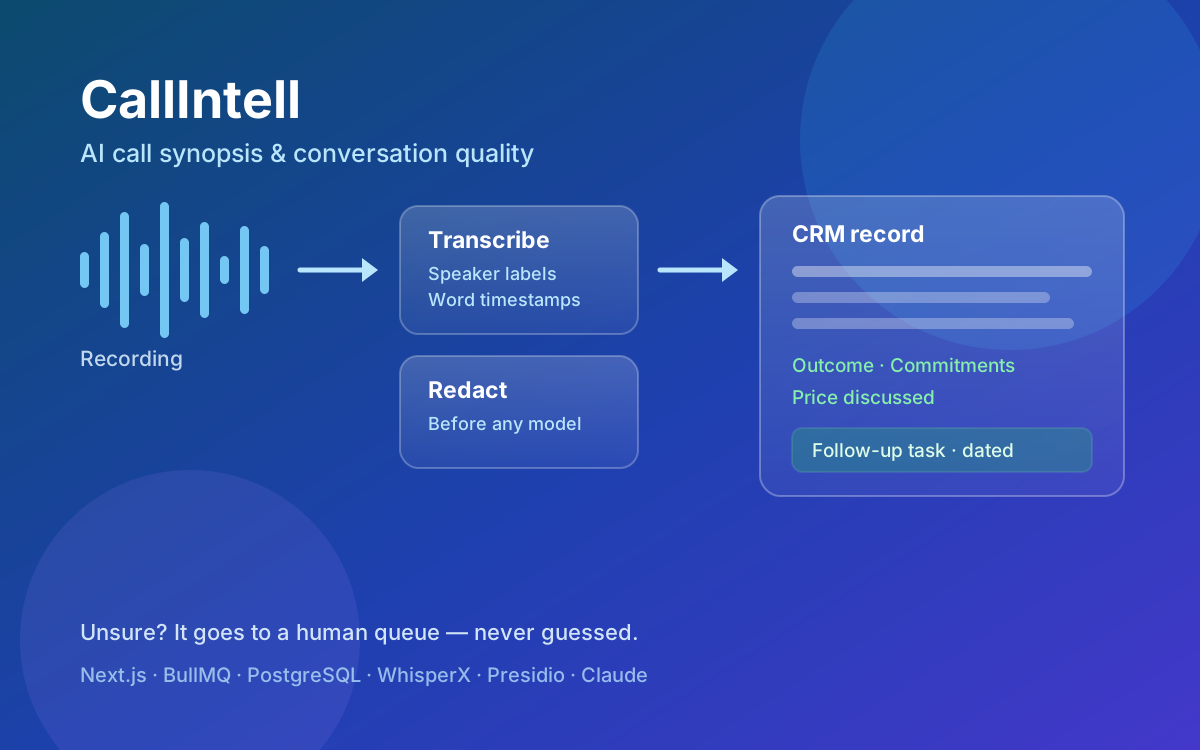
CallIntell — AI Call Synopsis & Quality
CallIntell turns recorded phone calls into reviewed, structured CRM records without anyone listening to the call. A six-stage queue-backed pipeline fetches the recording, transcribes it with speaker labels and word-level timestamps on serverless GPU, strips personal identifiers before any text reaches a language model, matches the call to its CRM record, and generates a schema-validated synopsis — outcome, commitments, objections, price discussed — with every point linked to the second of audio it came from. Spoken follow-up phrases such as “call me in ten days” are resolved into dated CRM tasks in the customer's own time zone, with the verbatim wording kept alongside. Anything the system is not confident about routes to a human review queue rather than being guessed, and CRM writes are idempotent so a retry cannot duplicate a note or a task. Built on Next.js, BullMQ on Redis, PostgreSQL with Drizzle, WhisperX with diarization, Microsoft Presidio redaction and Claude, with passkey and TOTP sign-in, an append-only audit log, per-company isolation and usage metering. Deployed and running the first customer workflow; not yet opened as a public product.
Read Full Case Study