Cloud Computing
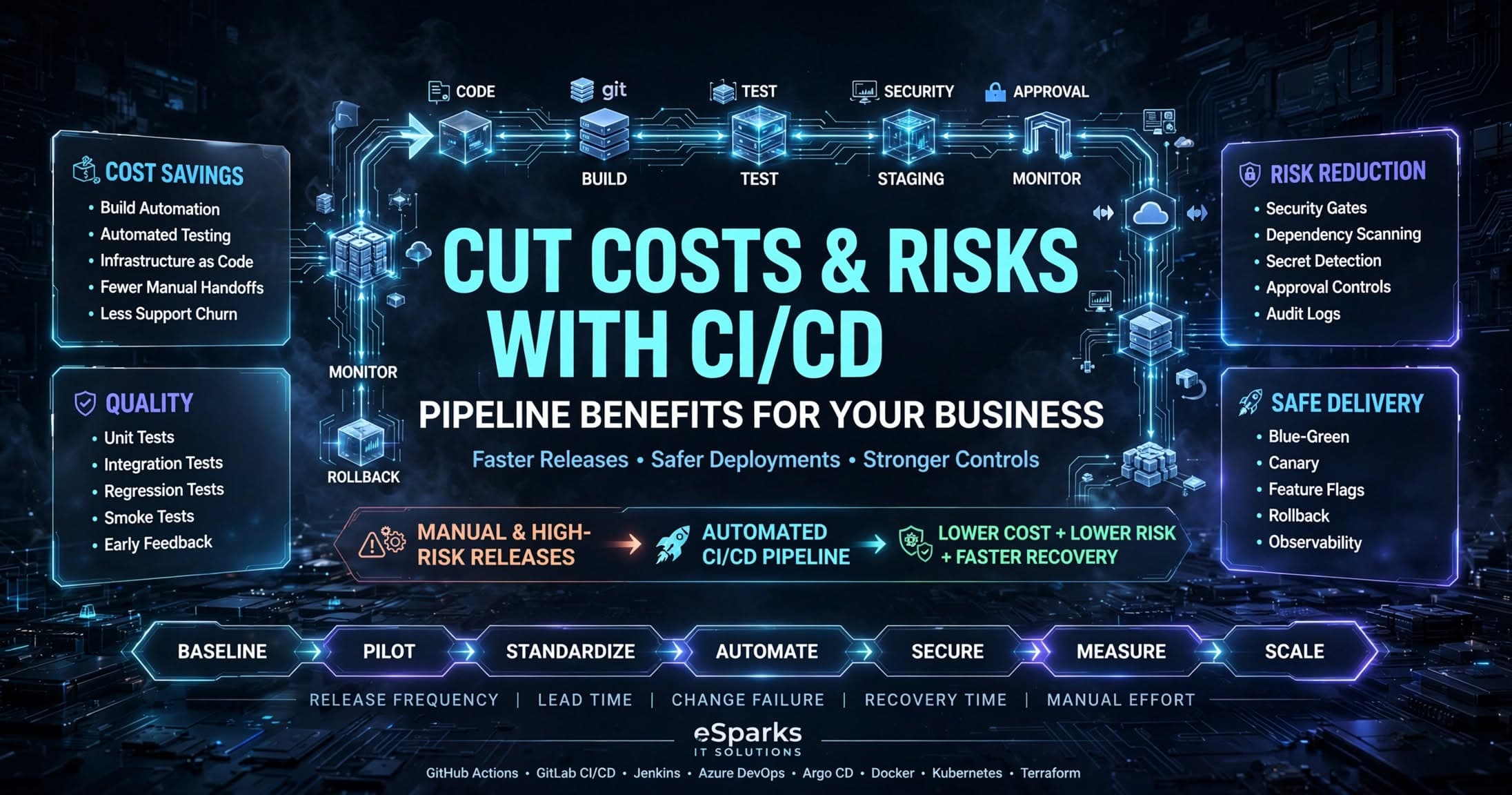
Cut Costs and Risks with CI/CD Pipeline Benefits for Your Business
Learn how to Cut Costs and Risks with CI/CD Pipeline Benefits for Your Business through faster releases, safer deployments, and stronger controls.

Tauseef Alam
Chief Technology Officer
Jul 4, 2026
10 min read
Cut Costs and Risks with CI/CD Pipeline Benefits for Your Business by replacing manual, error-prone release work with automated build, test, security, and deployment workflows. For business leaders, the real advantage is not just speed: it is lower change risk, better engineering productivity, faster recovery when something breaks, and more predictable software delivery.
Key takeaways
- A well-designed CI/CD pipeline reduces delivery costs by automating repetitive testing, packaging, deployment, and rollback tasks that otherwise consume expensive engineering time.
- CI/CD lowers operational risk by finding defects earlier, standardizing release steps, and making every code change traceable through version control, approvals, and audit logs.
- The biggest business value from CI/CD usually comes from smaller, more frequent releases that are easier to test, review, recover, and prioritize.
- Effective CI/CD is not just a tooling project; it depends on branch strategy, test quality, environment consistency, security gates, and clear ownership across teams.
- For most organizations, the practical path to CI/CD starts with one product, one pipeline, and a measurable baseline before scaling standards across teams.
Why CI/CD matters to business leaders
Continuous Integration and Continuous Delivery, usually shortened to CI/CD, are often described as engineering practices. That is true, but the business impact is what matters when you are deciding where to invest. In simple terms, CI means developers merge code changes frequently into a shared repository, where automated checks validate each change. CD means those validated changes move through repeatable release stages toward production with minimal manual intervention.
For founders, CTOs, and IT managers, this changes the economics of software delivery. Instead of bundling weeks of work into one risky release window, teams ship smaller increments. Smaller changes are easier to review, test, approve, and roll back. That reduces the cost of defects, shortens downtime when incidents happen, and lowers the dependency on a few senior engineers who know the release process by memory.
A mature pipeline also improves visibility. With tools such as GitHub Actions, GitLab CI/CD, Jenkins, Azure DevOps, CircleCI, Argo CD, or Bitbucket Pipelines, leaders can see where releases are blocked, how long builds take, which tests fail repeatedly, and which environments drift from the standard. That level of traceability matters for budgeting, planning, compliance, and vendor accountability.
Cut Costs and Risks with CI/CD Pipeline Benefits for Your Business
The phrase sounds broad, so it helps to break the benefits into concrete cost and risk categories. First, there is labor efficiency. Manual build packaging, environment setup, regression testing, deployment checklists, and post-release verification all consume high-value engineering hours. Automating these steps does not eliminate engineering work; it shifts effort from repetitive release mechanics to product improvements, architecture, and customer-facing issues.
Second, there is failure cost. A failed release does not just create technical cleanup. It can affect revenue, customer trust, support volume, team morale, and executive attention. CI/CD reduces that exposure by validating changes earlier with unit tests, integration tests, static analysis, dependency scanning, infrastructure checks, and deployment smoke tests. If a problem appears, it is usually tied to a small, recent change instead of a large release bundle from several weeks.
Third, there is governance risk. Businesses in sectors such as fintech, healthcare, logistics, retail, and SaaS increasingly need evidence of who changed what, when it was tested, what was approved, and how production access is controlled. A well-structured pipeline can enforce pull-request reviews, signed commits, role-based approvals, secrets management, artifact retention, and audit logs. That is a practical advantage when aligning with internal controls or standards such as SOC 2, ISO 27001, PCI DSS, or change-management policies.
Common business gains usually show up in these areas:
- Lower release overhead because builds, tests, packaging, and deployments are automated
- Less downtime from failed releases due to smaller change sets and easier rollback paths
- Faster time to market because teams do not wait for large release windows
- Better resource planning because lead time, failure causes, and deployment status are visible
- Reduced key-person dependency because release knowledge moves into documented pipelines
Where CI/CD saves money in real operations
The savings from CI/CD are rarely a single line item. They accumulate across engineering, operations, support, and opportunity cost. Consider a web platform that currently releases once per month using a manual checklist. Two developers prepare the build, a QA lead runs regression tests, an operations engineer deploys late at night, and a product manager coordinates communications. Even if nothing fails, the release process pulls multiple skilled people into low-leverage work. If a deployment breaks, everyone stays longer, support tickets rise, and the next sprint loses momentum.
Now compare that with a pipeline that automatically builds a Docker image, runs unit and integration tests, scans dependencies with tools like Snyk or Trivy, applies database migrations safely, deploys to staging, executes smoke tests, and promotes to production after approval. The savings come from fewer manual handoffs, fewer after-hours releases, and faster root-cause analysis because every stage is logged.
Typical cost-saving areas include:
- Build and packaging automation: Artifact creation becomes consistent across environments, reducing “works on my machine” issues.
- Automated testing: Unit, API, UI, contract, and regression tests catch errors before human QA spends time reproducing them.
- Infrastructure as Code: Terraform, Pulumi, AWS CloudFormation, or Bicep reduce environment setup time and drift.
- Containerization: Docker and Kubernetes standardize runtime behavior, reducing deployment surprises.
- Rollback and recovery: Blue-green or canary deployments lower the cost of failed releases by limiting blast radius.
- Less support churn: Cleaner releases mean fewer urgent tickets and less interruption to planned work.
In our experience, the biggest hidden saving is decision speed. When release status is reliable, leaders can commit to launch windows, customer updates, and roadmap priorities with more confidence. That reduces the expensive ambiguity that often surrounds software projects.
The risk reduction side: quality, security, and compliance
Many companies first pursue CI/CD to ship faster, then discover that risk reduction is the more valuable outcome. The reason is straightforward: speed without control creates fragile systems. Good pipelines increase speed by improving control.
Quality starts with the feedback loop. A pipeline can run linting, static application security testing, unit tests, API tests, and integration checks on every pull request. For services that depend on third-party APIs, queues, or databases, contract testing and ephemeral test environments help catch compatibility issues before production. For mobile apps, pipelines can automate builds, run emulator tests, sign releases, and manage staged rollouts through app stores.
Security should be built into the path, not bolted on afterward. Practical controls include secrets management through Vault, AWS Secrets Manager, or Azure Key Vault; software composition analysis for open-source dependencies; container image scanning; Infrastructure as Code scanning with tools like Checkov or tfsec; and policy gates using Open Policy Agent or built-in platform controls. For businesses handling sensitive data, pipelines should also separate duties, restrict direct production access, and require approvals for high-risk changes.
Risk reduction usually depends on a few architectural choices:
- Feature flags let teams release code without exposing unfinished functionality to all users.
- Canary deployments send a small portion of traffic to the new version first, making issues easier to detect and contain.
- Blue-green deployments keep the previous environment ready, allowing fast reversal.
- Database migration strategies, including backward-compatible schema changes, reduce release lockups.
- Observability through logs, metrics, tracing, and alerts helps teams verify releases quickly.
Without these controls, “automated deployment” can simply automate mistakes. With them, CI/CD becomes a safety system for change.
What a good business-grade CI/CD pipeline looks like
Not every pipeline needs the same depth, but business-grade CI/CD is more than a script that pushes code to a server. It should reflect how your software is built, tested, secured, approved, and operated in the real world.
A practical baseline often includes source control in GitHub, GitLab, or Azure Repos; branch protection rules; pull-request reviews; automated builds; test stages; dependency and secret scanning; artifact repositories such as Nexus, JFrog Artifactory, Amazon ECR, or GitHub Container Registry; environment promotion rules; deployment automation; and monitoring hooks. For cloud-native systems, Kubernetes with Helm or Kustomize, plus GitOps tools like Argo CD or Flux, can strengthen consistency across environments.
For most businesses, the pipeline should answer these operational questions clearly:
- What happens when a developer opens a pull request?
- Which tests must pass before a merge?
- How are build artifacts versioned and stored?
- Who can approve staging and production promotion?
- How are secrets injected without exposing them in code or logs?
- How can a deployment be rolled back safely?
- What evidence is retained for audits, incident reviews, or customer requirements?
The best design depends on system type. A monolithic internal application may need a simpler path than a multi-service SaaS platform. A regulated B2B product may need stronger approvals and traceability than a marketing site. At eSparks, we usually advise clients to optimize for repeatability first, then speed. Fast but inconsistent pipelines create expensive downstream problems.
A step-by-step framework to decide if you are ready
Business leaders often ask whether CI/CD should come before cloud modernization, QA improvement, or platform engineering. The answer depends on current pain points. The best way to decide is to use a staged assessment rather than treating CI/CD as a universal fix.
Start with a baseline. Measure release frequency, lead time from code commit to production, common failure points, rollback effort, manual testing load, and how often production issues are caused by release process errors versus code defects. You do not need perfect numbers; even directional baselines help. Then map bottlenecks. Some teams think they need deployment automation when the real problem is unstable test data, poor branching discipline, or environments that differ wildly.
A practical decision framework looks like this:
-
Identify the business objective.
- Reduce release delays?
- Lower production incident risk?
- Support compliance evidence?
- Free engineering time from repetitive work?
-
Choose one product or service for the pilot.
- Pick something important enough to matter, but not so critical that every change is politically difficult.
-
Standardize the foundations.
- Define branch strategy, review rules, naming conventions, environment variables, and artifact versioning.
-
Automate the minimum viable path.
- Build, unit test, package, deploy to staging, smoke test, and require approval before production.
-
Add security and quality gates.
- Dependency scanning, secret detection, IaC checks, integration tests, and rollback procedures.
-
Measure pipeline outcomes for one or two release cycles.
- Track time saved, failure causes, release confidence, and where manual work still remains.
-
Scale patterns, not just tools.
- Reuse templates, shared runners, policy controls, and deployment standards across teams.
For a small to mid-sized application, a solid first implementation commonly takes several weeks to a few months, depending on test maturity, environment complexity, and compliance needs. Costs vary widely by stack and scope, but they are usually driven less by the CI tool license and more by engineering time spent improving tests, infrastructure consistency, and release practices.
Common pitfalls that waste money instead of saving it
The most common mistake is assuming CI/CD is mainly a tooling purchase. Buying Jenkins plugins, GitLab Ultimate, or a cloud DevOps suite will not fix unclear branching, weak tests, or inconsistent environments. If your test suite is flaky, your pipeline will become a faster way to generate mistrust.
Another expensive pitfall is overengineering the first version. Teams sometimes build highly complex pipelines with multiple approval layers, custom scripts, parallel jobs, temporary exceptions, and environment-specific logic before they have a stable release path. That complexity increases maintenance cost and makes troubleshooting harder. Start with one reliable path, then modularize.
Watch for these issues early:
- Flaky automated tests that fail unpredictably and train teams to ignore pipeline results
- Long-running builds that slow developers so much they bypass good practices
- Hard-coded credentials or poorly managed secrets in scripts and environment files
- No rollback strategy, which turns every release into an all-or-nothing event
- Pipeline logic that differs by developer, branch, or server in undocumented ways
- Skipping database migration planning, especially for systems with large datasets or zero-downtime requirements
- Treating production monitoring as separate from delivery, leaving teams blind after deployment
The remedy is disciplined simplification. Make pipeline stages visible, deterministic, and documented. Keep test data realistic but manageable. Use reusable templates where possible. Prefer Infrastructure as Code over manual setup. And review the pipeline itself as a product that needs maintenance, ownership, and periodic refactoring.
How to evaluate a delivery partner for CI/CD work
If you are considering outside help, evaluate the partner the way you would evaluate a platform change: by method, transparency, and operational judgment, not by generic promises of speed. A credible team should be able to explain how they will assess your current delivery process, which controls belong in the pipeline, how they will handle secrets and approvals, and what tradeoffs they recommend for your stack.
Ask specific questions. Which CI/CD platforms do they use most often: GitHub Actions, GitLab, Azure DevOps, Jenkins, Argo CD? How do they design pipelines for containerized apps versus VM-based systems? How do they approach test pyramids, environment parity, rollback design, and migration safety? Can they support cloud targets such as AWS, Azure, or Google Cloud while aligning with your internal access controls and audit requirements? Their answers should be concrete, not generic.
A strong partner will also be honest about prerequisites. If your current application lacks tests, has manual infrastructure, or mixes deployment logic with tribal knowledge, the right first step may be pipeline readiness work rather than full automation. That honesty is useful. The goal is not to deploy a fashionable CI/CD setup. The goal is to build a delivery system that lowers cost, reduces risk, and remains maintainable as your business grows.
Frequently Asked Questions
What are the main CI/CD pipeline benefits for a business?
The main business benefits of CI/CD are lower release overhead, fewer deployment errors, faster recovery from failures, and more predictable delivery. By automating build, test, security, and deployment steps, teams spend less time on manual release work and gain better control over software change.
How long does it usually take to implement CI/CD?
A basic but reliable CI/CD pipeline for one application often takes several weeks, while a more mature setup with security gates, Infrastructure as Code, and multi-environment promotion can take a few months. The timeline depends heavily on existing test quality, environment consistency, and the complexity of your application and compliance requirements.
Does CI/CD only help large engineering teams?
No, smaller teams often feel the benefits earlier because manual releases consume a larger share of their limited time. Even a compact pipeline that automates builds, core tests, and staged deployments can reduce key-person dependency and improve release confidence.
What is the difference between faster delivery and safer delivery in CI/CD?
Faster delivery means reducing the time and friction required to move code from development to production. Safer delivery means adding automated checks, approvals, traceability, and rollback paths so that changes can be released with lower operational and security risk; the best CI/CD systems achieve both together.
Work with eSparks IT Solutions
Planning a project around this? We help businesses across the USA, UK, Canada, Australia and the GCC ship it. Explore our Programming services and portfolio, estimate your project cost, or book a free call.
Related cloud & DevOps services

Tauseef Alam
Chief Technology Officer
Passionate technology writer and industry expert with years of experience in software development, cloud computing, and digital transformation. Dedicated to sharing insights and helping developers stay ahead of the curve.
Related Topics
Continue Reading
More insights in Cloud Computing
Cloud Computing
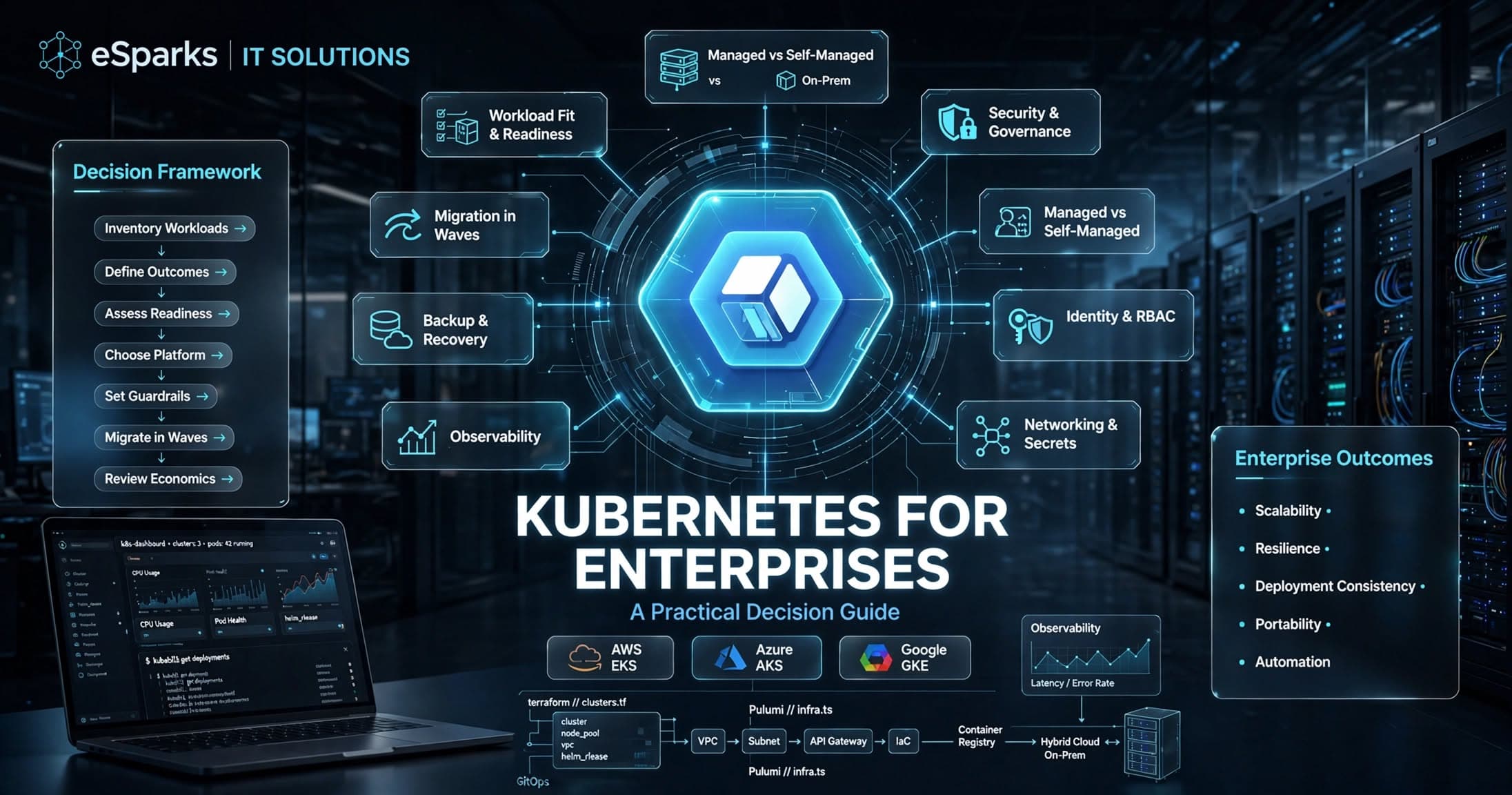
Kubernetes for Enterprises: A Practical Decision Guide
Kubernetes for enterprises can improve scalability, resilience, and release speed—but only when platform maturity, security, and operating model align.
Sep 26, 2026
Read More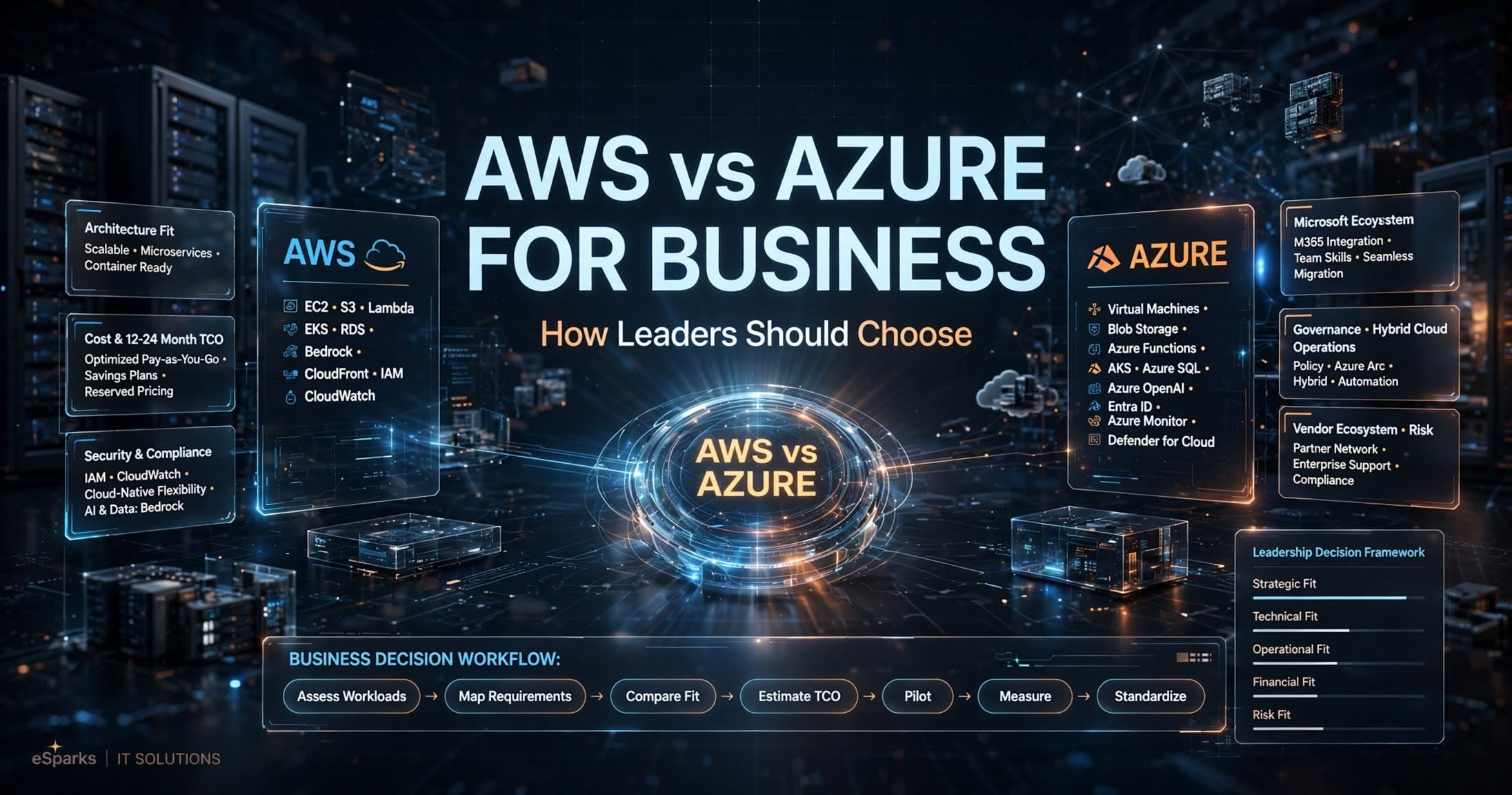
Cloud Computing
AWS vs Azure for Business: How Leaders Should Choose
Compare aws vs azure for business across cost, security, Microsoft fit, AI, and operations with a practical decision framework for leaders.
Sep 25, 2026
Read More
Cloud Computing
Mysql to Postgresql Migration Service: UK Decision Guide
A practical UK guide to choosing a mysql to postgresql migration service, covering risks, cost, timelines, tooling and delivery approach.
Sep 14, 2026
Read MoreReady to Transform Your Business?
Let's discuss how our expertise can help you achieve your goals