Cloud Computing
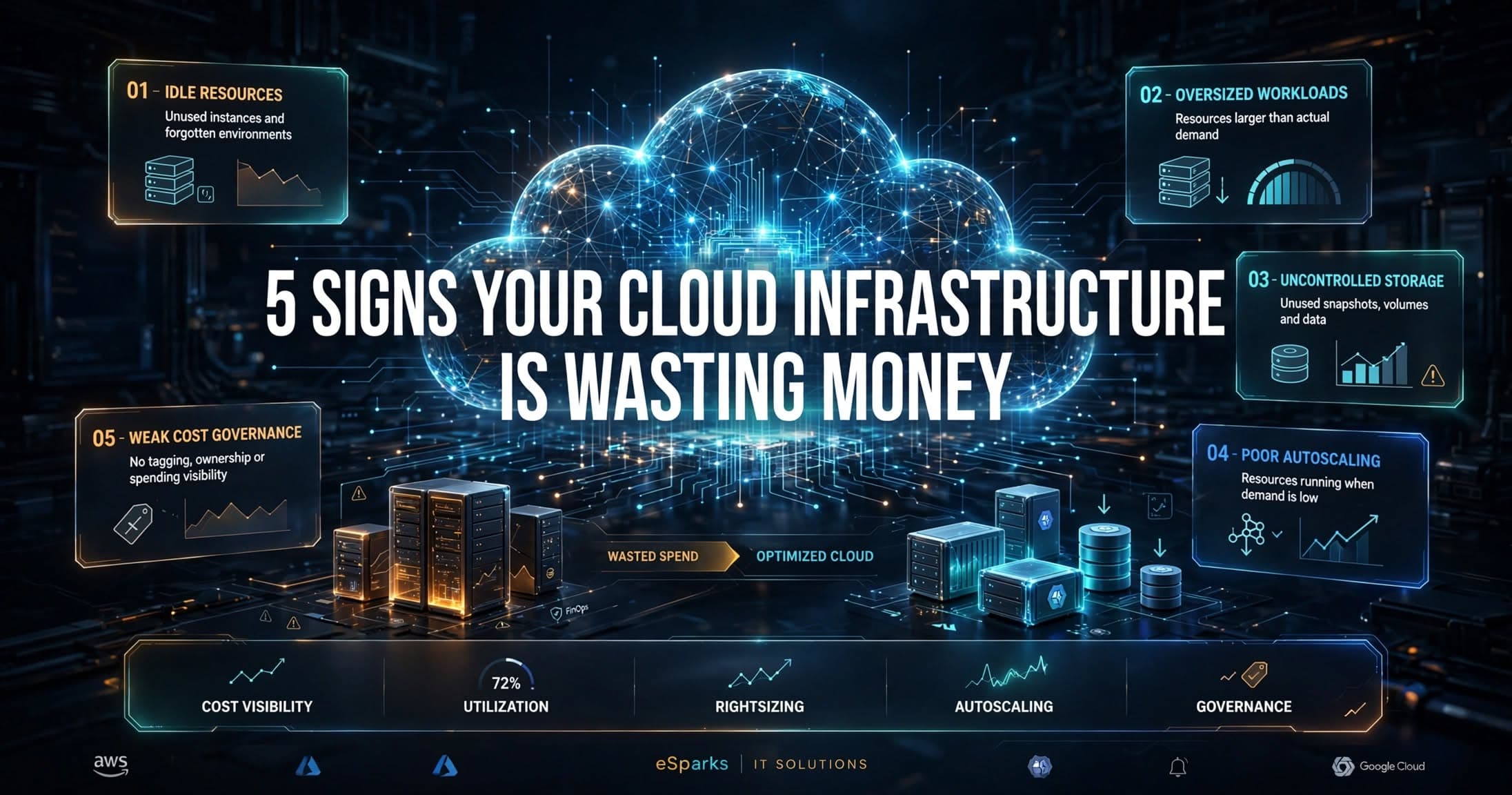
5 Signs Your Cloud Infrastructure is Quietly Wasting Money
Learn 5 Signs Your Cloud Infrastructure is Quietly Wasting Money, how to spot hidden spend, and what leaders can fix first.

Tauseef Alam
Chief Technology Officer
Jul 1, 2026
10 min read
If you are seeing rising cloud bills without a clear business reason, the answer is usually not that “cloud is expensive” by itself. The real issue behind 5 Signs Your Cloud Infrastructure is Quietly Wasting Money is that resources, architecture choices, and governance rules have drifted away from actual workload needs. In practice, waste shows up as idle services, oversized environments, unmanaged storage growth, and teams lacking the visibility to connect spend with value.
Key takeaways
- Cloud waste usually comes from design and governance issues, not just high usage.
- Idle resources, oversized compute, unmanaged data growth, and poor visibility are among the most common reasons cloud bills rise without business value.
- FinOps works best when finance, engineering, and operations review cost, performance, and architecture decisions together.
- Reserved capacity and autoscaling save money only when teams understand actual workload patterns and review them regularly.
- A focused 30-day audit can usually identify enough avoidable cloud spend to justify deeper optimization work.
Why cloud waste hides so well
Cloud waste is rarely caused by one obvious mistake. It usually builds slowly: a development environment stays online after a project ends, a database is sized for peak load that happens only a few days a year, or logs are retained far longer than anyone intended. Because cloud platforms like AWS, Microsoft Azure, and Google Cloud make it easy to provision resources quickly, they also make it easy to forget what was provisioned, why it exists, and whether it still serves the business.
For business decision-makers, this is why cloud spend can feel confusing. The bill is detailed, but not necessarily understandable. A CTO might see compute, storage, data transfer, managed services, Kubernetes clusters, snapshots, and observability tools all increasing at once. An IT manager may know costs are high but still struggle to identify which part is normal growth and which part is waste. Founders often assume the solution is simply to negotiate pricing or move providers, when the bigger opportunity is usually internal architecture and operating discipline.
The pattern we see most often is not reckless overspending. It is reasonable technical decisions made at one stage of growth that were never revisited later. A system designed for speed during product launch may become too expensive at scale. A security control added quickly may duplicate an existing native cloud feature. A backup policy may make sense for critical production systems but gets copied into test environments where the same retention period is unnecessary.
5 Signs Your Cloud Infrastructure is Quietly Wasting Money
The clearest warning signs are operational, not just financial. If you recognize two or more of the following, there is a good chance your cloud estate is carrying silent waste.
- Your monthly cloud bill keeps rising, but traffic, users, or transaction volume are relatively stable.
- Teams cannot quickly explain which workloads are driving the increase or who owns them.
- Production, staging, and development environments look nearly identical in size, even though their usage is very different.
- You are paying for premium managed services, but still doing significant manual operational work around them.
- Cost reviews happen only when finance escalates a bill rather than as part of routine engineering operations.
A healthy cloud environment is not necessarily a cheap one. High spend can be justified if it supports customer growth, resilience, compliance, or speed to market. Waste is different: it is money spent without a proportional technical or business benefit. That distinction matters because reducing waste should not mean creating risk. Turning off redundancy, shrinking databases aggressively, or removing monitoring may lower the bill in the short term while increasing outage risk later.
The better question is this: if you had to defend every major cloud cost line item to your board or leadership team, could you explain what value it creates? If the answer is no, you likely have optimization work to do.
Sign 1 and 2: idle capacity and wrong-sized compute
The most common form of cloud waste is paying for resources that are underused or unused. This includes EC2 instances with low CPU and memory utilization, Azure Virtual Machines left running overnight, unattached EBS volumes, unused Elastic IPs, forgotten load balancers, dormant Kubernetes nodes, and database replicas that were created for a short-term event and never removed. These are easy to miss because they are individually small compared with the total bill, but together they create a constant background leak.
Right-sizing is the second closely related problem. Many teams choose larger instance families than they need because they are planning for spikes, trying to avoid performance complaints, or simply copying production-like configurations into every environment. In AWS this might mean running m6i or r6g instances where smaller burstable or general-purpose families would do. In Azure, it may mean using premium tiers for workloads that are not latency-sensitive. In Kubernetes, over-requested CPU and memory can force the cluster autoscaler to add nodes unnecessarily.
Practical checks that reveal this quickly include:
- Review 30 to 90 days of CPU, memory, IOPS, and network metrics in CloudWatch, Azure Monitor, or Google Cloud Monitoring.
- Identify instances averaging very low utilization during business and non-business hours.
- Compare reserved size against peak, not average, usage for managed databases such as Amazon RDS, Azure SQL Database, or Cloud SQL.
- Separate production from staging and development policies. Non-production should usually scale down more aggressively or run on schedules.
- For Kubernetes, inspect requests, limits, node utilization, and pending pod behavior using Prometheus, Grafana, or native cluster dashboards.
A typical fix can take a few days for obvious idle resources and a few weeks for safer compute right-sizing, because production systems should be tested carefully before changes. The pitfall is optimizing based on CPU alone. Many systems are constrained by memory, storage throughput, connection limits, or latency requirements, so rightsizing must consider the full workload profile.
Sign 3 and 4: storage sprawl and poor cost visibility
Storage waste is often underestimated because storage appears inexpensive at first glance. But object storage, block storage, snapshots, backups, archived logs, container images, analytics datasets, and cross-region replicas accumulate over time. Teams may retain everything “just in case,” even when data has no operational, compliance, or analytical value. The result is not only a larger bill but also slower recovery processes, cluttered environments, and unnecessary governance risk.
Look closely at areas such as:
- S3, Azure Blob, or Google Cloud Storage buckets with no lifecycle rules.
- Snapshots retained indefinitely instead of according to recovery point and recovery time objectives.
- Database backups copied across regions or accounts without periodic cleanup.
- High-volume application and security logs kept in hot storage when warm or cold tiers would be enough.
- Multiple copies of datasets for analytics, testing, machine learning, and reporting.
The fourth sign is weak cost visibility. If you cannot trace cost to teams, products, environments, or customers, optimization becomes guesswork. Good visibility starts with tagging or labeling standards, but it cannot stop there. Tags must be enforced, reviewed, and tied to real ownership. At minimum, most organizations should be able to break cloud spend down by environment, application, owner, and business function.
This is where FinOps practices become valuable. A mature setup usually includes cloud cost dashboards, anomaly detection, budget alerts, and regular reviews involving engineering, operations, and finance. AWS Cost Explorer, Azure Cost Management, Google Cloud Billing, Kubecost for Kubernetes, and observability platforms can all help. The mistake is assuming the tool alone solves the problem. The real gain comes from governance: naming standards, tag policies, chargeback or showback models, and a clear process for decommissioning resources.
Sign 5: architecture choices that made sense once, but not now
Some of the biggest savings opportunities come from architecture, not housekeeping. A cloud platform can be technically sound yet economically inefficient because it was built for a different stage of the company. For example, always-on VMs may be fine early on, but event-driven services using AWS Lambda, Azure Functions, or managed queues can become more efficient for intermittent workloads. Conversely, serverless can become costly for sustained high-throughput jobs where containers or reserved compute are more predictable.
The same applies to databases, networking, and delivery pipelines. A managed database with high availability across zones may be essential for a customer-facing transaction system, but excessive replication for internal tools may be unnecessary. NAT gateway charges, inter-zone traffic, egress between services, and chatty microservice designs are frequent hidden costs. In CI/CD, running every pipeline with full test suites and heavyweight runners can quietly inflate spend when many checks could be cached, parallelized intelligently, or run conditionally.
When we built Database Migration Platform, one practical lesson was that cost optimization could not be separated from migration design. Decisions about data movement patterns, staging, retries, storage tiers, and observability all affected operating cost as much as they affected reliability. That is true in most cloud projects: architecture and economics are linked, so the right question is not “what is the cheapest service,” but “what design gives the required reliability, security, and performance at a sustainable operating cost.”
Common architecture-related waste patterns include:
- Using premium managed services for low-criticality workloads.
- Replicating microservices where a simpler modular architecture would suffice.
- Keeping legacy lift-and-shift environments unchanged for too long.
- Overengineering high availability for systems that do not need strict uptime targets.
- Ignoring egress and data transfer costs during multi-region or multi-cloud designs.
A practical framework to diagnose and fix cloud waste
A useful cloud cost review should be structured, not reactive. We recommend a five-step approach that business and technical leaders can use together.
- Baseline the spend. Pull 3 to 6 months of cost data and group it by provider, account, subscription, project, environment, and service category. Note which areas are rising faster than the business they support.
- Map cost to ownership. Every major cost center should have a technical owner and a business purpose. If no one owns it, that is itself a finding.
- Measure utilization and value. Compare spend against utilization metrics, service criticality, user demand, and compliance requirements. A resource can be expensive and still justified; it is unjustified cost that matters.
- Prioritize by risk and effort. Quick wins include idle cleanup, scheduled shutdowns, storage lifecycle rules, and commitment discounts such as Savings Plans, Reserved Instances, or Azure Reservations. Medium-effort items include rightsizing, Kubernetes optimization, and backup policy redesign. Higher-effort items include architecture changes, data redesign, or network refactoring.
- Put governance in place. Add budget alerts, policy-as-code, tag enforcement, regular review cadences, and approval workflows for expensive resources.
Typical timelines vary. A light assessment focused on obvious waste can often be done in 1 to 2 weeks. A deeper optimization initiative covering architecture, security, observability, and operating models commonly takes 4 to 12 weeks depending on environment size and change risk. If regulated workloads are involved, expect longer review cycles because cost changes must still meet standards such as ISO 27001 controls, SOC 2 requirements, CIS benchmarks, least-privilege IAM practices, encryption policies, and disaster recovery expectations.
A final caution: do not separate cost optimization from performance and security. Turning off logging, reducing backups indiscriminately, or collapsing environments without proper access controls creates hidden risk. The right target is efficient resilience, not just a smaller invoice.
What good looks like after optimization
An efficient cloud environment has a few visible traits. Leadership can see where spend goes and which teams own it. Engineers know the expected cost profile of major services and review it as part of normal operations. Non-production environments have different scaling and retention rules than production. Storage tiers, backup schedules, and observability settings are based on policy rather than habit. Architecture decisions are revisited as workloads evolve.
In practical terms, that often means autoscaling with sensible thresholds, scheduled start-stop policies for test systems, lifecycle rules for object storage, right-sized managed databases, committed-use discounts for stable workloads, and policy checks built into infrastructure-as-code using tools such as Terraform, OpenTofu, AWS Config, Azure Policy, or OPA. It also means monthly or quarterly FinOps reviews where cost, reliability, and roadmap decisions are discussed together instead of in isolation.
For organizations operating across the USA, UK, Canada, Australia, UAE, Saudi Arabia, Qatar, or the Netherlands, one additional factor is important: local compliance, data residency, and latency needs can justify costs that would otherwise look high on paper. Good cloud governance does not remove those requirements; it makes them explicit so you can distinguish intentional spend from silent waste. That is the real goal. In our experience at eSparks, the companies that control cloud costs best are not the ones chasing the cheapest configuration. They are the ones that treat cloud architecture as an ongoing business discipline, with technical evidence behind every major spend decision.
Frequently Asked Questions
What is the most common cause of cloud waste?
The most common cause of cloud waste is unused or oversized resources that remain in place after workload needs change. Examples include idle virtual machines, overprovisioned databases, unattached storage volumes, and non-production environments left running continuously.
How often should a business review cloud costs?
Most businesses should review cloud cost and utilization at least monthly, with deeper architectural reviews each quarter. Fast-growing teams, multi-cloud environments, or Kubernetes-heavy platforms often benefit from more frequent reviews and automated anomaly alerts.
Can cloud cost optimization hurt performance or security?
Yes, if it is done superficially. Safe optimization reduces waste while preserving service levels, backup requirements, monitoring coverage, access controls, and compliance obligations.
Should we use reserved instances or savings plans to reduce cost?
Reserved pricing models can reduce cost for stable, predictable workloads, but they should be based on actual usage patterns rather than assumptions. They work best after a baseline analysis confirms which services are consistently needed over time.
Work with eSparks IT Solutions
Planning a project around this? We help businesses across the USA, UK, Canada, Australia and the GCC ship it. See a related project: Database Migration Platform. Explore our Cloud Computing services and portfolio, estimate your project cost, or book a free call.
Related cloud & DevOps services

Tauseef Alam
Chief Technology Officer
Passionate technology writer and industry expert with years of experience in software development, cloud computing, and digital transformation. Dedicated to sharing insights and helping developers stay ahead of the curve.
Related Topics
Continue Reading
More insights in Cloud Computing
Cloud Computing
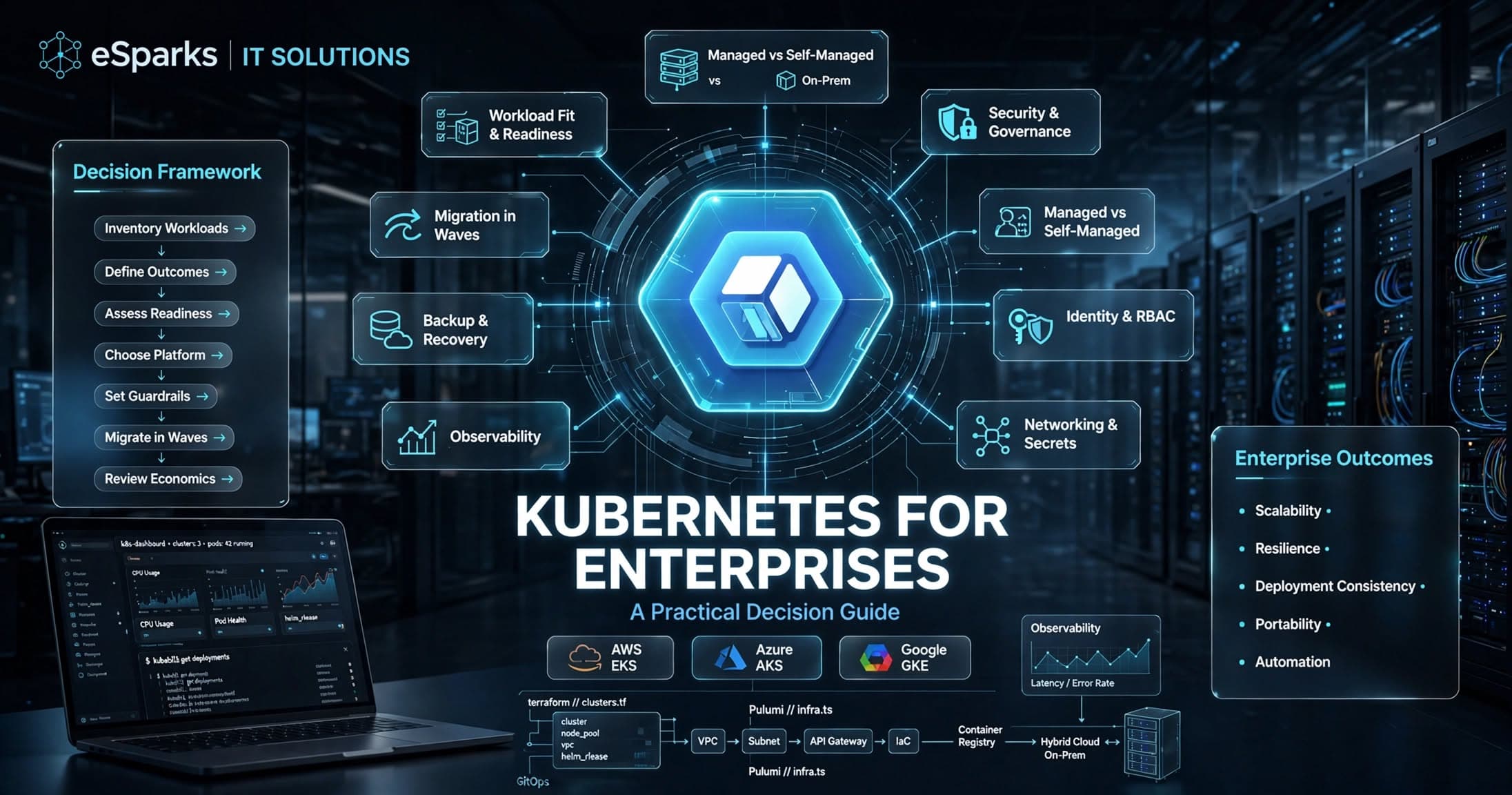
Kubernetes for Enterprises: A Practical Decision Guide
Kubernetes for enterprises can improve scalability, resilience, and release speed—but only when platform maturity, security, and operating model align.
Sep 26, 2026
Read More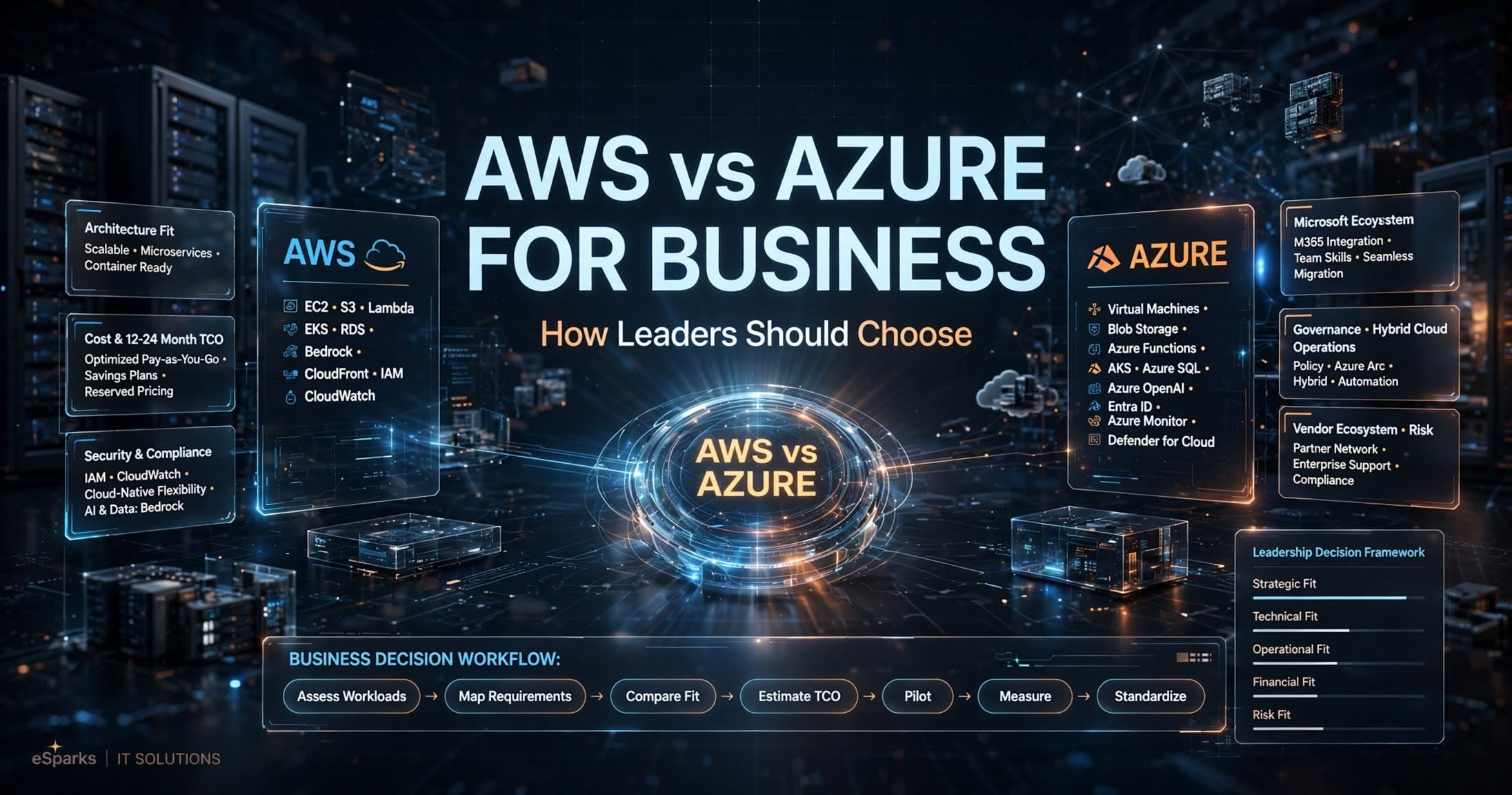
Cloud Computing
AWS vs Azure for Business: How Leaders Should Choose
Compare aws vs azure for business across cost, security, Microsoft fit, AI, and operations with a practical decision framework for leaders.
Sep 25, 2026
Read More
Cloud Computing
Mysql to Postgresql Migration Service: UK Decision Guide
A practical UK guide to choosing a mysql to postgresql migration service, covering risks, cost, timelines, tooling and delivery approach.
Sep 14, 2026
Read MoreReady to Transform Your Business?
Let's discuss how our expertise can help you achieve your goals