
AI & Machine Learning
How to Choose an AI Development Company in Dubai
A practical guide to choosing an ai development company in dubai, covering use cases, architecture, cost, delivery, security, and vendor fit.

Tauseef Alam
Chief Technology Officer
Jul 16, 2026
10 min read
If you are evaluating an ai development company in dubai, the real question is not who has the flashiest demo. It is who can turn AI into a reliable business capability without creating security risk, technical debt, or a system your team cannot maintain six months later. For founders, CTOs, and IT managers, the best partner is usually the one that can connect AI strategy to product delivery, cloud operations, governance, and measurable workflow improvement.
Key takeaways
- The best AI partner is usually the one that connects AI strategy to product delivery, cloud operations, governance, and measurable workflow improvement.
- A credible vendor should say no when AI is unnecessary, because simpler tools like rules engines or workflow automation may solve the problem with lower cost and risk.
- AI projects rarely fail because of model quality alone; they fail when the model does not fit the surrounding business process.
- A strong AI development company should assess data, workflow, constraints, and ownership before discussing frameworks or models.
- Enterprise AI usually requires orchestration around the model, including APIs, access controls, observability, guardrails, and real workflow integration.
Dubai is a strong market for digital transformation, but that also means buyers face a crowded vendor landscape: AI consultancies, software houses adding AI services, offshore delivery teams, and niche model specialists. In our experience at eSparks IT Solutions, the evaluation process gets easier when you focus less on broad claims like intelligent automation and more on fit: the use case, data readiness, integration complexity, security requirements, and the partner's ability to ship production-grade systems.
Start with the business problem, not the model
Many AI initiatives fail before development begins because the problem statement is too vague. Requests like add AI to our app or automate support with ChatGPT usually hide several different goals: reduce repetitive work, improve forecast quality, speed up search, personalize customer journeys, or extract information from unstructured documents. Each of those goals needs a different approach, data pipeline, and success metric.
A useful starting point is to define the operational decision you want AI to improve. For example:
- Customer support: classify tickets, draft replies, retrieve policy answers, summarize conversations
- Sales operations: lead scoring, proposal drafting, CRM enrichment, call note summarization
- Finance and back office: invoice extraction, exception detection, reconciliation support, spend categorization
- Industrial or field operations: predictive maintenance signals, anomaly detection, route optimization, image-based inspection
- Knowledge management: enterprise search, document Q&A, policy retrieval, multilingual summarization
Once the decision point is clear, assess whether AI is actually the right tool. Rules engines, workflow automation, search indexing, or analytics dashboards often solve the problem with lower cost and lower operational risk. A credible partner should say no when AI is unnecessary. That is often a stronger sign of expertise than an aggressive proposal.
What a strong ai development company in dubai should evaluate first
Before discussing frameworks or models, a capable team should pressure-test four areas: data, workflow, constraints, and ownership. This discovery phase matters because AI projects rarely fail due to model quality alone. They fail because the model does not fit the process around it.
A practical vendor assessment usually includes questions like these:
- What data exists today, and in what systems? CRM, ERP, support tools, cloud storage, data warehouse, email, PDFs, images, IoT streams?
- Is the task prediction, generation, classification, ranking, retrieval, extraction, or optimization?
- What level of accuracy is acceptable before a human reviews or approves output?
- What are the privacy, residency, and regulatory constraints?
- Which systems need integration: Salesforce, HubSpot, SAP, Microsoft 365, ServiceNow, Shopify, custom apps?
- Who will own prompts, evaluation rules, feedback loops, and model monitoring after launch?
The answers shape the technical route. A document processing workflow may need OCR, entity extraction, confidence scoring, and human-in-the-loop review. A knowledge assistant may require retrieval-augmented generation, permission-aware search, vector databases, and audit logs. A forecasting system may need feature engineering, time-series pipelines, and MLOps more than generative AI.
If a vendor jumps straight from discovery to we will build a chatbot, that is a warning sign. Enterprise AI usually means orchestration around the model: APIs, role-based access, observability, prompt controls, evaluation datasets, guardrails, and integration into the actual work environment where staff will use it.
Choose the right delivery pattern for the use case
Not every AI system should be built the same way. Business buyers often get better results when they ask vendors which delivery pattern fits the problem instead of asking which model is best. In practice, most projects fall into a few common architectures.
One pattern is AI-assisted workflow automation. Here, the model helps users inside a business process: triaging tickets, drafting responses, reviewing contracts, enriching records, or extracting fields from documents. The stack may include Python or Node.js services, FastAPI or NestJS backends, queues such as RabbitMQ or Kafka, document storage on AWS S3 or Azure Blob, and integrations with business tools. The human approval step is usually as important as the model itself.
A second pattern is retrieval-based enterprise knowledge. This is common when leaders want employees or customers to ask natural-language questions across policies, manuals, contracts, or product content. The core components often include document ingestion, chunking, embeddings, a vector store such as Pinecone, Weaviate, Elasticsearch, or PostgreSQL with pgvector, and an LLM layer for answer generation. The critical design choice is access control: users must only retrieve content they are authorized to view.
A third pattern is predictive ML for operational decisions. These systems use structured data and are often better served by classical machine learning than LLMs. Typical tools include scikit-learn, XGBoost, LightGBM, TensorFlow, or PyTorch, backed by data pipelines in Airflow, dbt, Spark, Databricks, BigQuery, Redshift, or Snowflake. Examples include churn propensity, demand forecasting, risk scoring, and anomaly detection.
A fourth pattern is multimodal AI for image, audio, or document-heavy workflows. Examples include passport or ID verification, site inspection image review, call transcription analysis, and medical or industrial image tagging where regulations allow. These projects require more careful evaluation, especially around false positives, edge cases, and dataset quality.
When a partner explains which pattern they recommend and why, you can judge their maturity. When they treat every problem as a generic chatbot, you should keep looking.
Technical due diligence: architecture, security, and operations
An AI proof of concept can be built quickly. A production system that handles real users, sensitive data, and uptime expectations is a different standard. Decision-makers should push vendors to show how they handle the surrounding engineering, not just the model prompt.
Look for clarity on architecture choices:
- Cloud platform: AWS, Azure, Google Cloud, or hybrid depending on existing estate and compliance
- App stack: React, Next.js, Angular, Flutter, iOS, Android, .NET, Java, Python, Node.js depending on integration and team fit
- AI services: OpenAI, Azure OpenAI, Anthropic, Google Vertex AI, open-source models on private infrastructure, or mixed strategy
- Data layer: SQL and NoSQL stores, vector search, warehouse, feature store if needed
- Deployment: containers with Docker, Kubernetes or managed services, CI/CD, environment separation, rollback strategy
- Monitoring: application logs, tracing, cost observability, prompt/version control, output quality evaluation
Security and governance deserve special scrutiny. For many UAE businesses, especially in finance, healthcare, government-adjacent services, and enterprise platforms, this is where deals are won or lost. Ask how the vendor approaches encryption in transit and at rest, secrets management, SSO, role-based access control, audit trails, data retention, redaction of sensitive fields, and regional hosting constraints. If the system uses third-party LLM APIs, clarify whether prompts or outputs are retained by the provider and what settings can limit that.
Also ask about model risk controls. Good teams define fallback behavior when confidence is low, restrict actions the model can take, and keep a human review layer for high-impact outputs. They test prompts against jailbreak attempts, malformed inputs, and domain-specific edge cases. They create evaluation sets from real examples, not just happy-path demos. These are the practices that separate an experiment from a dependable business system.
A practical framework to compare vendors
When multiple proposals look similar, use a step-by-step scorecard. This helps you compare firms objectively and keeps internal stakeholders aligned.
-
Define the target workflow State the user, the task, the systems involved, and what good output looks like. Example: support agents need suggested replies grounded in approved policy documents inside Zendesk.
-
Decide the acceptable risk level Classify the use case as low, medium, or high impact. Marketing content support is very different from financial recommendations, identity verification, or compliance-sensitive automation.
-
Review discovery quality Did the vendor ask sharp questions about data, process, exception handling, and adoption? Strong discovery usually predicts strong delivery.
-
Inspect proposed architecture Can they explain why they chose a hosted LLM, open-source model, RAG pipeline, or ML model? Do they address latency, scaling, observability, and handoff to your team?
-
Validate integration capability Most value comes from connecting AI to your existing stack. Ask for their approach to APIs, webhooks, ETL, identity systems, and legacy applications.
-
Test evaluation discipline How will they measure answer quality, extraction accuracy, hallucination rate, ranking quality, or prediction drift? Ask to see a sample evaluation plan.
-
Review delivery model Who is on the team: product lead, solution architect, ML engineer, backend developer, frontend developer, DevOps engineer, QA? How often will they demo progress? How are changes managed?
-
Check post-launch ownership AI systems need iteration. Confirm who will update prompts, review logs, retrain or fine-tune where appropriate, tune retrieval quality, and manage cloud costs.
This framework often exposes weak proposals quickly. Some vendors are strong at prototypes but weak on integration. Others are excellent software engineers but thin on AI evaluation. The goal is not to find a company that claims to do everything. It is to find one that is honest about trade-offs and strong where your project is likely to fail.
Typical costs and timelines without hype
Executives need budget reality, but AI estimates vary widely because scope varies widely. A reasonable partner will give ranges tied to assumptions rather than one magic number. That is a sign they understand discovery risk.
Typical project patterns often look like this:
- Focused proof of concept: 4 to 8 weeks for a narrow use case such as document extraction, internal search assistant, or support reply drafting
- Pilot integrated into one team or workflow: 8 to 14 weeks depending on data access, authentication, UI changes, and review flows
- Production rollout across multiple systems or business units: 3 to 6 months or more, especially with complex governance, mobile apps, or legacy integrations
Budget ranges also depend on scope, security, and whether you are building net-new software or adding AI into an existing product. A lightweight internal assistant may cost far less than a regulated, multilingual, customer-facing platform with analytics, role-based permissions, and auditability. Ongoing costs can include cloud compute, LLM token usage, vector database hosting, monitoring, support, and iterative improvements. In many cases, the monthly operating cost becomes manageable only after prompt optimization, caching, retrieval tuning, and disciplined usage policies are put in place.
To keep budget under control, ask vendors to phase the work:
- Phase 1: discovery, data audit, success metrics, architecture choice
- Phase 2: prototype on real examples, not synthetic samples
- Phase 3: pilot with user feedback and approval workflows
- Phase 4: production hardening, monitoring, and handover
This staged approach reduces the chance of committing enterprise budget before proving workflow value.
Common pitfalls and how to avoid them
The most expensive AI mistakes are usually predictable. Buyers can avoid them by insisting on a few practical disciplines from day one.
Pitfall one: choosing a demo over a system. A slick interface can hide weak retrieval, no audit trail, and poor exception handling. Avoid this by asking vendors to walk through failure scenarios, permissions, and monitoring.
Pitfall two: ignoring data readiness. AI cannot compensate for inaccessible documents, inconsistent labels, duplicate records, or missing ownership of source systems. Start with a data inventory and sample quality review.
Pitfall three: no human-in-the-loop design. For many business processes, the right outcome is not full autonomy but faster, better-reviewed decisions. Build review queues, confidence thresholds, and correction capture into the workflow.
Pitfall four: underestimating integration work. The AI layer is often only part of the effort. SSO, CRM sync, document pipelines, message queues, analytics, and mobile or web interfaces can dominate timelines.
Pitfall five: weak governance. Without prompt versioning, access controls, redaction, and logging, teams struggle to trust the system. This is especially risky for external-facing assistants and regulated operations.
Pitfall six: no adoption plan. Even technically sound AI tools fail if they interrupt existing work. The best implementations appear inside the tools employees already use, with clear boundaries on what the AI can and cannot do.
A strong partner should bring these risks up proactively. That is usually a better predictor of long-term success than bold claims about model sophistication alone.
Final checklist before you sign
Before selecting a partner, ask for a concise solution brief that covers the use case, architecture, integrations, security controls, delivery phases, and ownership after launch. If the proposal cannot explain those basics clearly, the project will likely become harder once development starts.
Your shortlist should ideally answer yes to most of these questions:
- Do they understand the business workflow, not just the AI tooling?
- Can they build production software as well as AI features?
- Do they show clear thinking on cloud, DevOps, and security?
- Can they work with your current stack and data environment?
- Do they propose measurable evaluation criteria and fallback paths?
- Are estimates phased and assumption-based rather than overconfident?
- Is there a realistic plan for maintenance, retraining, tuning, and support?
For companies evaluating an ai development company in dubai, the most dependable choice is rarely the one promising the biggest transformation in the shortest time. It is the team that treats AI as part of a broader engineering and operational system, aligns the solution to a real business decision, and builds with enough rigor that your internal team can trust and extend it over time.
Frequently Asked Questions
What should I ask an AI development company in Dubai before hiring them?
Ask how they define the business use case, what data they need, how they will integrate with your current systems, and how they will handle security, access control, and monitoring. You should also ask how they evaluate model quality and what happens when the AI is uncertain or wrong.
How long does it take to build an enterprise AI solution?
A focused proof of concept often takes a few weeks, while a production system with integrations, security controls, and user workflows commonly takes several months. The timeline depends more on data readiness and integration complexity than on model selection alone.
Is generative AI always the right choice for business automation?
No. Many problems are solved more effectively with rules, search, analytics, or traditional machine learning. A good partner should recommend the simplest approach that reliably solves the business problem.
What is the difference between an AI prototype and a production-ready AI system?
A prototype proves that a concept can work on sample inputs. A production-ready system adds security, permissions, observability, error handling, evaluation, integration, and operational controls so real users can depend on it.
Work with eSparks IT Solutions
Planning a project around this? We help businesses across the USA, UK, Canada, Australia and the GCC ship it. Explore our AI & Machine Learning services and portfolio, estimate your project cost, or book a free call.
Related AI services & solutions

Tauseef Alam
Chief Technology Officer
Passionate technology writer and industry expert with years of experience in software development, cloud computing, and digital transformation. Dedicated to sharing insights and helping developers stay ahead of the curve.
Related Topics
Continue Reading
More insights in AI & Machine Learning

AI & Machine Learning
AI Document Automation: A Practical Guide for Business
Learn how ai document automation works, where it fits, common pitfalls, costs, timelines, and how to evaluate the right delivery approach.
Oct 1, 2026
Read More
AI & Machine Learning
AI Adoption for Small Business: A Practical Guide
AI adoption for small business works best when you target one clear use case, secure your data, and roll out in measured phases with ROI checks.
Sep 28, 2026
Read More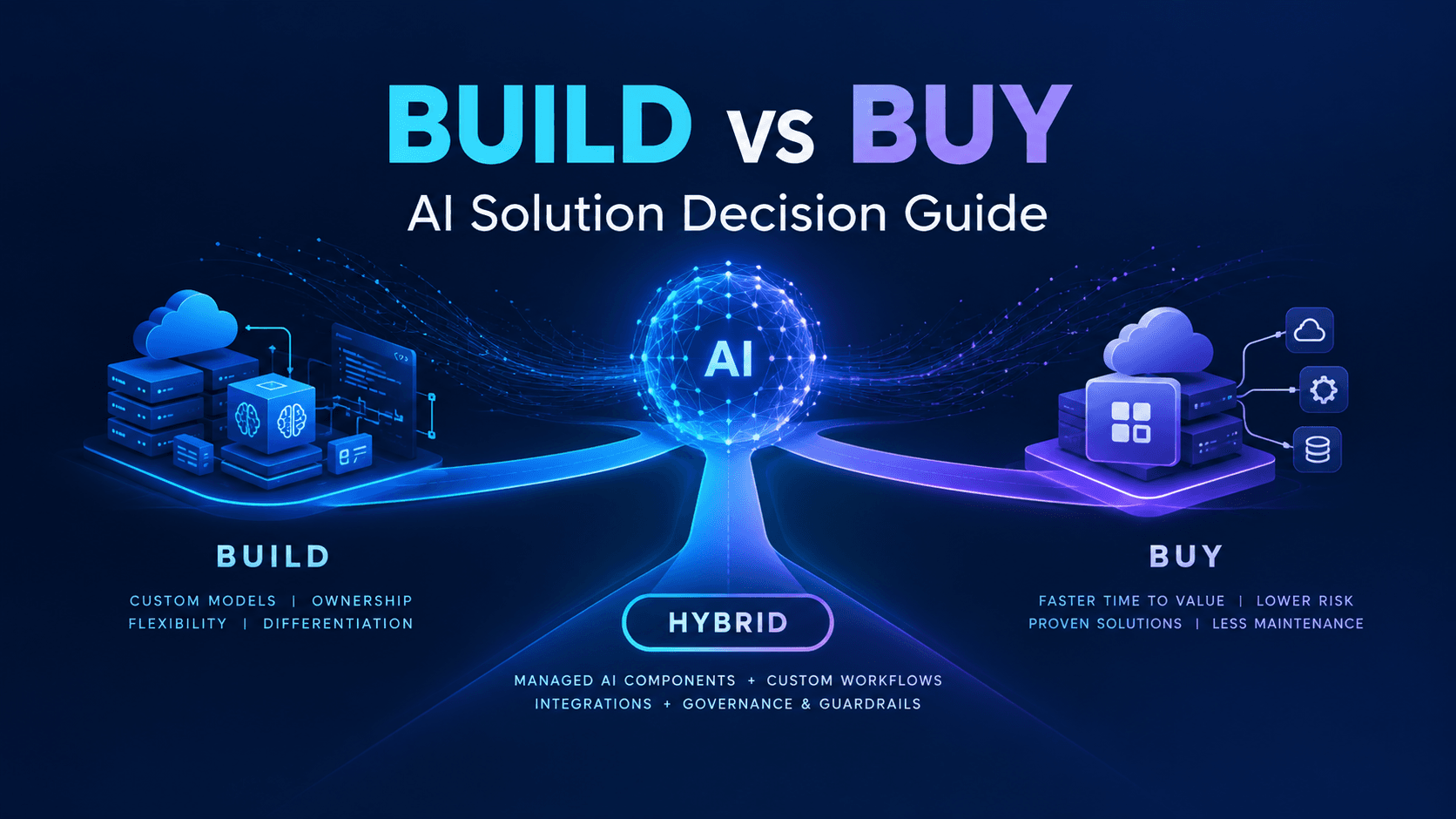
AI & Machine Learning
Build vs Buy AI Solution: A Practical Decision Guide
How to decide build vs buy ai solution for your business: costs, timelines, risks, architecture, and a practical framework for leaders.
Sep 10, 2026
Read MoreReady to Transform Your Business?
Let's discuss how our expertise can help you achieve your goals